On Sunday, actor Anthony Rapp came forward with his story about how Kevin Spacey assaulted him when he was 14. Reading
this made my stomach turn. There are many similar ties between this
narrative and my own particular trauma. I was 19, and my rapist was 38.
Like Rapp, I was alone. I had no one to turn to, and no one would have
believed me anyway.
No
one did believe me. All of my friends at the time were his friends. He
was the established one, the former drag queen popular in all the right
social circles, and I was just his trophy twink of the year.
This
is where it gets dangerous. In an effort to shield himself and preserve
his reputation, Spacey has chosen to implicate the entire LGBT
community in his actions. Now, that’s not the intention. The obvious
goal is to bank on the secrecy he has kept to keep the press talking
about him finally coming out. Spacey knows what many queer people
already do: queerness is considered more shocking and horrific to the
American people than sexual assault.
Slate:
Spacey is using the logical fallacy of Gawker’s posts—the idea that consensual gay sex belongs on the same plane as a gay man’s sexual abuse—to his advantage in the face of Rapp’s allegation. To divert attention away from his alleged sexual intimidation of a child, Spacey is counting on homophobia to do its work: the homophobia that makes coming out a cause for surprise or celebration among heterocentric progressives, and the homophobia that conflates unwanted sexual advances toward a male child with a history of consensual sexual relations with men in their 20s. Spacey has also ignited—deliberately, I have to believe—the terror gay men may still feel in a society whose most bigoted members publicly paint them as child molesters. By outing himself as gay, Spacey hopes gay communities will defend him, if only to forestall the addition of someone who has been accused of child molestation to their ranks. His statement cheapens the bold, political act of a public coming-out, using a seeming admission of vulnerability as a weapon against the vulnerable.
House of Cards is done (Netflix says they had already made that decision before Spacey's admission).
He was in the closet all those years, afraid that being gay would hurt him. In the end, it was pedophilia that hurt him.
There's a lesson there -- Helen Hunt, are you listening -- it's okay to come out. It's not okay to mess around with kids.
Here's C.I.'s "Iraq snapshot:"
Iraqi army won the title of the best army in the world!
Alsumaria News:
The British military magazine Jeans has named the #Iraqi_army the "best army in the world" of 2017, while Lieutenant General Abdul Wahab al-Saadi won the award of the best military commander.
YES2IRAQ might need to rethink their claims. There's no "Jeans." Possibly they mean JANE'S DEFENCE WEEKLY?
At any rate, no such praise has been published in the print edition of JANE'S nor has it been published online. And if ALSUMARIA truly presented the claims, it did so in a live broadcast and not in a story it filed at its website -- which makes no sense at all.
But if the Iraqi military had to pretend on genuine praise, they'd be waiting forever.
Iraq can't defend itself.
Even now, it cannot defend itself.
A US-led coalition scrambled ISIS. Did it defeat it? Nope because that's not how you defeat terrorism. But they scrambled ISIS.
To pretend that the Iraqi military is competent let alone praiseworthy requires serious delusion.
There's so much pretending going on.
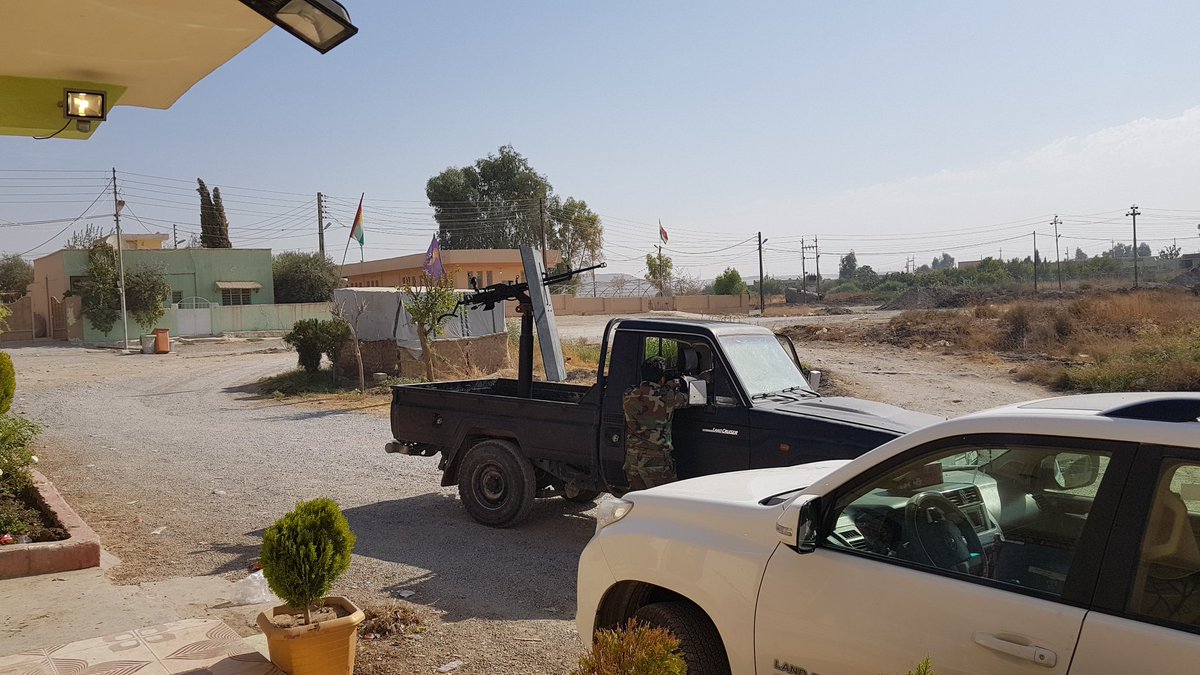
In last night's "Looks like a victory for Massoud Barzani despite the pack mentality of the press," we noted that the resignation of KRG President Barzani on Sunday came at the perfect time for his legacy. He stood up to all foreign powers and honored the Kurdish people by holding a referendum -- in which over 92% of the voters declared that they did not want to be a part of Iraq.
Barzani is now a folk hero.
The press can't see that? Or it refuses to admit it?
We knew that our failure to address the disputed territories and conflicting Kurdish-Arab claims to places like Kirkuk was dangerous. When I was back working in Iraq again from 2008 to 2010, Ambassador Ryan Crocker predicted in a senior staff meeting that our leaving the Kirkuk issue unresolved “would destroy Iraq.” Distracted by each new crisis du jour, we never mounted a sustained, determined effort to bring Erbil and Baghdad together to resolve the smoldering problem of the disputed territories.
That's Robert Ford writing at THE ATLANTIC this morning in a piece entitled "America Never Understood Iraq: As the Kurdish crisis continues to spiral, a former diplomat laments a history of missed opportunities." Ford writes:
While Abadi and others in Baghdad condemned the Kurdish vote as illegitimate, there is nothing in the Iraqi constitution that expressly forbade such a non-binding referendum. Moreover, its result merely confirmed what everyone in Iraq already knew: Iraq’s Kurds don’t want to be in Iraq.
Over the weekend, Aziz Weysi Bani weighed in at NEWSWEEK:
Following our vote for independence, Iraqi and regional backlash escalated with closure of our airspace, an end to financial transactions and arrest warrants for our officials. Emboldened by the total lack of international response, Iraq and Iran’s aggression culminated with an invasion of our territory by the Iraqi Army and their Iranian-backed militant counterparts. These militants include terror-designated groups such as Hezbollah and the Iranian Revolutionary Guards Corps (IRGC).
These attacks on all fronts, from Sinjar to Kirkuk to Khanaqin, took us by surprise. It was not a complete surprise to the United States, however, which knew the attack was imminent but failed to provide us with a warning or apply adequate pressure to prevent it. Our weakness was partly due to some of our political and military leaders having made a desperate deal with Iran and Iraq, and who retreated their forces without a fight. Had the West provided us with sufficient support, we would not be as susceptible to such lethal manipulation by our common enemies.
When President Donald J. Trump was elected, Kurds were buoyed with new hope. Initially positive signals from his administration prompted babies and businesses to be named after America’s new president.
This support began to wane with President Trump’s opposition to our independence referendum and then turned to outrage when the United States stood by as our lines collapsed under the Iraqi assault. America's policy of not having a policy is all the more confusing, as President Trump only one week ago committed to decertifying the Iran deal and listing the IRGC as a terror organization.
Donald Trump was able to turn his back on the Kurds largely due to the American media. It's a point Baria Alamuddin (ARAB NEWS) made Sunday as she reflected on her recent trip to the US:
From inside the Washington media bubble it can feel as if the outside world has ceased to exist. The liberal US media appears ill-equipped to handle any news story that doesn’t involve feigning outrage at Donald Trump’s absurd tweets. I wouldn’t want to trivialize the shocking Harvey Weinstein scandal, but is it inopportune to inquire whether anything else is going on in the world?
Americans across the political spectrum appear so consumed with their shattered and polarized national identity that they struggle to pay attention to complex international developments. The White House is obsessed with self-generated crises and own goals, dominated by a president who, if he were suddenly minded to lash out at Tehran and Pyongyang, might struggle to find them on a map.
Trudy Rubin may have been the only journalist at a daily paper paying attention to what was taking place -- see her October 18th column "Betraying the Kurds plays into Tehran's hands" (PHILADELPHIA INQUIRER).
In other news, another journalist has been killed in Iraq.
#Kurdish journalist Arkan Sharif leaves behind three children, he was killed in his home in Daquq by Iraqi militiamen. #KurdistanBlockade

India's TRIBUNE reports:
A Kurdish video journalist with a channel backing Iraqi Kurdistan's
leader Massud Barzani was stabbed to death at his home overnight in
disputed Kirkuk province, a security source said on Monday.
Four armed men broke into the home of Arkan Sharif, a 54 -year-old
journalist with Kurdistan TV, at 2:30 am (local time) in the Daquq area
south of Kirkuk city, the source said.
Sharif, a father of three, was stabbed five times after his family were locked up in another room, the source said.
New content at THIRD:
- Truest statement of the week
- Truest statement of the week II
- A note to our readers
- Editorial: Calm the f**k down already
- TV: True crime
- Put The Bitch In Her Place (Ava and C.I.)
- The age we're living in
- Top ten ice cream flavors
- Iraq: Massoud Barzani
- Spot on media critique in one Tweet
- Iraq: The media bias
- This edition's playlist
- I Am Not a Witch: The cruel humour behind a mix of...
- Denounce the massacre of campesinos in Tumaco, Col...
iraq iraq iraq iraq iraq iraq iraq iraq iraq iraq iraqiraq iraq iraq iraq iraq iraq
iraq iraq iraq iraq iraq iraq iraq iraq iraq iraq iraq iraqiraq iraq iraq iraq iraq iraq
iraq iraq iraq iraq iraq iraq iraq iraq iraq iraq iraq iraqiraq iraq iraq iraq iraq iraq
iraq iraq iraq iraq iraq iraq iraq iraq iraq iraq iraq iraq iraq iraq iraq iraq iraq Iraq