Tuesday, Maleficent comes out on DVD.
Tuesday.
The closest thing to a horror film Disney has and they don't release it in time for Halloween?
That was beyond stupid.
I feel Disney mismarkets repeatedly.
It never understands the audience or the film they're trying to market.
They get lucky -- at present -- due to the large number of kids 10 and under in the US.
But what happens when that market diminishes the way it did in the 70s?
Disney goes back to struggling.
I really think Disney needs to explain why they failed to release the film on DVD last week.
Not to me, to the shareholders.
This was a huge film, one of the biggest of the summer.
And now it's DVD time and they've already screwed things up.
Here's C.I.'s "
Iraq snapshot:"
Saturday, November 1, 2014. Chaos and violence continue, Grand
Ayatollah Ali al-Sistani issues a call, cleric and movement leader
Moqtada al-Sadr makes a promise, US government officials insist Barack
Obama is helpless and inept, we remind about the power Barack once had
regarding Iraq (and how he blew it), and much more.
In June of this year, US President Barack Obama sent a number of US
troops into Iraq to gather information that he would use to formulate a
'plan' which he then implemented on August 8th.
And Barack's 'plan' has consisted of nothing but bombing Iraq.
And Barack's 'plan' has been a complete and utter failure.
If you needed further proof of that, you just needed to catch
Friday's State Dept press briefing
as spokesperson Jen Psaki tried to dance around the reality the the
Islamic State's recruitment figures have increased -- not decreased --
as Barack's 'plan' has been carried out.
QUESTION: Yes, please. Regarding the foreign fighters in ISIL,
from your answer it’s not clear enough that – are you – are you
agreeing or not agreeing with what was mentioned today in The Washington Post that their number is increasing or not? I mean, this is like a reality or just news story?
MS. PSAKI: Well, I don’t have an assessment from the United
States Government on numbers. We’ve given numbers in the past that
obviously comes out of other agencies. What I was pointing to is the
fact that there are a range of steps that we have worked on
diplomatically with a number of these countries on cracking down on
foreign fighters, whether it’s putting new laws on the books, whether
it’s doing more to crack down on borders. That’s one of the primary
topics of discussion as it relates to the coalition.
QUESTION: The reason that I’m asking because at the beginning
of the year it was mentioned the number of around five or six thousand,
and then by July it reached more than 15,000 people from 80 countries.
And when you say additional steps were taken by countries who are really
concerned about or they have – they are concerned about the foreign
fighters, do you have any assessment of these additional steps block
some people from entering there, or it’s just like additional steps on
the paper?
MS. PSAKI: Well, one, I’d say first on your first part, we
have talked before in the past publicly about our assessment that ISIL
can muster between 20,000 and 31,500 fighters across Iraq and Syria.
That’s based on a review of all intelligence reports from May to August.
And we saw an increase over the previous assessment, which is
consistent with what we’ve been saying, which is that they grew in
strength and numbers over the course of the early period of this year.
We’ve seen specific impacts and countries – we’re working on an Iraq
first strategy, which is something we’ve consistently talked about.
We’ve seen the Iraqi Security Forces strengthen in some areas. We’ve
seen efforts to try to take back some parts of territories. But this is
going to be a long process, so I just don’t have a new assessment for
you.
QUESTION: The other thing which is like always when this story
or this issue is raised is based on the – one of the front line or the
lines that you are fighting, which is propaganda war or what we can say
deviating people from being misled by the ISIL message. Do you still
believe there is a link between these two thing, I mean that the war of
the – let’s say the war of ideas has to be done in order to stop these
people from going there?
MS. PSAKI: Absolutely. The question of what is attracting
individuals to join ISIL, to travel across borders is one that is key to
us addressing the threat. And that’s why we’ve spent time and energy
and the – of high-level State Department officials, including Under
Secretary Stengel, to try to coordinate efforts to combat that.
QUESTION: I’m not trying to make the assessment of what you
are doing of war of ideas, but generally people are linking between the
increasing of the number and the Administration or generally the
coalition failure in doing this war, I mean, properly or efficiently. Do
you agree with that assessment?
MS. PSAKI: I would not. I think that there is a recognition
that more needs to be done to take on ISIL messaging and that they have
been effective in using online tools to recruit and to provide often
misleading information out there. This is something – it’s not that the
United States is the sole – will not be the sole owner of this. We will
work with many countries in the region who have more impactful voices in
the region to do that.
So Barack's 'plan' has increased the number of Islamic State members?
As the 'plan' becomes even more recognized as a failure,
Akbar Shahid Ahmed (Huffington Post) notes an increase in US officials blaming the Iraqi government;
Tony Blinken, the deputy national security adviser to President
Barack Obama, said Wednesday that he had been involved for over two
years in U.S. efforts to convince the Iraqi government to tackle ISIS
and its predecessor group, Al Qaeda in Iraq. These efforts began after
Obama controversially withdrew U.S. troops from Iraq at the end of 2011.
Speaking at an event at the Carnegie Endowment for International Peace,
Blinken noted that the president had warned former Iraqi prime minister
Nouri al-Maliki last November to check the Islamic State's growing power and pursue less divisive policies.
"We
were focused and acting on ISIL and the threat that it posed more than a
year before the fall of Mosul," Blinken said, referencing a key victory for the group
over the summer in which it gained significant stocks of U.S.-made
weapons intended for the Iraqi army. "But the problem began to outrun
the solution, fueled by the conflict in Syria, Iraqi reluctance, and
renewed sectarianism in Iraq."
Blinken's comments suggest the
administration traces its current policy against ISIS further back than
it appeared to just months ago, when the president compared the group to a "JV team."
Poor Akbar. He has a gross factual error in his article (we're not
quoting that section). That tends to happen when you source to
CIA contractor Juan Cole.
We're not stupid like Akbar.
And we can note the problem with Blinken's lies.
Blinken is lying.
He's not spinning, he's flat out lying.
In what world was Barack a prisoner of Nouri?
In November, Nouri was wrapping up his visit to the US.
Did we all forget that?
Or was it just Juan Cole and his fan club that forgot?
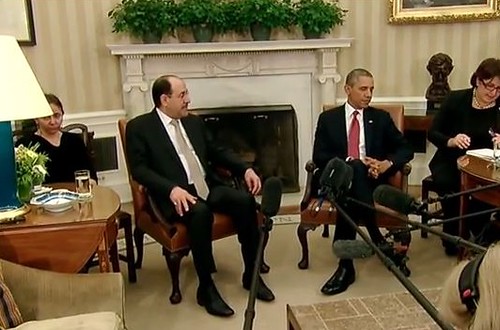
That's from November 1, 2013, Nouri's meeting Barack at the White House, which was the culmination of thug Nouri
al-Maliki's DC visit that began in October.
Blinken declared Wednesday:
We were focused and acting on ISIL and the threat that it posed more
than a year before the fall of Mosul. But the problem began to outrun
the solution, fueled by the conflict in Syria, Iraqi reluctance, and
renewed sectarianism in Iraq.
Nouri was responsible for "renewed sectarianism" and that started in
2010, after the US government insisted on (and secured) a second term
for Nouri al-Maliki after Nouri lost the 2010 elections.
But let's just focus on this "more than a year claim."
How weak is Barack Obama?
How inept is he?
Nouri didn't stop by the White House for tea.
He came to the US on that visit wanting something.
November 1st, on The NewsHour (PBS -- link is video, audio and text), Judy Woodruff discussed the visit with Margaret Warner. Excerpt:
JUDY WOODRUFF: So, tell us about the approach of the
administration vs. the Congress. I mean, what are you hearing? What are
-- what are they saying?
MARGARET WARNER: It's very different.
First of all, Congress really matters here, it's important to know,
because the sales he wants, say, Apache military helicopters, for
instance, have to get yea or nay from the Senate Foreign Relations
Committee. It's just a quirk in the law, not the whole Senate, but the
Foreign Relations Committee.
So, the senators, the two leading senators there, Chairman Robert
Menendez, a Democrat, and Bob Corker of Tennessee, the Republican, and
many others, Senator McCain, who you saw interviewed this week, all
believe that Maliki's exacerbating his problems by alienating the
Sunnis. I mean, they do things like go into Sunni neighborhoods and
round up 500 young men in the name of fighting terrorism.
And one American official told them, you know, you're making the same
mistakes we made in Iraq early on. We just create more terrorists.
They're also concerned about allowing Iranian overflights of material
and weapons to Assad's forces in Syria. And, finally, they are very
concerned that any counterterrorism or weapons they give, Maliki could
use to repress his own people, because they have cracked down on a lot
of protesters.
So, the White House, let me just say briefly, sees all that, but they
are most concerned about this absolutely volatile situation along that
border between Iraq and Syria, and that, one, they could "lose Iraq" --
quote, unquote -- as one official said to me today. And, two, that makes
it really hard to contain the radical jihadis within Syria.
The NewsHour titled that report "Iraqi PM Maliki takes plea for help to President Obama."
Nouri comes pleading and Barack can't demand concessions?
How weak is Barack Obama?
How inept is he?
By the time of his visit, it wasn't just this site calling thug Nouri
out and noting that he was breeding the terrorism in Iraq. You also
had, for example,
the editorial board of the New York Times noting:
These are serious problems. Mr. Maliki,
however, has been playing a central role in the disorder. There is no
doubt that militant threats would be less pronounced now if he had
united the country around shared goals rather than stoked sectarian
conflict.
Instead, he has wielded his power to favor his Shiite majority brethren
at the expense of the minority Sunnis. The Sunnis, banished from power
after Saddam Hussein’s ouster, have grown more bitter as they have been
excluded from political and economic life. Mr. Maliki is also at odds
with the Kurds, the country’s other major ethnic group in what was
supposed to be a power-sharing government.
But instead of strong arming Nouri, using what he wanted (weapons) to
force him to be inclusive, the White House turned on Senator Robert
Menendez and strong armed him into dropping his opposition to arming
Nouri. The White House was perfectly to bully when it came to a
Democratic senator. But when it came to a thug, one who had broken his
word repeatedly since 2006, Barack made no demands or pre-conditions for
the weapons?
How stupid is Barack Obama?
When a US-installed puppet journeys to the United States to beg for
weapons -- weapons Congress doesn't want to give him because he's
attacking the Iraqi people -- why in the world do you give that thug
what he wants? And having decided to give him what he wants, why don't
put conditions on those weapons, make him make concessions to inclusion
before he receives a single new weapon?
That's what smart people in power would do if they were arming a thug.
How stupid is the White House?
And how stupid is the press.
I'm about to start getting really mean to some really big liars.
The Hawija massacre? We covered it in real time. We even noted when the State Dept got concerned.
Nouri is now out of power.
So the US press finally mentions the massacre while watering down the details.
The
April 23, 2013 massacre of a peaceful sit-in in Hawija resulted from Nouri's federal forces storming in.
Alsumaria noted Kirkuk's Department of Health (Hawija is in Kirkuk) announced 50
activists have died and 110 were injured in the assault.
AFP reported the death toll rose to 53 dead.
UNICEF noted that the dead included 8 children (twelve more were injured).
The lead up really began
Friday, April 19th,
when
Nouri's forces first attacked the Hawija sit-in killing 1 protester and
wounding three others. From that point until after the massacre, people
were not allowed into the sit-in and were not allowed to leave. This
includes a delegation of MPs from Parliament who traveled from Baghdad
in an attempt to bring medical supplies and to see with their own eyes
what was going on. Nouri's forces refused to allow the MPs to enter the
area. It's at this point that the US State Dept finally gets concerned. Sunday, April 21st (I noted that
here).
But they did nothing. The White House did nothing.
Weak ass Barack Obama did nothing.
So despite 'concern' developing Sunday, April 21, 2013, nothing was done
to help the protesters and, two days later, the slaughter took place
and we noted here "
Blood on their hands, all of their hands."
They didn't, the White House, do a damn thing to protect the protesters.
And the press basically whored (non-Iraqi press) with the sole exception
of AFP. Even with some strong work from AFP it was still left to
BRussells Tribunal to present an account of one of the activists present at the slaughter:
I am Thamer Hussein Mousa from the village of Mansuriya in the district
of Hawija. I am disabled. My left arm was amputated from the shoulder
and my left leg amputated from the hip, my right leg is paralyzed due to
a sciatic nerve injury, and I have lost sight in my left eye.
I have five daughters and one son. My son’s name is Mohammed Thamer. I
am no different to any other Iraqi citizen. I love what is good for my
people and would like to see an end to the injustice in my country.
When we heard about the peaceful protests in Al-Hawija, taking place at
‘dignity and honor square’, I began attending with my son to reclaim
our usurped rights. We attended the protests every day, but last Friday
the area of protest was besieged before my son and I could leave; just
like all the other protestors there.
Food and drink were forbidden to be brought into the area….
On the day of the massacre (Tuesday 23 April 2013) we were caught by
surprise when Al-Maliki forces started to raid the area. They began by
spraying boiling water on the protestors, followed by heavy helicopter
shelling. My little son stood beside me. We were both injured due to the
shelling.
My son, who stood next to my wheelchair, refused to leave me alone. He
told me that he was afraid and that we needed to get out of the area. We
tried to leave. My son pushed my wheelchair and all around us, people
were falling to the ground.
Shortly after that, two men dressed in military uniforms approached us.
One of them spoke to us in Persian; therefore we didn’t understand what
he said. His partner then translated. It was nothing but insults and
curses. He then asked me “Handicapped, what do you want?” I did not
reply. Finally I said to him, “Kill me, but please spare my son”. My son
interrupted me and said, “No, kill me but spare my father”. Again I
told him “Please, spare my son. His mother is waiting for him and I am
just a tired, disabled man. Kill me, but please leave my son”. The man
replied “No, I will kill your son first and then you. This will serve
you as a lesson.” He then took my son and killed him right in front of
my eyes. He fired bullets into his chest and then fired more rounds. I
can’t recall anything after that. I lost consciousness and only woke up
in the hospital, where I underwent surgery as my intestines were hanging
out of my body as a result of the shot.
After all of what has happened to me and my little son – my only son,
the son who I was waiting for to grow up so he could help me – after all
that, I was surprised to hear Ali Ghaidan (Lieutenant General,
Commander of all Iraqi Army Ground Forces) saying on television, “We
killed terrorists” and displaying a list of names, among them my name:
Thamer Hussein Mousa.
I ask you by the name of God, I appeal to everyone who has a shred of
humanity. Is it reasonable to label me a terrorist while I am in this
situation, with this arm, and with this paralyzed leg and a blind eye?
I ask you by the name of God, is it reasonable to label me a terrorist?
I appeal to all civil society and human rights organizations, the
League of Arab States and the Conference of Islamic States to consider
my situation; all alone with my five baby daughters, with no one to
support us but God. I was waiting for my son to grow up and he was
killed in this horrifying way.
I hold Obama responsible for this act because he is the one who gave
them these weapons. The weapons and aircrafts they used and fired upon
us were American weapons. I also hold the United States of America
responsible for this criminal act, above all, Obama.
He's right to hold Barack responsible.
Barack didn't do a damn thing.
A religious minority (Yazidis) were trapped on a mountain top and
because the White House as anti-Christian (I don't see them that way, I
do understand why so many do), Barack was forced to 'do something.'
But when peaceful protesters in the hundreds were under lethal threat,
when Members of Parliament were not allowed to enter the square and
speak to the protesters, when the military would not allow the
protesters to leave, Barack didn't do a damn thing.
Thamer Hussein is right to hold Barack accountable for the death of his son and all the others killed in that massacre.
It's after that massacre that thug Nouri demands more weapons and comes to the US to make that plea.
Not only does Barack support Nouri -- and bully the US Congress to get
weapons for the thug -- Barack is also so stupid he doesn't demand that
Nouri meet any concessions before he gets the weapons.
Ben Rhodes wants to lie and say the White House did everything they could.
Wrong.
While Nouri was conducting his US visit last year,
Russia Today spoke with Haifa Zangan:
RT: Why can't the government cope on its own?
HZ: The government doesn’t represent the people. The
government is quite busy with squabbling among the alliance –
it’s a form of alliance or some political parties. Most of them
have got militias and they are very busy fighting each other.
This inter-fighting is causing a lot of the horrendous violence
against civilians. It’s not the lack of weapons, it’s the trust
of the people. It’s the real intention and the work of the regime
itself and the many political parties there in order to ensure
the security of the people. The only safeguard for any government
in the world to reduce terrorism – whatever that is – is to build
up the trust with their own people. And the Maliki regime with
all its militia has failed tremendously in that aspect.
It is true that most Americans weren't giving Iraq a second thought.
It's also true that the media they counted on was filled with whores who
covered for Nouri and pretended that things were going well. It should
also be noted that Tim Arango of the
New York Times did get some
truths out and that this resulted in the White House phoning editors at
the paper to complain. It also resulted in the hideous Jill Abramson
-- the most unethical of all journalists -- making the decision to
censor certain stories and, under pressure, allow them to be minor
sentences buried in the middle of reports.
For example, in the fall of 2012, when Barack sent a Special Ops brigade back into Iraq, that should have been front page news.
But trash named Jill Abramson felt it was more important that Barack's
re-election take place with Barack lying that he had ended the Iraq War
and brought the troops home. Telling the truth in a front page story of
the
New York Times in September would have meant outlets would
have had to pay attention, that the October debates would have had to
note what Barack had done, that he would have been forced to answer
questions on it.
Instead,
the news was buried in two sentences in the fourteenth paragraph of an article (top of page two if you're reading online):
Iraq and the United States are negotiating an agreement that could
result in the return of small units of American soldiers to Iraq on
training missions. At the request of the Iraqi government, according to
General Caslen, a unit of Army Special Operations soldiers was recently
deployed to Iraq to advise on counterterrorism and help with
intelligence.
It's tough for the White House today.
So many of their whores have been forced out of their power positions.
(David Remick still whores for the White House at The New Yorker.) And
the new ones rising to power? Not interested in whoring for an
administration that only has two years left in power -- two years as
lame duck, if they're lucky, or as a sitting duck, if they continue to
be so inept.
So Barack's actions against the Islamic State don't get all the spin
that the White House would have received, for example, in 2012.
At Time magazine this week, David Rothkopf observes of Barack's 'plan:'
Even if the U.S. manages to defeat ISIS militarily in Iraq or Syria,
there is no clear plan to fill the political, economic and social void
that will be created by its elimination. In Syria victory over ISIS
might end up empowering the brutal regime of President Bashar al-Assad,
which is already responsible for a war that’s produced 200,000 deaths
and a massive humanitarian catastrophe. In Iraq, if the only result is a
Shiite-led regime in Baghdad that acts much like the last one, it won’t
be long before Sunni unrest invites the rise of a new insurgency. We’ve
seen that movie once before.
Yes, and we've seen The Susan Rice Story several times before, where
Rice goes on Sunday morning talk shows and lies through her teeth to the
American people.
But today Susan Rice has reached a low point in the administration.
Things are so bad, her problems with Secretary of Defense Chuck Hagel
are now openly noted in the press.
What's less noted is the fact that it was, yet again, going on a Sunday talk show that's hurt her standing.
In October, Rice went on NBC's
Meet The Press and lied the way
Dirty Rice always does. This time she was claiming Barack's 'plan' was a
success and, to provide proof, she cited the operation carried out on
Mount Sinjar.
Yazidis were trapped there.
But Rice said that was a thing of the past.
Not only did Rice's lies leave out the fact that US bombing did damn
little to help the Yazidis, she also left out credit the Kurdish
Peshmerga -- the group that carried out the actual evacuation of the
Yazidis trapped on Mount Sinjar by the Islamic State.
Worst of all for Dirty Rice, within days of her lying, the press
(non-US) was reporting that 700 Yazidi families remained trapped on
Mount Sinjar -- all this time later but Susan Rice saw it as a
'success.'
Dirty Rice has a credibility problem with the public that's only
intensified. And that's why she's in serious trouble within the
administration currently.
On the Yazidis, the administration released the following statement:
Deputy National Security Advisor for Strategic Communications Ben
Rhodes met today at the White House with Baba Sheikh Khurto Hajji Ismail
– the leader of the Yezidi Supreme Religious Council – and other
leaders of the Iraqi Yezidi community to discuss the ongoing threat to
the community from ISIL and to provide an update on coalition efforts to
counter ISIL in Iraq. Mr. Rhodes condemned ISIL’s ongoing attacks on
the Yezidi community and other religious minorities in northern Iraq,
including Christians, Turkmen, and Shabak, as well as their perpetration
of bombings in Shi’a areas and massacre of Sunnis. On behalf of the
President, he offered condolences for those who lost their lives in the
violence of the past few months in Ninawa province and elsewhere.
Mr. Rhodes thanked the participants for relaying the latest
information on the humanitarian situation of the thousands of Yezidi
refugees who fled during the ISIL assault on Mount Sinjar over the
summer. As part of the military campaign, Mr. Rhodes noted that the
coalition had conducted airstrikes against ISIL positions around Mount
Sinjar in recent days. He underscored that ISIL’s continued acts of
abuse, kidnapping, torture, forced conversion, horrific violence against
women and girls, and murder only further serve to highlight the group’s
inhumanity and reinforce the international community’s resolve to
counter this common threat. Mr. Rhodes urged all Iraqis, including Iraqi
Security Forces, Kurdish Peshmerga, tribes, and minority and vulnerable
communities to work together to counter the common ISIL enemy. He also
discussed plans by the Iraqi Government to develop a National Guard in
which communities could help provide for their own security.
Mr. Rhodes reiterated the United States’ commitment to the safety and
security of the Yezidi community within a unified and pluralistic Iraq.
He noted the recent positive steps in the formation of an Iraqi
government under the leadership of Prime Minister Abadi and stressed
continued U.S. support for the development of a national program in Iraq
that addresses the interests and desires of all its communities. He
pledged continued humanitarian assistance for those who have been
displaced inside Iraq, including the Yezidi population, and expressed
our determination to provide support for Yezidi women and girls who have
faced terrible abuse from ISIL.
Let's turn to the topic of militias which were raised in the Friday State Dept press briefing.
QUESTION: Do you think that --
QUESTION: Can I ask --
QUESTION: Oh, sorry.
MS. PSAKI: Yeah.
QUESTION: Can I go to Anbar?
MS. PSAKI: Sure.
QUESTION: Your statement about Anbar really quickly?
MS. PSAKI: Yes, yes.
QUESTION: I mean, I’m just reading over – as you know, this came out right before we --
MS. PSAKI: Yes.
QUESTION: -- came here. And it just reminds me so much of what
we saw in Iraq in 2006. And as the propaganda and the message of ISIL
is kind of a “you’re either with us or you’re against us” type of thing,
and so I wonder if that’s what was the circumstances for these
executions of these Sunni militia tribesmen. I’m wondering if there’s
anything more that the U.S. can do or plans to do to get the Sunni
tribesmen to continue standing against ISIL in Anbar, which as you know –
where the Sahwa beginning – the Awakening Council was, and such a
turning point of that war.
MS. PSAKI: Well, I think, one, as – Secretary Hagel and
Chairman Dempsey spoke a little bit to this yesterday, but we know that
the Sunni tribes are going to have to be and will be a key part of any
effort to defeat ISIL, and it’s also in their interests for the security
of their provinces as well. It’s about, sure, what we’re doing, and
Secretary – I mean – I’m sorry, Ambassador McGurk and General Allen have
made efforts to meet with Iraqi leaders and, certainly, leaders of the
Sunni tribes when they’ve been on the ground to engage them in this
effort.
But it’s also about what the prime minister is doing, and how Prime
Minister Abadi is engaging with officials. Just earlier this week, he
met with a number of tribal leaders in Anbar to try to engage them in
this effort to take on ISIL. I think we’ve felt from the beginning that
unity and work across all of the parties in Iraq is the only way that
they will be successful. So yes, you’re right there are, if you look
back – although they’re entirely different scenarios. But certainly, we
can look back and know that the Sunni tribes will play a key part in the
success here. That’s why we’re working with the prime minister on this
national guard plan which is beginning to be implemented. It’s going to
take some time, and certainly, we recognize that.
QUESTION: How much time do you think it’ll take, and do you
think those tribesmen are getting paid yet? Because that’s what a lot of
that will come down to, is whether they’re getting paid.
MS. PSAKI: I don’t have an assessment of the time it will
take. It’s probably more appropriate at DOD; I can check with them and
see if they have any assessment of that. I know that we’ve started to
start the implementation process of it – the Iraqis have.
QUESTION: But looking at the urgency of the situation – I
mean, it all comes down to payments, because that’s what happened when
Maliki stopped paying them after U.S. departure. Basically, they went
back (inaudible).
MS. PSAKI: I’m familiar with the history, and obviously,
incorporating them into the overarching work of the Iraqi Security
Forces and ensuring they have the resources they need is certainly part
of the factors.
QUESTION: And this – I’m sorry, one question on the national
guard. Will this national guard include only Sunni – or will it include
others, like the – perhaps incorporating the Shia militias?
MS. PSAKI: It will include – it’s about them all working together, Said.
Go ahead, Leslie.
QUESTION: Is your assessment of the situation – I mean, we
know over the last few weeks you’ve been raising concerns about Anbar. I
mean, is your assessment that this situation is grave now?
MS. PSAKI: Well, as you know, there have been – “ups and
downs” is probably a too low-key way of stating it, but – in Anbar. And
we’ve known – this is one of the reasons that there have been numerous
airstrikes by the United States, by partner nations in Anbar province.
And it’s something – it’s an area where we of course are watching
closely, and we’re adapting our strategy as needed. But the province has
been under severe threat since the beginning of this year, and the
situation remains contested. So we’ve seen it have many ups and downs,
and it’s one of the reasons it’s an area we’re especially focused on.
QUESTION: Jen --
MS. PSAKI: I think – let’s almost wrap this up so we can move to a new topic, but go ahead.
QUESTION: On Syria too, Secretary Kerry
said yesterday answering a question, “In Iraq, if we didn’t get engaged,
I don’t know where ISIL would be today – maybe in Baghdad. What would
happen then with Assad and deterioration if ISIL commanded even more
territory?” What did he mean by that, do you think?
MS. PSAKI: Well, he means that our engagement and work with
the Iraqi Government – which, obviously, they were the leaders on – to
form a new government, to have leadership that ruled in a more inclusive
manner, to assess the Iraqi Security Forces, to build a coalition to
take on airstrikes – or to take on ISIL with airstrikes and military
action but also other components, has led to helping to push back ISIL
from where it could have been. We’ll never – it’s hard to prove it, but I
think there’s no question without these efforts, ISIL would’ve made
more progress.
QUESTION: But in his words regarding President Assad that
“what would happen then with Assad and deterioration if ISIL commanded” –
did he mean that the U.S. doesn’t want Assad to fall to the benefit of
ISIL and ISIL takes control?
MS. PSAKI: No, I think our position has been consistent. I don’t think he actually said exactly as you’ve said --
QUESTION: Yeah, this is from the transcript.
MS. PSAKI: I’m happy to look at the context, but I have to be
honest with you: Our position has continued to be that we don’t see a
place for Assad. He’s lost his legitimacy. I don’t think he was
inferring that at all. He was making the point that without our effort
and without our engagement, things would be far worse than they are
today.
Are tribes the answer, Jen Psaki? Too bad because they haven't been brought into the government.
Daily Sabah notes:
Despite Abadi's call on Sunni tribes to help the Iraqi forces against
ISIS, the Sunnis are not eager to join the anti-ISIS front since they do
not trust Baghdad administration. In a recently released report by
Amnesty International, which covers human rights violations in more than
150 countries, it was revealed that Iraqi people are not only suffering
from atrocities committed by ISIS militants but also from armed
government-backed Shiite militants. The report claims that the Iraqi
government is largely responsible for the attacks on the civilians since
the militias target Sunni Iraqis deliberately, as a response to the
ISIS attacks, despite there being no concrete evidence that links ISIS
and unarmed Sunnis.
The report said "In recent months, Shi'a militias have been abducting
and killing Sunni civilian men in Baghdad and around the country. These
militias, often armed and backed by the government of Iraq, continue to
operate with varying degrees of cooperation from government forces –
ranging from tacit consent to coordinated, or even joint, operations.
For these reasons, Amnesty International holds the government of Iraq
largely responsible for the serious human rights abuses, including war
crimes, committed by these militias."
And if they are the answer, why weren't they helped or aided earlier this week when the
Islamic States was killing over a hundred of them?
Ben Hubbard, Omar al-Jawoshi and Rick Gladstone (New York Times) report:
One
tribe member, Sabah al-Haditheh, said the Albu Nimr had called for
military help and arms support from the government in Baghdad but had
received nothing.
“We
put the responsibility on the government because they didn’t respond,”
he said. “We were fighting ISIS with rifles, and it was fighting us with
heavy machine guns.”
A spokesman for Mr. Abadi’s office, Rafid Jaboori, said he could not comment on whether the tribe had asked for support.
Raheem Salman (Reuters) reports
the Grand Ayatollah Ali al-Sistani issued a call to the government out
of Baghdad "to rush to the aid of the Sunni tribes battling Islamic
State, after the militant group executed at least 220 tribesmen west of
Baghdad this week." Those rushing to aid should not be Shi'ite militias
(folded into the security forces under thug Nouri). Cleric and
movement leader Moqtada al-Sadr grasps that.
Kitabat reports
he met with tribal leaders from Anbar who visited his Najaf home and he
promised them his backing if they request it but also promised that no
one would be sent in from his movement without the request of the Anbar
tribal leaders.
iraq
pbs
the newshour
judy woodruff
margaret warner
the new york times

 Paul (PJ) Rieckhoff