Tuesday, October 7, 2014

Loony Clooney

George Clooney took a beard last month and got a huge amount of publicity even though most of the press knew it was a sham.  It was important to promote it because the world still uncomfortable -- or the press thinks they are -- with a leading man who sucks cock.

At any rate, Daniel Reventos and Julie Wark (CounterPunch) examine the hoopla from another angle:


George is big on charity. Everyone knows that. His publicists make sure of it. He founded the NGO “Not on Our Watch” with his Hollywood pals Don Cheadle, Matt Damon, Brad Pitt and producer Jerry Weintraub, ostensibly to call attention to human rights violations in Darfur and provide resources to put an end to other mass atrocities. It also calls attention to George. Much of his funding to the region goes through the United Nations World Food Programme and he was also named United Nations Messenger of Peace in 2008, in support of the UN’s peace-keeping efforts around the world. These efforts are, in fact, less than glorious with debacles like the Srebrenica massacre, child sex abuse scandals, failure to prevent the massacres in Darfur, Rwanda, and the Nepalese strain of cholera the peacekeepers imported into Haiti with tragic consequences for the already battered people of the country, and for which the UN still pleads “immunity” (read impunity). But anyway it’s all A-list and well publicised.
What’s wrong with charity? Plenty. Charity is antithetical to human rights. Human dignity is trampled on by charity and its postmodern form of humanitarianism whereby alms are selectively offered or imposed from outside on a temporary basis and usually to benefit the giver, almost always in some kind of self-serving public act. It insults the humanity of those on the receiving end. Their human dignity is offended by enforced dependence on people who can splurge millions on a wedding. Charity is all about image.


That loony Clooney.


Here's C.I.'s "Iraq snapshot:"

 
Tuesday, October 7, 2014. Chaos and violence continue, US officials betray the Constitution with remarks that goes against democratic principles, Barack's 'plan' gets more criticism, AP's Matt Lee asks the State Dept if they can point to a success, a new US Ambassador to Iraq has arrived in Baghdad, and much more.


There seems to be some confusion over this part of yesterday's snapshot:


Former Secretary of Defense Leon Panetta has taken public many criticisms that he made in real time privately to the administration.  They can't deny these charges, so the administration has tried to attack Leon.  I know Leon and I like him.  I also know and like Vice President Joe Biden.  But . . .

I don't think Joe's ever said anything as idiotic as what Jason Ditz quotes him as saying:


Vice President Joe Biden was quick to criticize Panetta, although not on the content of his hawkish comments. Rather, Biden said it was “inappropriate” for Panetta to criticize Obama at all, on anything, until after 2016, and that he should “at least give the guy a chance to get out of office.”


A friend was joking over the weekend that "Uncle Joe" should run for the Democratic Party's presidential nomination with the slogan Free Flow Joe to note that Joe lacks any filter or self-censorship.

And he's said many dumb things but to insist that Leon or anyone is unable to criticize Barack for two more years is so deeply stupid and so deeply offensive that Joe, who doesn't have a real shot at the presidential nomination, should go ahead now and announce he won't be seeking it.

I like John Kerry and I supported his 2004 run.  When he had an incident that was just too destructive, I noted here he should give up plans to seek a second run in 2008.  Joe's remarks are the same type of offensive.  You really can't come back from that.  It doesn't go away and it undermines you at every step.

That's far from Joe's only problem remarks of late. As Alsumaria reported, Joe spent the weekend working the phones with the UAE and Turkey after he publicly declared that the two governments supported terrorism.


A number of e-mails maintain that I stated (stated, not wrote, the snapshots are dictated) Joe had blown his shot at the presidency due to his remarks about the UAE and Turkey.

That's not what I said.

That error was glaring because you don't say what Joe said -- whether it's true or not -- about Middle East countries who are assisting you with your 'plan' to destroy the Islamic State -- especially when you're trying to shore up support in the region.

At today's State Dept press briefing, spokesperson Jen Psaki noted:

Okay. I have two items for all of you at the top. General Allen and Ambassador McGurk are in Amman today, where they met with tribal leaders and sheikhs who have bravely resisted ISIL in Iraq. General Allen and Ambassador McGurk praised their courage and affirmed that those who stand against ISIL will continue to be supported by the international coalition. They also discussed our support for Prime Minister Abadi’s vision of a united Iraq and a united Iraqi National Guard that both empowers local populations to protect their communities and incorporates those forces within the formal national security structure.
Tomorrow, General Allen and Ambassador McGurk will meet with the King of Jordan and other Jordanian Government officials. They will also travel tomorrow to Cairo and then will be in Ankara October 9th and 10th. And we’ll have, of course, further readouts of their meetings there as the week continues.


Joe's remarks threw a monkey wrench into the efforts of reaching out to other MidEast countries.

The remarks were poorly timed and diplomatic efforts had to come to a sudden stop in order to address the situation Joe created.

I stated Joe's criticism of Leon Panetta was the problem.

Joe can be as stupid as he wants to be but while he's the Vice President of the United States, he needs to defend the Constitution -- in fact, he took an oath to do so.

Free speech is not aided by Joe's ridiculous and undemocratic barriers.

And that's not an open society or democracy -- one in which people must wait until an elected official is out of office for him or her to face any criticism.

Leon Panetta does not just have a legal right to speak out, he has a duty to as a member of a democracy.  And open society only exists when people can speak freely.

Anyone -- including Joe -- can disagree with what Leon says.

But if Leon feels it's important to democracy, he has a duty to speak out.

Joe makes many silly comments -- he also makes his share of wise ones -- but that wasn't the problem with the issue Jason Ditz was reporting on.

The problem was that Joe Biden argued Leon should be quiet until Barack was out of office.

That goes against the Constitution, it goes against free speech, it goes against democracy and open societies.  Someone who expresses that sort of belief -- a fleeting one or a firmly held one, it doesn't matter -- should not run for the US presidency.

I know there are many things going on in the world and that Joe says his share of stupid things; however, I am surprised that the media failed to pick up on the statements, specifically the undemocratic nature of them.


Joe's not the only one saying stupid things.  Democratic member of the House of Representative Dutch Ruppersberger has added his voice to the cry for more war and US boots (officially) on the ground in Iraq.  Peter Sullivan (The Hill) reports the House Intelligence Committee's Ranking Member appeared on Erin Burnett's CNN program last night and noted he was open to (more) US troops on the ground in Iraq.  He observed, "We have boots on the ground right now but they're not out there fighting."  Ruppersberger apparently wants them to be but frets that this would be announced ahead of their entering combat because, he says, "The only thing I'm concerned about, you don't tell the enemy what you're going to do."


Uh, yeah, you do.

You declare a war, Dutch.

Do you not know how it works, are you that stupid?

Maybe you are.

It's one thing not to offer battle plans to the enemy or 'enemy.'

But saying, "X will lead to combat" -- or saying "We are declaring war" -- those are basic statements.

Again, a war is supposed to start with a declaration.

Maybe Dutch should stop flapping his gums and brush up on the US Constitution?

One of the reasons declaring war is not hidden?

Because in a democracy citizens are supposed to weigh in.

In a democracy, citizens are over the officials.  The officials work for the citizens.

Dutch seems to struggle with that concept.  It's a shame people in his district can't give him two years off via the November election so he could take some time to learn about civic participation and other elements of an open society.

The bombing of Iraq is disturbing, the ongoing illegal war is disturbing.

But so are undemocratic statements made by elected officials who betray the Constitution with their guttural
expressed remarks that embrace totalitarianism and deception.


 US President Barack Obama has no plan.  By Dutch and Joe's 'educated' opinions, I should be silent about that.

No, I'm an American citizen and I can offer my opinion and should.  And so should all voices in a democracy.

Barack not only doesn't have a plan, he's repeating Bully Boy Bush (yet again!).

Bully Boy Bush knew the way to save Iraq from violence was (a) send a huge infusion of US troops into Iraq and (b) this military might would create the space -- fostered by US diplomatic officials -- for a political solution.

Barack knows he can save Iraq by (a) sending in us planes and helicopters over Iraq to bomb and (b) this military might will create the space -- fostered by US diplomatic officials -- for a political solution.

As with Bully Boy Bush, Barack got distracted playing war and forgot about the need for a political solution.

The surge failed because part (b) never took place.  The US military did their part.  The US diplomatic effort was a joke.

And that's what's happening with Barack's 'plan' today.

If you're not getting what a failure at diplomacy Barack has been, you may have missed yesterday's snapshot.  It closed with a transcript of a US press conference in Baghdad from last Friday.

Think about the issue of diplomacy as we note the key passage:


AMBASSADOR JONES:  Ladies and gentlemen, welcome to the American Embassy.  It is great to see you here. So, welcome to the Embassy, it is great to have you here.
My name is Stuart Jones.  I had the honor yesterday of presenting my credentials to His Excellency, the President of the Republic of Iraq.  And so I am now very pleased to be here to replace my good friend and colleague, Steve Beecroft.  And, on this, my third day of work, it is also a great honor to present to you my good friend and colleague, General John Allen, who, as you know, is the President's special envoy to building the coalition against Daeesh.

In the midst of a diplomatic mission and focus, Barack is yet again switching US Ambassadors to Iraq.

In his six years as president, Barack has had four Ambassadors to Iraq:


1) Chris Hill
2) James Jeffrey
3) Robert S. Beecroft
4) Stuart Jones


Where is the consistency?

Maybe a stronger Iraq would be possible if the White House wasn't forever changing the lead US diplomat in Iraq.

Chris Hill was an utter failure, no question.

But Jeffrey was competent and Beecroft was competent and energetic.

How is there a consistent message to the government of Iraq or consistent support for it when they should be expecting every US ambassador to disappear within 16 months.

On Barack's 'plan,' Walter C Ladwig (Irish Independent) offers:

The recent wars in Iraq and Afghanistan have demonstrated that air power and other forms of long-range precision strikes can be devastatingly effective against relatively unskilled opponents, such as the 2001-era Afghan Taliban or Iraqi army conscripts in 2003. 
However, the same weapons have proved to be far less effective against relatively more skilled opponents, such as al-Qa'ida's foreign fighters, who have the ability to employ cover and concealment, build effective fighting positions, and otherwise adapt to the circumstances on the battlefield. .
Despite the startling advances in sensor technology in the past 20 years, it is still very hard to find targets to strike with air power in complex terrain, be it natural or man-made. Although Iraq is devoid of detection-disrupting forests, the critical landscape is its urban areas, which contain vast amounts of cover, not to mention innocent civilians that must be distinguished from legitimate military targets. Conducting effective air strikes in these circumstances against an opponent who knows how to exploit the terrain for their protection is not an easy task.


Ladwig goes on to argue that US troops are needed on the ground in Iraq.  And that really appears to have been the point of Barack's plan.  The planes were the early pregnancy of this wave of the Iraq War.  Now, at the start of the second trimester, he's adding helicopters.  Like a pregnancy, the war will continue to grow and increase in size.


You can object to the bombings without calling for more US troops to be sent into Iraq.  Last night, Mike noted  Robert Fisk (Indpendent) pointing out how limited Barack's plan actually is:


Is there a “Plan B” in Barack Obama’s brain? Or in David Cameron’s, for that matter? I mean, we’re vaguely told that air strikes against the ferocious “Islamic State” may go on for “a long time”. But how long is “long”? Are we just going to go on killing Arabs and bombing and bombing and bombing until, well, until we go on bombing? What happens if our Kurdish and non-existent “moderate” Syrian fighters – described by Vice-President Joe Biden last week as largely “shopkeepers” – don’t overthrow the monstrous “Islamic State”? Then I suppose we are going to bomb and bomb and bomb again. As a Lebanese colleague of mine asked in an article last week, what is Obama going to do next? Has he thought of that?

After Alan Henning’s beheading, the gorge rises at the thought of even discussing such things. But distance sometimes creates distorting mirrors, none so more than when it involves the distance between the Middle East and Washington, London, Paris and, I suppose, Canberra. In Beirut, I’ve been surveying the Arab television and press – and it’s interesting to see the gulf that divides what the Arabs see and hear, and what the West sees and hears. The gruesome detail is essential here to understand how Arabs have already grown used to jihadi barbarity. They have seen full video clips of the execution of Iraqis – if shot in the back of the head, they have come to realise, a victim’s blood pours from the front of his face – and they have seen video clips of Syrian soldiers not only beheaded but their heads then barbecued and carried through villages on sticks.


Barack's 'plan' is a failure.

The Associated Press' Matt Lee underscored that at today's State Dept press briefing:

QUESTION: Jen, you said that the President had laid out a clear and comprehensive strategy for dealing with this. Is it not at all distressing to the Administration that this clear and comprehensive strategy thus far has seen ISIL make gains rather than driving – than retreat?

MS. PSAKI: Well, in fact, I would disagree with that, Matt. There have been certainly gains made by the Iraqi Security Forces in Iraq. I can go through some of those for you if that would be useful.
We’ve said from the beginning and the President has said from the beginning that this would be a – an – would not be overnight, that this would be a long-term effort. And certainly, I outlined – as I just outlined, there are some strategy objectives that we’re focused on. We’ve gone after refineries. We’re going after strategic locations. And let me just tick through these and then we can go to your next question – some of our successes we’ve seen on the ground by the Iraqi Security Forces. One moment. Sorry. Well, I’ll find these.

QUESTION: Okay.


MS. PSAKI: Sorry, I wanted to highlight them --


QUESTION: Does that mean there aren’t any? (Laughter.)


MS. PSAKI: That does not at all mean that, Matt. There have been – the Iraqi Security Forces have pushed back and regained territory, and I just wanted to list through those. But I’ll find them before we end the briefing.
Go ahead.


QUESTION: Okay. But you say, clearly it’s – this isn’t going to be an overnight campaign, regardless of whether it’s clear and comprehensive or not. But overnight Kobani almost fell and by tomorrow may be in ISIL’s hands. And so I just don’t know how – is there not any concern at all that you’re not doing – that the clear and comprehensive strategy the President has laid down is not – isn’t working yet?


MS. PSAKI: Well, Matt, I think --


QUESTION: Or do you think that the successes --


MS. PSAKI: -- the reason why I outlined our objectives here and what are the deliberate and focused campaign is, is to outline and highlight the fact that it’s been focused militarily on command and control structures, destroying ISIL’s critical infrastructure, and attacking sources of ISIL’s fuel and financing. And certainly, we’re undergoing airstrikes in a range of places, including in the neighborhood.


Iraq has so many crises and Barack's 'plan' does not appear to address any.


The United Nations News Centre notes:

The deteriorating humanitarian situation in Iraq is more than a crisis of food and shelter, it is a “crisis of spirit” that requires urgent action from the international community, the Deputy United Nations Humanitarian Coordinator in Iraq said today.
Briefing reporters in New York via video-link from Erbil, Kevin Kennedy said that currently there are some 1.8 million people displaced in the country, mostly in Kurdistan and Anbar Province.
Over 860,000 internally displaced persons (IDPs) have arrived from Anbar, Mosul and Sinjar in the last several months as the situation has deteriorated in all those regions, he noted.
In August alone, 650,000 people arrived in Kurdistan seeking shelter, security and safety. Many of them have been staying with friends and relatives. Most of the refugees arriving now are seeking shelter in schools. This has caused the start of the school year to be delayed for months, Mr. Kennedy said, adding that it is uncertain when schools will reopen.
The IDPs are also dispersed, with about 400,000 of them in Anbar Province, which is not controlled by Iraqi Government forces. On top of that, Iraq is also hosting some 220,000 Syrian refugees and another one million people displaced since the start of the 2003 war.
“The people who are here came here to seek refuge. They are very traumatized having seen things they did not want to see,” said Mr. Kennedy, recalling a recent visit to Tikrit, where he met an elderly man who said that he could not account for his 41 family members.


As distressing as that is, it's October.  This is a time when cholera often becomes a serious issue in Iraq.  With all the fighting, if there is another serious cholera outbreak, it will probably receive little to no press coverage.

The waves of cholera result from a lack of potable water -- water which can be drank without causing illness, safe drinking water.  Iraq has a problem with that due to the decaying infrastructure.  Nouri al-Maliki was prime minister from 2006 until this past summer.  Eight years and he failed to address water and sanitation issues.  The water in many areas is unsafe to drink.

If you don't boil it or use purification tablets in it, you will likely get ill.

For eight years, Nouri was allowed to ignore this while claiming to represent the Iraqi people.

The water and sanitation issue may also be an issue this month if heavy rains emerge.

The decaying public infrastructure also means that sewers which would normally drain water remain out of commission and rains lead to flooding as the water stands.  It's now common for heavy rains to result in water up to the knees in parts of Sadr City.  (Sadr City is a section of Baghdad where some of cleric and movement leader Moqtada al-Sadr's followers live.)


Iraq and Afghanistan Veterans of America is a non-partisan group. They have released a voters guide for the upcoming mid-term elections.


Ahead of Election Day, IAVA Releases Voter Guide for Veterans’ Issues

CONTACT: Gretchen Andersen (212) 982-9699 or press@iava.org


Ahead of Election Day, IAVA Releases Voter Guide for Veterans’ Issues
Issue guide will help Americans cast smart votes to support new veterans on November 4th


Washington, D.C. (October 6, 2014) – In advance of midterm elections, Iraq and Afghanistan Veterans of America (IAVA), the nation’s first and largest nonprofit, nonpartisan organization representing post-9/11 veterans and their families, has released a guide to help voters assess candidates on their support for vital veterans’ issues. The 2014 IAVA Veteran Voter Guide focuses on policy issues for: combating suicide among troops and veterans; ending the Department of Veterans Affairs (VA) disability claims backlog; improving support for female veterans; combating effects of burn pit exposure; defending veterans’ education benefits; and lowering the veteran unemployment rate. The guide includes issue summaries and a checklist to help every American evaluate a political candidate’s platform and talking points.


To read the full 2014 IAVA Veteran Voter Guide, click here. Also included in the nonpartisan guide are questions voters can ask directly to candidates running for office; techniques to use when raising veterans issues at town halls and political events; and a tear-away Call to Action page.
IAVA is a nonprofit, nonpartisan organization and does not endorse any candidates for office or support any political party.


“This election year, IAVA wants to make sure that every veteran’s voice is heard loud and clear by candidates across the country,” said IAVA CEO and Founder Paul Rieckhoff. "This is a pivotal year for the military and veteran communities, as 22 veterans die by suicide each day and our country marks 13 years in Afghanistan. We expect more than yellow ribbons and campaign speeches from our lawmakers. Thousands of servicemembers will be returning home this year and our country isn’t yet capable of meeting their needs. From increasing mental health care access to modernizing VA services for the unique needs of women, each American’s vote will get us one step closer to improving the lives of the new greatest generation.”


IAVA and its supporters want to see smart policy and tough decisions from leaders of both sides of the aisle on six critical issues:


1. Combating suicide among troops and veterans: According to the VA, 22 veterans die by suicide each day. Combating veteran suicide has been IAVA’s top priority in 2014 with the “We’ve Got Your Back: IAVA’s Campaign to Combat Suicide.” In July, House Veterans Affairs Committee (HVAC) Chairman Jeff Miller (R-Fla.) introduced the Clay Hunt Suicide Prevention For American Veterans Act (Clay Hunt SAV Act), H.R. 5059. Once passed, the bill will combat veteran suicide and improve access to mental health care. IAVA is urging for bipartisan support for H.R. 5059.


2. Ending the VA disability claims backlog: Although the VA has made significant changes to meet its goal of reaching backlog zero by FY 2015, there is still work to be done. Currently, more than 230,000 veterans are stuck in the disability claims backlog. IAVA continues to call on the VA to create an infrastructure that allows the disability compensation system to protect future needs and adapt to a growing population of new veterans and even more complex injuries.


3. Improving support for female veterans: Women are the fastest growing segment of the veteran population. Similar to their male counterparts, women are facing challenges with unemployment, suicide and accessing mental health care.  According to the latest data from the VA, 57.4 percent of female veterans are enrolled in VA health care. However, the VA health care system is not designed to support the unique needs and experiences of female veterans with a lack in even the most basic VA services. IAVA is urging the VA to modernize its health care system for our women warriors.


4. Combating effects of burn pit exposure: According to IAVA’s 2014 Member Survey, 76 percent of respondents were exposed to burn pits while deployed and 54 percent of those exposed feel they have symptoms associated with that exposure. IAVA urges Congress to pass the Helping Veterans Exposed to Toxic Chemicals Act (H.R. 2510) to help improve health outcomes for veterans exposed to burn pits.


5. Defending veterans’ education benefits: The Post-9/11 GI Bill (or New GI Bill) has been the best investment our country has made in its veterans since World War II. However, GI Bill benefits are under attack. Due to the “90/10 loophole,” some for-profits are targeting the New GI Bill to line their pockets with taxpayer money by aggressively and deceptively recruiting veterans while failing to deliver the high-quality education and career opportunities they promised. Congress should pass legislation to close the 90/10 loophole that causes veterans to be unfairly targeted by some predatory for-profit schools.


6. Lowering the veteran unemployment rate: Post-9/11 veterans have consistently experienced a higher unemployment rate than their civilian counterparts. According to IAVA’s 2014 Member Survey, 10 percent of respondents are currently unemployed. While veteran unemployment rates have gradually declined in the last few years, there are still populations of veterans that are struggling more than most. IAVA calls on Congress to pass legislation to translate military skills into equivalent certifications.


Note to media: Email press@iava.org or call 212-982-9699 to speak with IAVA CEO and Founder Paul Rieckhoff or IAVA leadership about pressing veterans issues during the 2014 midterm election cycle. 


Iraq and Afghanistan Veterans of America (www.IAVA.org) is the nation's first and largest nonpartisan, nonprofit organization representing veterans of Iraq and Afghanistan and has nearly 300,000 Member Veterans and civilian supporters nationwide. Celebrating its 10th year anniversary, IAVA recently received the highest rating - four-stars - from Charity Navigator, America's largest charity evaluator.
###


The Originals

Tonight on The CW, we got the return of The Originals.

It's a show about New Orleans, where vampires and witches and werewolves battle one another.

Last season, the werewolves took over -- a vile subgroup of werewolves.

They still own the quarter but vampires Eli and Klaus, with help from Klaus' sire Maurice, took then on with werewolf Hayley who is still furious with this group and the witches for causing her to miscarry her child by Klaus.

They managed to get the rings (20?) that protect the wolves from turning into wolves off their fingers.  Each one removed, reduced the witches' curse on Klaus and allowed him to return to his power -- though he's not at full power yet.

It's obvious Eli loves Hayley but she remains devoted to his brother Klaus.  Eli gave Klaus advice regarding Hayley and how to talk to her and why Klaus needed to talk to her.

Their battle also included a newly revealed vampire Joe.

Joe ran the record store.  But the wolves found out he was a vampire.  Davina saved him with her witch powers.

This enraged the wolves and they demanded the head of the witches take care of this but the head said Davina had walked out on the coven and there was nothing that could be done.

Joe did in the battle against the wolves.

Davina's going to help (it looks like) Klaus' father.  She let him feed off of her.

And the head of the coven?

It's actually Klaus and Eli's mother taking a teenager's body.  She's plotting the downfall of Klaus and she has two of his brothers to help her.

It was a fast moving episode.


Here's C.I.'s "Iraq snapshot:"

 
Monday, October 6, 2014.  Chaos and violence continue, Barack's spent over a billion tax payer dollars on his bombing 'plan' in two months alone, the 'plan' faces more criticism, a bombing kills civilians in hit, the Pentagon insists they know of no civilian deaths, the Islamic State takes another city, the Pentagon insists the problem is not the taking of the city but the media coverage it has received, and much more.


It is now months since US President Barack Obama sent the first wave of 'advisors' into Iraq to determine what was needed.  The 'advisors' were US military in one form or another.

So is it really that surprising that what Barack's so-called 'plan' ended up being was a military action?

Barack has repeatedly (and rightly) insisted that what Iraq needs is a political solution, that only such a solution will provide stability and ease the tensions at the root of Iraq's multiple crises; however, his 'advisors' sent in to determine how to address the crises were not experts in politics or diplomacy.

Had they been, Barack might have had some sort of political aspect for his 'plan.'

Cokie Roberts and Steven V. Roberts (Bemidji Pioneer) note in their syndicated column:

The president has set out two clear principles. The first is to “degrade and ultimately destroy ISIL,” the extreme jihadist movement also known as ISIS and Islamic State that now occupies large swaths of Iraq and Syria. The second is to accomplish that goal without deploying American combat troops.
“As your commander in chief,” he told soldiers based in Tampa, Fla., “I will not commit you and the rest of our armed forces to fighting another ground war in Iraq.”
But what if those two principles are not compatible? What if the resources Obama is prepared to commit — American airpower and advisers, working with local military assets — are not sufficient to accomplish the mission of crippling ISIL? Then what?

Then what indeed?

Yesterday, Barack added to the military 'plan' of endless bombing by putting US Apache helicopters into the mix.  Mitchell Prothero (McClatchy Newspapers) explains:


The United States escalated its involvement yesterday, sending helicopters into combat against targets west of Baghdad — the first time low-flying Army aircraft have engaged in President Obama’s new campaign in Iraq, despite promises it would not include “boots on the ground.”
Until yesterday, U.S. airstrikes in Iraq had involved Air Force and Navy jets and drones. The use of the low, slow-flying helicopters also suggests the security situation in Iraq’s Anbar province is deteriorating. Last week, the Islamic State terrorists overran numerous Iraqi bases and towns.


Dan Lamothe (Washington Post) explains, "Using Apaches introduces considerably more risk to the U.S. troops involved, however. While fighter jets and bombers might have to contend with mechanical malfunctions, they can operate in Iraq unimpeded by rocket-propelled grenades and other weapons that can be used to target low-flying aircraft. Helicopters have been shot down over Iraq, Afghanistan, Somalia in the last 25 years."  And an Iraqi helicopter was shot down days ago by the Islamic State, "AP reports the Islamic State 'shot down an Iraqi military attack helicopter' near Baiji on Friday. NINA adds both pilots were killed in the crash."

Of the helicopters, RT observes, "Their use in aggressive bombing of areas controlled by Islamic State (also known as ISIS or ISIL) could signal mission creep for the US military, which US President Barack Obama has said will not take part in ground-force operations."  Jason Ditz (Antiwar.com) points out, "The eventuality of such a shootdown is likely to mean US ground troops sent on rescue missions to try to recover the downed pilots. This could end up being the pretext for launching a ground operation against ISIS, and such an incident seems only a matter of time."  Ben Farmer (Irish Independent) echoes that point, "Though they are known for their formidable battlefield firepower, they are also more vulnerable to ground fire than the attack jets and bombers that have so far led the air campaign."

Of the air campaign, right-wing  Kimberly Kagan and her husband Frederick (Foreign Policy) are unhappy with the level of war Barack is providing and they want ground troops and they want them now:

The U.S. has hit about 334 mostly tactical targets in both Syria and Iraq in the intervening 50-odd days. To put that number in perspective, the 76-day air campaign that toppled the Taliban in 2001 dropped 17,500 munitions on Afghanistan. Those bombs directly aided the advance of thousands of Afghan fighters supported by U.S. special operators capable both of advising them and of identifying and designating targets to hit. There are no U.S. special operators on the ground in Iraq or Syria, no pre-planned or prepared advance of Iraqi security forces, and no allies on the ground in Syria. This is not an air campaign.


It's also not a 'plan' but you probably have to be concerned about Iraq, and not getting sexually aroused by the killing, to notice that.


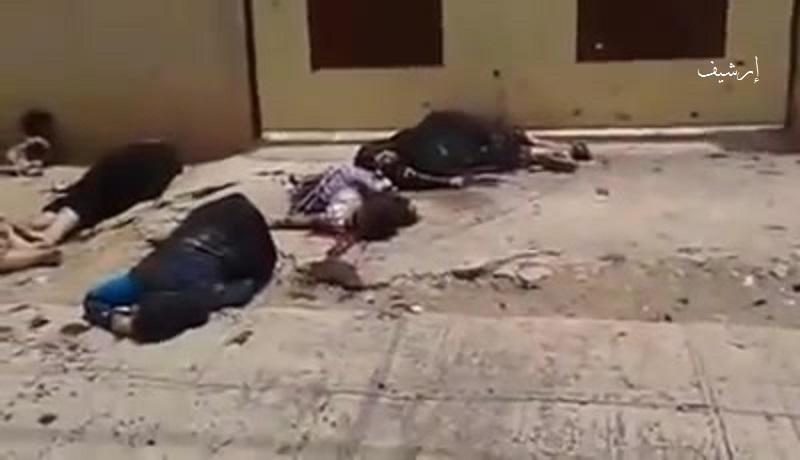
Barack's plan is getting attention today -- for so many reasons.  Reasons like the bombing in Hit which has resulted in 42 people being injured and 24 killed.


: مقتل(24)مدنيا، وإصابة 42 آخرين بجروح -في حصيلة أولية-؛ جراء قيام الطيران باستهداف سوق شعبي وسط قضاء هيت. .


What you can see above with your own eyes and what medical sources in Hit report isn't good enough for the US military command.  Nabih Bulos and Patrick J. McDonnell (Los Angeles Times) quote CENTCOM spokesperson Major Curtis J. Kellogg insisting, "We have seen the media reports alleging civilian casualties in Hit, Iraq.  However, based on our current assessment, we believe them to be false and have seen no evidence to corroborate these claims. I can assure you that prior to any mission, every precaution is taken to ensure we do not harm civilians or civilian facilities. However, we take all such reports seriously and look into them further."  By all means, look further at the photo and maybe take some time to speak with the local hospital.  You know Kellogg is just hoping there's no serious media interest -- like last week when US bombings in Mosul resulted in the deaths of 4 Iraqi civilians.  He's hoping there's no interest and, if that's the case, in a week or so you can expect CENTCOM to quietly release a minor statement acknowledging the 'regrettable' deaths and pretending that such deaths happen in spite of Barack's 'plan' as opposed to because of Barack's 'plan.'

The 'plan' is a failure.  The decision to send in US helicopters is an acknowledgment of that.  But it doesn't alter the 'plan,' it only feeds into the worst parts of the 'plan' and the overall failure of the 'plan.'

Lyse Doucet (BBC News) points out, "Depending on how you calculate the percentages, IS fighters still hold anywhere from a quarter to a third of Iraqi territory.  Hundreds of Western and Iraqi air strikes since 8 August have not fundamentally altered the new map although many say it would look even worse if the aerial campaign had not been unleashed."

It's been two months and the White House still can't admit that the 'plan' is a failure.

Instead, the answer is to add more US forces hoping that can somehow fix a failing plan.

No.

It's not going to.

Political leaders make this mistake repeatedly and the result in loss of lives.

Instead of having the courage to admit they've made a mistake, they grow stubborn and throw more lives onto the battle.  It's not their lives so they're not too concerned.  They're more concerned about their own egos.  So the 'answer' becomes send more and more troops in and pretend that the 'plan' itself is sound.

And that's always what's behind 'mission creep' -- another reality few wish to be honest about.

The 'double down' is never about 'saving' a supposed victim but instead about attempting to salvage their own reputation.

At what cost?


For starters, Lolita C. Baldor (AP) reports the Pentagon has announced the US war against the Islamic State has resulted in US war planes having "dropped roughly 185 munitions, including 47 cruise missiles" and that at least $1.1 billion had been spent so far.

That's a lot of money spent on a failing 'plan.'  Xinhua reports:


The Islamic State (IS) militants captured three neighborhoods in the predominantly Kurdish city of Kobane in northern Syria on Monday, the oppositional Syrian Observatory for Human Rights reported.
The IS attacks on the neighborhoods of Kani Araban, Industrial City, and Maqtala al-Jadeeda in the eastern part of Kobane came after the terrorist group's intense clashes with the Kurdish militants of the People's Protection Unites, or YPG, according to the Observatory.


And the US government's response to this latest setback -- humiliating setback?  To claim that this is an issue inflated by local media.  Holly Yan, Michael Pearson and Ingrid Formanek (CNN) note:


And the Pentagon, the [unnamed "senior military"] official said, believes there's a media outcry about the situation in Kobani because reporters are there. Many other towns have fallen to ISIS without TV crews present, the official said.


Oh, it's the fact that "TV crews [were] present," that's the problem -- not that Kobani was taken.  In other words, if an Iraqi city falls in the forest when no one is around, it doesn't make a sound.

In a similarly stupid vein, the White House and administration officials have argued that the problems include a poorly trained military -- this despite all the years and billions the US spent training the military.

The military problems might not be an issue if, for example, the US government hadn't demanded the military be purged of Ba'athists back in 2003 and the years that followed.  It might also not be a problem if former prime minister and forever thug of Iraq Nouri al-Maliki hadn't brought Shi'ite death squads into the Iraqi military (Tim Arango broke that story in the fall of 2013).  But, as Mustafa Habib (Niqash) reports, those are hardly the only problems with the Iraqi military:

The Iraqi army is suffering badly from what locals describe as the “astronaut phenomenon”. That is, soldiers who pay money to superior officers so they can leave the world of the military and stay out of danger, far from the battle field. This means that sometimes when a general sends a battalion to fight, only half the soldiers are there. And recently, with attacks by extremists, this phenomenon has been getting worse.  

Last week a confidential meeting was hosted by Iraq’s Parliamentary committee on security and defence and one of the guests was Rasheed Flaih, the Lieutenant General who is in charge of the Iraqi army’s operations in the province of Anbar.  

At the September 27 meeting the military men and politicians discussed the ever-increasing absence of soldiers from their units in the province.  

“Participants in the meeting discussed the number of different sieges of the Iraqi army in the Anbar area and how many soldiers were being killed by members of the terrorist organisation, the Islamic State,” one of those who attended the meeting told NIQASH on condition of anonymity.

“Also discussed was the fact that there had been an increase in the number of Iraqi soldiers who were leaving areas where they could expect to see action – such as the provinces Anbar, Salahaddin and Diyala. This means that there are fewer than expected soldiers on the battlefields,” the source said.  
The stupidity of the White House never fails to stun.  Former Secretary of Defense Leon Panetta has taken public many criticisms that he made in real time privately to the administration.  They can't deny these charges, so the administration has tried to attack Leon.  I know Leon and I like him.  I also know and like Vice President Joe Biden.  But . . .

I don't think Joe's ever said anything as idiotic as what Jason Ditz quotes him as saying:


Vice President Joe Biden was quick to criticize Panetta, although not on the content of his hawkish comments. Rather, Biden said it was “inappropriate” for Panetta to criticize Obama at all, on anything, until after 2016, and that he should “at least give the guy a chance to get out of office.”


A friend was joking over the weekend that "Uncle Joe" should run for the Democratic Party's presidential nomination with the slogan Free Flow Joe to note that Joe lacks any filter or self-censorship.

And he's said many dumb things but to insist that Leon or anyone is unable to criticize Barack for two more years is so deeply stupid and so deeply offensive that Joe, who doesn't have a real shot at the presidential nomination, should go ahead now and announce he won't be seeking it.

I like John Kerry and I supported his 2004 run.  When he had an incident that was just too destructive, I noted here he should give up plans to seek a second run in 2008.  Joe's remarks are the same type of offensive.  You really can't come back from that.  It doesn't go away and it undermines you at every step.

That's far from Joe's only problem remarks of late. As Alsumaria reported, Joe spent the weekend working the phones with the UAE and Turkey after he publicly declared that the two governments supported terrorism.


The White House fails repeatedly at diplomacy.  Today, at the US State Dept press briefing, spokesperson Jen Psaki attempted to focus on diplomatic efforts in Iraq:


Over the weekend, General Allen and Ambassador McGurk traveled to Erbil where they met with Kurdistan Regional Prime Minister Barzani, other senior KRG officials, provincial leaders, and tribal sheiks. Noting important recent victories by joint Sunni-Shiite tribal fighters and with Peshmerga forces – excuse me -- and Arab tribes joining to retake the vital border crossing at Rabia. General Allen and Ambassador McGurk conveyed our strong support for all Iraqis coming together as a national front to defeat ISIL, including through the formation of integrated national guard units that would work in concert with a restructured Iraqi army.
General Allen and Ambassador McGurk confirmed that the United States and other international partners are prepared to support these security reforms in a manner consistent with Iraq’s constitution, sovereignty, and independence. They also discussed the urgent need for the coalition to support the humanitarian crisis in Iraq, which is a critical line of effort in the comprehensive campaign to degrade and defeat ISIL.

In their meetings with KRG officials, General Allen and Ambassador McGurk affirmed the historic relationship with the Kurdistan region of Iraq and its people and underscored our full commitment to that relationship.


I don't have a great deal of confidence in those efforts but I could be wrong -- and I hope I am.  We'll close with the October 3rd press conference Allen held in Baghdad (and we'll pick up on that tomorrow).


AMBASSADOR JONES:  Ladies and gentlemen, welcome to the American Embassy.  It is great to see you here. So, welcome to the Embassy, it is great to have you here.
My name is Stuart Jones.  I had the honor yesterday of presenting my credentials to His Excellency, the President of the Republic of Iraq.  And so I am now very pleased to be here to replace my good friend and colleague, Steve Beecroft.  And, on this, my third day of work, it is also a great honor to present to you my good friend and colleague, General John Allen, who, as you know, is the President's special envoy to building the coalition against Daeesh.
So, General Allen has been here now since yesterday.  He is here with Deputy Special Envoy Ambassador Brett McGurk, who, as you all know, is also no stranger to Iraq.  And so, I will just ask General Allen to make a few brief remarks, and then he will take a couple questions.  Thank you.


GENERAL ALLEN:  Thank you, Mr. Ambassador.  Good afternoon, ladies and gentlemen.  Mesah Al-Kheir, and it is a pleasure to be back in Iraq, and see so many familiar faces.  And I would like to, in advance of this moment, wish all of you a very hearty Eid Mubarak.  I want to thank the great team here at the embassy here in Baghdad for the support that has been rendered to my team, to assist me in having access to so many of the leaders and the individuals within the Iraqi Government.  And I particularly appreciate Ambassador Jones's welcome to our team, and to the hospitality that he has shown here, as we have arrived in Baghdad.
This is the first of many trips that I anticipate making to the region.  And it was important that the first trip that we took to the region would be to Baghdad, particularly in my new capacity as a Special Presidential Envoy for the Global Coalition to Counter ISIL.
That Ambassador McGurk and I have come to Iraq for our first international trip speaks volumes about the importance that we place on our partnership with Iraq as we go forward with the intent, ultimately, to degrade and to defeat ISIL over time.
Now, before I read out our meetings thus far, let me first say that the United States strongly condemns the terrorist attacks across Iraq this week that took scores of innocent lives, including women and children.  This kind of wanton violence against innocents, especially during the holy period of Eid, underscores ISIL’s utter absence of respect for the sanctity of human life. 
From January forward, the U.S. has focused on strengthening the Iraqi Security Forces, because that is the desire and the request of the Government of Iraq, and because enabling partners to take on this fight is a critical part of the strategy to defeat ISIL.
Ambassador McGurk and I met last night with Prime Minister Abadi and National Security Adviser Al-Fayad, where I conveyed the strong, ongoing U.S. support for Iraq in our shared fight against ISIL.  And we are continuing to meet with a broad range of actors from across the Iraqi political and military spheres.
As President Obama said in New York during the United Nations General Assembly, Prime Minister Abadi has committed his government to addressing the issues that led to past failures in the security ranks, and has already been replacing commanders and reaching out to all of Iraq’s diverse communities.  The United States, like Prime Minister Abadi, believes in a vision of an inclusive Iraq, in which Sunni, Shia, Kurds are all able to come together to peacefully iron out their differences to achieve prosperity and peace for all Iraqis.  All Iraqis. We have great respect for the Prime Minister’s vision of the necessary reforms, and strongly support his efforts to reach out to Iraq’s neighbors and to work with them on this shared challenge of degrading and defeating ISIL.
In all of our meetings, I am emphasizing our strong support for Iraqi sovereignty and territorial integrity.  And we are committed to working in close support of Iraq regaining territory that ISIL has currently taken over, and making sure that the new government is able to control its territory once ISIL is pushed back. 
President Obama and Prime Minister Abadi have been clear: We must build Iraqi capacity to take on the fight. That is why the U.S. will not send combat troops to Iraq, but instead continue our support for Iraqi security forces through military advisers, training, and capacity building.  The fight will not be easy, and there will be an ebb and flow on the battlefield as time goes on, particularly as Iraqi leaders appoint new commanders,
reconfigure their formations on the ground, and restore the capacity of their forces. This will take time and will require patience.
To that end, we also discussed how the international coalition can help bring to life Prime Minister Abadi’s vision for an integrated National Guard program. We have appreciated the opportunity here in Baghdad to hear about the Iraqi Government’s work with the provincial and tribal leaders as this plan moves forward from concept to reality, and we applaud this broad-based conversation amongst the Iraqis.  The U.S. and some of our international coalition partners will continue to work closely to support that vision, as well.
While naturally the military piece of this is very important, and in all our meetings we are discussing coalition contributions, we also put emphasis on the other lines of effort for the strategy, not just the military support, which obviously gets a lot of attention today, but we also talk about the stopping of the flow of foreign fighters, cutting off ISIL revenue and access to financing, providing humanitarian assistance, and, very importantly, fighting ISIL’s messaging, the idea of ISIL.
And I would like to talk a bit more about that last portion, that last of the five components, because it is something that goes right to the heart of how ISIL will eventually be defeated.  As President Obama said before the UN General Assembly a few weeks ago, “The ideology of ISIL will wilt and die if it is consistently exposed and confronted and refuted in the light of day.”  So we strongly encourage and we support those voices here in Iraq and in the region articulating what ISIL is, which is an un-
Islamic terrorist entity, spreading a message of hate, undertaking violence and nihilism.
But it is incumbent on all of us in this fight against ISIL to work together, and to offer an alternative vision for the future.  ISIL turns frustrated young people into potential agents of terror.  To resist ISIL’s lure, these young people have to believe in a different future, one of inclusivity, one of tolerance, and one of economic hope.  That is why the United States so strongly supports Prime Minister Abadi’s continued outreach to all Iraqis, and his efforts to build an inclusive Iraq that offers hope and promise for all Iraqis, for all your people.
As President Obama and Secretary Kerry have said, this is ultimately a fight that the Iraqi people will have to win.  We cannot win it for you. And it will take time. A single round of airstrikes will not defeat the enemy.  That is why we are going after ISIL not just in the battle space, but we are attacking ISIL in the financial space and in the information space, as well. 
We can and we will stand shoulder to shoulder with Iraq in this fight.  You have suffered greatly at ISIL’s hands. We are here to help you fight back, and to make sure that, once ISIL is defeated, it can never regroup and terrorize the Iraqi people again.
Shukran Jazeelan.  With that, I will be happy to take a couple of questions.


MODERATOR:  Questions?


QUESTION:  (Via translator) There is this impression, General, that the American (inaudible) environment is not that effective right now, and they are ignoring many of the leads that are given to them by the informant and by the Iraqi Government.  Do you think that there is a different way to do this?  My first question.
Second question is regarding the headquarters of this international coalition.  Don't you think that the headquarters should be in Iraq?  But we heard a few days ago that it is going to be in Kuwait.  Don't you think that would reduce its efficiency, if it was away from the field of operation?


GENERAL ALLEN:  I will answer the second one first.  I am not going to comment on the operational locations of the headquarters or the command and control.  I know we are still building out the force, I know we are still consolidating the coalition.  And so I think we need some more time, obviously, to determine where the final location of that will be.  There will be, certainly, representatives of the headquarters that will be inside Iraq that will be located -- collocated with your security force leadership.  And whether the overall headquarters is ultimately in Kuwait or Iraq, that is a decision that I am not a party to at this particular moment.  But I know we will consider all of those locations.
With respect to the first point, I would dispute the contention that the airstrikes to this point have not been effective.  In fact, many airstrikes have slowed the momentum or halted the momentum of ISIL as it has moved across the ground.  Some of the airstrikes have supported, for example, the retaking of the Mosul Dam, the maintenance of Iraqi governmental support or Iraqi control of the Haditha Dam.  Airstrikes have supported counter-attacks, local counter-attacks by Iraqi security forces.
But your point is a good one, and is one that we should continue to try to refine, and that is the information flow to our forces which conduct the airstrikes needs to be closely coordinated.  We need to be talking to the Iraqi leadership and the sources of the information on targets, with the idea that we can be the most effective we possibly can be in applying the aerial fire power to support both the Iraqi people, but very importantly, the Iraqi security forces.  And that is a process I think we will continually re-evaluate to ensure it is as efficient and as agile as it can be. 
Thank you very much, a good question.


QUESTION:  (Via translator) (Inaudible) you are the presidential envoy to the -- for the Coalition to Combat ISIS.  Do you think that the international coalition intends to completely eliminate ISIS?  This is my first question.
The second question, we have some information that (inaudible) is going to be supportive, as well, in training, in arms, and in some advanced weapons.  Can you tell us a little bit about some of the advanced weapons that are going to be given to Iraq, and also the training that is going to be provided?  Is it going to be provided to the elite forces only, or to the general Iraqi Army?


GENERAL ALLEN:  Give me the first part of the question again, please.


QUESTION:  (Via translator) Well, the first part is you are the presidential convoy to the Coalition to Combat ISIS.  Do you think that the international coalition really intends to completely eliminate ISIS?  This is the first question.


GENERAL ALLEN:  That is a really important point.  The defeat of ISIS, which is the intent, will occur in several ways.  And I think it is useful to consider the environment in which ISIS operates. 
The traditional environment that we consider is that ISIS operates in the physical space.  It takes ground, it holds infrastructure, it dominates populations, it operates in the physical space.  Defeating ISIS in the physical space will require a counter-offensive in which we will help to train those forces which will be part of that counter-offensive.  We will help with the application of air power in support of those activities in the counter-offensive to liberate terrain, to liberate people. 
Coming in right behind those military actions will be a strong humanitarian assistance, as well, to rescue the populations from the oppression of ISIS, to provide relief to the people that have suffered so much. 
And the successful portion of the campaign, as it relates to Iraq, will be that, ISIS, as an identifiable organization, will cease to exist inside Iraq.  That doesn't mean that every single member of ISIS has been eliminated.  But the organization has ceased to exist.  There are no safe havens, there is no capacity to challenge Iraqi security forces and, ultimately, to dominate the people.  That is in the physical space.
But ISIS operates in several other spaces, as well.  It operates in the financial space, and it generates a lot of revenue.  And while the counter-attack against ISIS in the physical space is underway, there is going to be a very concerted international effort to attack ISIS in the financial space also, to try to deny it the revenue that it generates every single day that gives it the oxygen that it breathes to give it some effectiveness.  And we want to choke off its finances, to choke off that oxygen, to cause it to begin to wilt from within.
Your point is even more important when you think about the other space in which it operates.  It operates in the information space.  And in some cases ISIS is much less effective in the physical space than it is terrorizing in the information space.  And it achieves great effect in the information space.  And we not only want to compete with ISIS in the information space, in the space of ideas, we want to contest that space.  We want to deny that space to ISIS by a broad-based consensus of the participants in the coalition and, more broadly, the international community that what ISIS stands for is something that is so reprehensible and so odious, that the global community repudiates the very idea of ISIS.
So, as the physical attack is occurring, as the financial attack is occurring, we are attacking the very idea that gives life to ISIS as an ideology.
But it is broader than ISIS.  It is more broadly-based than ISIS.  It is about terrorism.  It is about extremism.  It is about attacking those issues, ultimately, that have given rise to ISIS.  So that is a really important question, and I hope I have given you some thoughts in that regard.
The other piece of this is the training that will -- we will undertake.  It is not just for the special operators, your special forces.  And, by the way, your special forces are some of the best on the planet; they are very, very good.  This is about restoring the capabilities of the Iraqi Army.  And as we work closely with your government, and work closely with the Iraqi Army to determine the size of that army and its organization, there will be decisions that will be made on the means to move that army -- in other words, how it will be transported across a battle space, some of which will be in wheeled vehicles, some of which will be in armored vehicles -- and the weapons systems that will be made available to that Iraqi Army, that refurbished Iraqi Army, so it is a competent, capable, and credible combined-arms force.
Now, I can't go into the details with you on that, because decisions are still being made.  But we are committed to doing that.  And thank you for that question.

And I think that does it?  Okay.  Ladies and gentlemen, thank you very much.  Thank you.


the los angeles times


Sunday, October 5, 2014

That awful Saturday Night Live

The best skit last night was the Joan Rivers skit.

Sarah Silverman I found suprisingly good as a host.  That was throughout.

But the writing was substandard.

Weekend Updates sucks.

And the only skit that really worked was Joan Rivers in heaven.

And it worked in spite of the only African-American female doing a HIDEOUS Eartha Kitt impersonation.

Did the woman think she was doing Vincent Price?

She did Bill Hader's old Vincent Price character but we were supposed to pretend it was Eartha Kitt.  That woman is awful.

So is Jay Pharoah.

He's a mimic, at best.

He can't do impersonations because that requires depth.  What Rich Little does requires some depth.

Jay's characters are always hollow. 

And then there was the awful Michael Che who has all the chemistry and timing of . . . Joe Lieberman.

Truly, Lieberman has to be the only person stiffer than Che. 

Wait.

There is one person worst: Colin Jost, Che's co-anchor.

Cecily Strong is sorely missed on Update.

Sorely missed.

Cecily brought humor in her appearances on the episode, Bobby Moynihan did a good Ben Franklin (in the Joan Rivers in heaven skit) and Kenan Thompson got by on energy in most of the show while, of course, nailing it with his Al Sharpton.  

And Jay should study Kenan's Al Sharpton, that's how you do a character.  You don't just offer a hollow mimic.  You act the part. 

Here's C.I.'s "Iraq snapshot:"

 
Saturday, October 4, 2014.  Chaos and violence continue, Barack's big 'plan' continues to show no results and we take an in depth look at US failure Chris Hill and his latest attempt at revisionary history.


Mitchell Prothero (McClatchy Newspapers) reports:

 Islamic State militants have taken control of key cities in Iraq’s western province of Anbar and have begun to besiege one of the country’s largest military bases in a weeklong offensive that’s brought them within artillery range of Baghdad.
The Islamic State and its tribal allies have dominated Anbar since a surprise offensive last December, but this week’s push was particularly worrisome, because for the first time this year Islamist insurgents were reported to have become a major presence in Abu Ghraib, the last Anbar town on the outskirts of the capital.

Read more here: http://www.mcclatchydc.com/2014/10/03/242105_islamic-state-reportedly-on-baghdads.html?rh=1#storylink=cpy

How's US President Barack Obama's 'plan' for Iraq working out?

AP reports the Islamic State "shot down an Iraqi military attack helicopter" near Baiji on Friday. NINA adds both pilots were killed in the crash.

Again, how's that 'plan' of Barack's working out?

All Iraq News reports that Alan Hennin, a UK aid worker, has been shown beheaded in a video released by the Islamic State -- following their previous video releases of the beheadings of "two U.S. journalists, James Foley and Steven Sotloff and a British aid worker, David Haines."

We know the question, right?  How's the 'plan' working out?

So let's move to something else.

And I have to start with a disclaimer: I'm not voting for Hillary Clinton if she runs for the Democratic Party's presidential nomination and, should she seek the nomination and receive it, I won't be voting for her in the general election.  She lost my support for a number of reasons and that was obvious when she behaved like a rabid dog in her infamous 'what difference would it make' moment before Congress which encapsulated her tenure as Secretary of State, where she refused oversight and served four years without an Inspector General.  John Kerry, by contrast, only had to be asked by a Congressional committee once, right after he became Secretary of State, and he promised they would have an IG by the end of the year and they had one a little over four months after he made that promise.

I know Hillary -- or I thought I did.  I don't know that beastly creature who appeared before Congress, refused to take accountability and belittled the deaths of 4 Americans with 'what difference does it make.'  As with her 1992 idiotic comments regarding baking cookies and offending Tammy Wynette, Hillary can't keep her damn feet out of her own mouth.  She would make a lousy president for that reason alone.  Her mouth always gets her in trouble.  As an independent critic, she can say whatever she wants.  As a member of the Senate, she only needs to please a plurality of voters in a state.  As president, she would be a frightmare.

If you want to vote for her, that's your business.  I'm not here to tell you who to vote for.  I probably, as I did in 2012, will vote for every office but the president in 2016.  I don't see anyone earning my vote -- I'd love to be surprised on that -- and I refuse to be part of the fear campaign.  In 2004, when The Nation magazine couldn't stop heavy panting that it was the torture election and the whole world would end, and that women would be enslaved and blah blah blah blah.  It was just too much.  I don't live in fear and I don't cower.

You can vote however you want, it's your vote.  You should use it as you feel comfortable -- and that might mean supporting Hillary or a GOP candidate or whomever or it might mean making the choice not to vote for any of them.  Your vote belongs to you and you need to use it in a way that you are satisfied with.

In what follows, there will be some defense of Hillary and there will be some criticism.  This is about what happened, it's not about swaying your vote.  I don't care who you vote for.  If I know you personally, my only care is that you're happy with your vote at the time of your vote.

I think we've been the biggest and most vocal critic from the left of Barack Obama.  There will likely be favorable comments on Barack which follow in this.  He's a War Hawk.  I don't support him.  In 2008, I didn't vote for him (first time I ever didn't vote for a Democrat for president) and instead went with a non-duopoly candidate.

If I was Salon ragazine, I wouldn't be focusing what we're about to.

Former US Ambassador to Iraq Chris Hill has told a pack of lies.

Those lies smear Hillary and Barack.  If they were personally smeared -- Hillary or Barack said to be gay in Hill's efforts to court homophobia, for example -- I wouldn't waste time on the issue.  But this is about Iraq and that's what we cover.

Chris Hill is responsible for what went wrong in Iraq and for where Iraq is today.  He's not solely responsible.  Barack's responsible, for example, for nominating him, for trusting him for far too long and for a few other things.

But Hill's nonsense at POLITICO -- where else does nonsense go -- oh, right, Salon! -- is nothing but lies and spin.

Hill betrayed Barack's nomination and trust by doing a half-assed job and repeatedly lying to the administration about what was taking place in Iraq.

Hill betrayed Barack.  Not the other way around as Hill tries to paint it in his bad essay.


Hill insists that Hillary gave him no support when she was Secretary of State in 2009, she made one trip to Iraq and she left him alone and whine, whine, whine.

Hillary wasn't over Iraq.

She might have liked to have been but Barack wasn't going to put her over Iraq.

Two reasons were Samantha Power.  She was Barack's advisor when he was in the Senate and she's had his ear ever since.  Power did not want Hillary in the administration (she can spin that if she wants but she didn't want Hillary in the administration at all -- however, once the two had to work together, they did get along -- Hillary can win people over and Power saw that she had misjudged Hillary and could own that reality).  That's reason one.  Reason two, which Power used to ensure Hillary wasn't in charge of Iraq, was that Hillary supported the Iraq War at the start.  Power said that judgment was fatal to moving forward in Iraq.  (Power herself supported the illegal war -- a fact she's denied and one that the press, in 2008, was eager to help her bury.)

Power was personally against Hillary and Hillary had supported the war and was notorious for that support.

Those are two reason which carried weight with Barack.

Here's the third:


During my last visit to Iraq in January, I expressed my reservations about the ability of the Iraqi government, led by Prime Minister Maliki, to make the tough political decisions necessary for Iraq to resolve its sectarian divisions. Since my visit, Iraqi leaders have not met their own political benchmarks to share power, modify the de-Ba'athification laws, pass an oil law, schedule provincial elections, and amend their constitution. During his trip to Iraq last week, Senator Carl Levin, the Chairman of the Senate Armed Services Committee on which I serve, confirmed that the Iraqi Government’s failures have reinforced the widely held view that the Maliki government is nonfunctional and cannot produce a political settlement, because it is too beholden to religious and sectarian leaders.
I share Senator Levin’s hope that the Iraqi parliament will replace Prime Minister Maliki with a less divisive and more unifying figure when it returns in a few weeks. 


That statement was released by then-Senator Hillary Clinton in August of 2007.

I happen to agree with her -- and with Carl Levin.

I think history and events since certainly demonstrate how accurate her publicly expressed hope was -- that the Parliament would vote Nouri out of office -- it would have been a no-confidence vote (which was attempted in the spring of 2012 but blocked by the White House via Jalal Talabani).

But here's was the thing for Barack -- how could Hillary be Secretary of State and interact with Nouri?

She couldn't.

So she was not the lead on Iraq.

That's why she traveled, she had a lot of time to fill.  Unlike her predecessor Condi Rice, Hillary was not a lead on Iraq.

She can rightly step away -- to some degree -- from the chaos in Iraq now because she was not a lead on this issue.

Nouri al-Maliki was notoriously paranoid.  We explained that here and how the State Dept had documented it and some wanted to scoff but, years later, the WikiLeaks Iraq State Dept cables demonstrated we were right and the term "paranoid" is applied to Nouri in them.

Nouri could not have worked with Hillary in any form because of her statements.  The White House knew that and addressed that.

 For those late to the party, Nouri al-Maliki was only booted out as prime minister over the summer.  His reign of terror ran from 2006 to 2014.

So for Chris Hill to lie and claim that Hillary wasn't there for him -- his snide remark about her ability to charm included -- is just a pack of lies.  And he was not her nominee.

He was Barack's nominee.

Let's note another liar, CIA contractor Juan Cole.  The day after Hillary issued her statement we noted above -- a week after Carl Levin made his (Carl's statement was a joint statement with Senator John Warner)  -- Juan 'discovers' a rumor that there is a plot to topple Nouri.  It turns out, Juan insists, Bully Boy Bush wants to get rid of Nouri.

These lies were then spread by venereal disease carrier Daily Kos which reposted Juan's 'proof' that Ayad Allawi was going to be the new pm because -- among other things -- Allawi penned a column for the Washington Post!

How sinsister!!!!

Juan just makes s**t up -- or maybe follows CIA orders, who knows.

But Bully Boy Bush was not walking away from Nouri and you can say, "Well, C.I., sure, we know that now but back then --"

Back then, we knew it too.

Hillary's statement that we quoted?

A response for Bully Boy Bush's praise of Nouri to the VFW just before she released her statement.  Her statement was in response to Bully Boy Bush's comments.

From the White House transcript of that August 22, 2007 speech to the VFW:


Bully Boy Bush: Prime Minister Maliki is a good guy, a good man with a difficult job, and I support him. And it's not up to politicians in Washington, D.C. to say whether he will remain in his position -- that is up to the Iraqi people who now live in a democracy, and not a dictatorship. (Applause.) A free Iraq is not going to transform the Middle East overnight. But a free Iraq will be a massive defeat for al Qaeda, it will be an example that provides hope for millions throughout the Middle East, it will be a friend of the United States, and it's going to be an important ally in the ideological struggle of the 21st century. (Applause.)  


The next day, at his (un)Informed Comment, Juan Cole was spreading lies that Bully Boy Bush was walking away from 'poor' Nouri.  Cole hadn't read the speech and, as usual, didn't know a damn thing.


Back to Hill,  Barack made a mistake in choosing Chris.

In his article, Chris wants to paint Barack as disengaged and uninformed.

On some topics, that is true of Barack and his presidency.

But no one was more disengaged from Iraq and uninformed than Chris Hill.

At the start of his presidency, Barack cared a great deal about Iraq because it was how he won the White House.  He wrongly agreed to back Nouri in 2010 and that was based in part on Samantha Power insisting US forces would not be able to drawdown at the end of 2011 without the "stability" (the term she used) Nouri provided the country.

In 2010, Ayad al-Allawi won the elections.

Power felt Allawi as prime minister was a question mark and she noted his "populist leanings" (again, her term) and how this could be a problem for the US because Nouri had no desire to represent the Iraqi people and was more inclined to ignore the will of the Iraqi people.  (Which does sum up his two terms as prime minister, on that Power was correct.)

Barack ultimately bears responsibility.  He is president and he made the decision.

But would he have made it if he received accurate reports?

If the administration received accurate reports, I doubt even Samantha Power would have backed Nouri.  I think she would have smelled the stench wafting off him and how damaging he could be to her image of "Never Again!" and argued that Barack shouldn't support him for a second term.

Chris Hill was unsuited for the job he was nominated to perform.

He did not speak Arabic.  He had no knowledge of the Middle East and was an idiot when it came to Iraq.

We covered his confirmation hearing (see the March 25, 2009 snapshot and the March 26th snapshot ) and, despite weeks of briefing, he still didn't understand what was going on, what the issues were or what the facts were.  (He also showed up at the confirmation hearing with his hair needing to be combed and a food stain on his shirt.  Was he applying for night manager at Denny's or US Ambassador to Iraq?)

Though he didn't know anything about Iraq -- most evident by his failure to grasp the importance of Kirkuk but also present in his testifying under oath that Nouri was now paying Sawha (Nouri was not) -- he presumably did know how to make a promise and his promise to the Committee was that if they confirmed him, he would be in Iraq the next day.


His first lie.

People say a lot when they want the job
Lining up eager around the block
Promising, promising never to quit
Well it's a full time job to be a hypocrite
Maybe they remember that they've done it before
Practicing, with their dolls on the floor
The lie itself becoming the seed
The messy mascara, the future deed
The actor's bow, the junkie's need
They line up again just to wipe you clean 

-- "People Say A Lot When They Want The Job," written by Carly Simon, first appears on her This Kind of Love

April 21st Chris was confirmed.

He didn't drag his tired ass to Baghdad until April 25th.

He broke his promise.

It registered here because if someone appears before a Congressional committee and gives their word, even uses the words "I promise, if confirmed," we pay attention to whether those are empty words or a promise kept.

Upon arriving, his chief concern was: Where is the press?

He wanted to be a media star.  But the cherubic looks (never handsome or pretty) had faded due to age, balding and weight gain.  So he'd have to attract media attention some other way.

Hill takes a swipe at Allawi in his essay, insisting Allawi was more interested in being on CNN than anything else.  It's called "projection" -- Hill's projecting his own desires and aims on to others.

In that section, he also insists that, while he was in Iraq in 2010, Allawi was more interested in going on CNN and calling Nouri the new Saddam.

That's interesting.

It didn't happen while Chris was US Ambassador to Iraq.

But if Chris couldn't make s**t up, what would he do?

Tell the truth?

Oh, we're all laughing at that slim prospect.

While Hill struggled to get media attention -- he fared better with NPR where endless jawboning often passes for 'discussion' -- the media was interested in the top US commander in Iraq, Gen Ray Odierno.   That was true the weekend Hill arrived and it remained true throughout.

While Chris went through a phase of wanting to be called "Christopher" and then "Mr. Hill" and then, when he wanted to be liked, "Call me, Chris," Odierno, the moment he was named top US commander in Iraq, stated publicly he was "Ray," not "Raymond."

Odierno was down-to-earth and plain spoken which made for good copy.  He also looked like a man.  Hill babbled and looked like a soft overgrown boy.

Those working under Chris saw nothing "soft," they saw a diva throwing tantrums -- and hurling objects in the office -- when his daily schedule failed to include the media.  Explaining that the media wasn't interested led Chris to explode, then pout, then hide out in his office napping.

While Hill was napping, Odierno was working.

He was rightly suspicious of Nouri al-Maliki.  He felt Nouri was harmful to Iraq.

Possibly because he wanted to get attention, Hill countered those observations by insisting Nouri was a real leader and a friend to America and blah blah blah.

Now maybe Chris believed those lines, he is and was deeply stupid.  But it's very likely he took that position just to counter Odierno and in the hopes that it would garner him attention.

Hill's views fed into Samantha Powers' views (again, had Hill been honest, I seriously doubt Power would have thrown her name behind Nouri).

Barack now had both his most trusted advisor (Power) and his ambassador to Iraq insisting Nouri was the answer to all the problems.

And Ray Odierno began to be shut out by the administration.

He was informed he was not to speak to the media anymore because it disturbed the diva Chris Hill.

Worse than that was the White House blew off Odierno's input.

Months before the March 2010 elections, Odierno wanted the White House to deal with a possibility no one wanted to consider.

What, Odierno wanted to know, does the US government do if Nouri loses the election and refuses to step down?

Hill insisted that would never happen and it was a waste of time to even consider.  That became the answer for the White House.


In March 2010, Iraq held elections and Nouri lost to Ayad Allawi.  What followed was a political stalemate that led Iraq to set the world record (it has since been reset) for the longest time between an election and the formation of a government.

This was due to the fact that, although Nouri lost, Nouri refused to step down.

In other words, what Odierno tried to get the White House to prepare for, the very thing Hill insisted would never happen, was taking place.

In his essay, Hill ignores Odierno's pre-election warning and brings up a post-election comment Odierno made that Nouri was attempting a "rolling coup d'tat" and Hill says he was shocked by the comment that came out of nowhere.  Hill is such a liar.

Much worse was taking place in Iraq and Hill was lying that everything was moving smoothly and a new government was only weeks away -- a lie he repeated monthly.

In fact, when he finally left   August 13, 2010,  Hill was still repeating these lies.


That day the late Anthony Shadid (New York Times) reported, "Hours before his departure from Baghdad, he said a power-sharing arrangement between the main winners in the March election was just weeks away."

August 13 to November 10?

That is "weeks."

In fact, it's around twelve weeks or three months away.

Hill never knew a damn thing.  He lied or he babbled stupidity.


To his credit,  Shadid noted in his report that Iraqi officials were not rushing to agree with Hill.


Shadid also pointed out,  "Preparation for the election, the vote and the negotiations on a new government have dominated the tenure of Mr. Hill, who took over the American Embassy at a time when Iraq was less violent and more stable, but only in comparison to the anarchic months of 2006 and 2007."

Hill wasted everything was built up in Iraq.

He turned a blind eye to Nouri's abuses, rushed to throw his lost (and the US government's lot) in with Nouri.

He withheld any bad information about Nouri from President Barack Obama.

It was left to Odierno to bring reality into the picture and he met with then-Secretary of Defense Robert Gates to basically say Hill was shading the truth and misleading the administration.

Gates listened and evaluated and then took Odierno to meet with then-Secretary of State Hillary Clinton.  She and Gates then met with Barack to discuss the newly discovered problem.

And that is why Hill was fired -- and he was asked to hand over his resignation -- as US Ambassador to Iraq.

Hill was a liar and served Nouri al-Maliki, not the US government, not the American people.  The day he left Iraq,  Alsumaria TV reported, "Hill explained that the political situation in Iraq is normal and doesn’t differ from any other country where the difference is slight between two winning parties."

He couldn't stop lying and since then all he's done is try to salvage his reputation with more lies.

Barack put Vice President Joe Biden over Iraq.  Hill apparently did not like that.  Nor did he like the fact that Joe was popular with a number of Iraqi politicians -- including then-President of Iraq Jalal Talabani, KRG President Massoud Barzani, Ayad Allawi and others.

Hill can't stop revealing his own bias such as when he types "Ayad Allawi’s Iraq National Party, or Iraqiyya, a party that was disproportionately Sunni, won 91 seats, while Maliki’s State of Law coalition had 89 seats."  Disproportionately Sunni?

What was State of Law but approximately 97% Shi'ite?

Iraqiya, Allawi's party, was not sectarian -- it was inclusive and that included Shi'ites (like Allawi) and Sunnis (such as Tareq al-Hashemi, Saleh al-Mutlaq, Osama al-Nujaif and others).  The success of Iraqiya was a testament to the Iraqi people and their desire for a united Iraqi identity and not one based on sect.  Hill misses that today as he did in real time.


Barack deserves blame for the current state of Iraq.  But for Hill to pretend he did not mislead Barack in his 'reports' from Iraq is a lie.

Samantha Power is a War Hawk.  She's also someone who has sold herself to the public as being on the side of right and not might, as someone who will protect the innocents from genocides.  She would not have ever risked her self-created reputation for Nouri had Hill not dismissed reports (of secret prisons) and insisted Nouri was willing to work with everyone and wanted inclusion and . . .

If he had told the truth, even a little of it, Power would have dropped her support for Nouri -- if only to protect her own image.

Without Power pressing on Nouri, Barack would have walked away from Nouri.

Following the start of Nouri's second term -- after Barack had personally phoned Ayad Allawi and made (false) promises to get Allawi to call off the Parliamentary boycott, Barack did walk away.

 Whether that was smart or not we can discuss at another time.
But Barack did learn quickly, in part from the reports of new US Ambassador to Iraq James Jeffrey, that Nouri was not as Hill had presented.
Barack cut Nouri out.  
He made no efforts with Nouri leading Nouri to whine that Bully Boy Bush would call him and teleconference with him and do this and do that but Barack did nothing.
Barack did do something.
What had been perceived as indifference became recognized shunning when, following the 2012 elections, Nouri made a call to the White House to congratulate Barack and Barack refused to take the call.
Hill had it easier than any US Ambassador.  When he arrived in Baghdad, violence was lower than during the ethnic cleansing.  There was hope among the Iraqi people that the US troops would be leaving (due to the SOFA).  The US Embassy in Baghdad was the largest US embassy in the world.
Hill had it better hitting the ground than any US Ambassador to Iraq since the start of the Iraq War -- anyone before or after Hill.
And he misjudged and misreported and played footsie with Nouri.  
Nouri had already begun targeting Iraq's LGBT community when Hill was US Ambassador to Iraq.
It's so funny -- and hypocritical -- that the Denver Post refuses to point out that their now-local academic Hill was in Iraq when that started since the Denver Post was one of the few US newspapers -- and, in fact, the first -- to run an editorial decrying the targeting of Iraq's LGBT community.
Next time Hill wants to talk or write Iraq, people should be demanding not only honesty, but also that he answer for the targeting of Iraq's LGBT community.
The sick f**k should also be asked to explain this.
chris hill


Remember that?

It's then-US Ambassador to Iraq Chris Hill in Baghdad at a Halloween party.  Peter Van Buren posted the photo to his blog here and here.

The US Ambassador has gone as a Secret Agent and the little trollop whore next to him is the First Lady.  She's a whore.  Not Jacqueline Kennedy Onassis.  The whore is the State Dept employee who thought it was funny to dress in the outfit the First Lady wore the day her husband was assassinated.

This is the US Embassy in Baghdad.  With the head diplomat.
Hill is a disgrace for many reasons and that photo is just one of them.  The death of president isn't funny.  The assassination even less so.  If talented comedians want to mine the terrain for humor, more power to them; however US government officials are not comedians -- no matter how many unintentional laughs they garner.