Wednesday, February 4, 2009

off our backs


The magazine in front is off our backs. that was my favorite magazine.

Was?

Supposedly it is going to maintain an online presence.

I've seen that announcement for about a year now and . . . seen no new content.

They always asked for contributors and many a time I thought, "Gee, maybe I should write something." Not because I'm any great shakes in the writing department but because I do wonder if they needed more material?

I'm sure that's not it, I'm sure it was the economy and the lack of caring about women (which means less support even in good economic times).

The magazine pleased me because it didn't try to be anything it wasn't. It wasn't on glossy pages, it wasn't offering up this issue's celebrity. It was talking about the lives that we (women) live. You could identify with the women in the pages.

And maybe that was why it had publishing problems?

Maybe in our society we no longer want to identify, we just want to worship?

The above cover was actually my all time favorite. In it, the magazine explored what war meant to women. Women who serve, women who don't. It was really an amazing issue.

You can click here to read some of it but, WARNING, if you do and you're new to the magazine, you'll immediately regret that it appears to now be dead.

After 2008, the year where women were openly scorned, ridiculed, put-down and attacked by the media, we need off our backs more than ever we did.


Here's C.I.'s "Iraq snapshot:"


February 4, 2009. Chaos and violence continue, a DC peace event looms, results from the provincial elections have still not been sorted out but that hasn't stopped thugs from making threats, what happens to your finger after the purple dye, and more?

Starting with an action that begins this week in the US.
Military Families Speak Out explains:

Come to Washington February 6-9 to demand "The Change WE Need"
President Elect Obama opposed the war in Iraq before it started, calling it a "dumb war." But he and his advisors have also said that they plan to spread the return of combat troops from that "dumb war" out over sixteen months and to keep
tens of thousands of other troops on the ground in Iraq indefinitely.
So from February 6-9, MFSO will be traveling to Washington to bring the new President and new Congress the message that it is long past time to bring all our troops home from Iraq. The four days of events will include:
* A
teach-in featuring the voices of military families, veterans, and Iraqis, explaining the need for an immediate and complete end to the war in Iraq -- and the human impacts of continuing the occupation. Friday, February 6 from Noon - 3:00 p.m. at Mott House, 122 Maryland Avenue.
* A solemn procession from Arlington National Cemetary to the White House beginning at 11:00 a.m. on Saturday, February 7. Meet at the front gate of the cemetery right outside the exit of the Arlington Metro stop. Please arrive early.
* A "Meet and Greet" and Legislative Briefing from 3:00 - 7:00 p.m. on Sunday, February 8 at the Mariott Metro Center.
* Lobbying members of Congress to end the war in Iraq. Meet in the cafeteria of the Rayburn House Office Building at 9:00 a.m. Monday, February 9.


The
November 27th snapshot noted Iraq War veteran Andre Shepherd who self-checked out of the US military while in Germany and held a press conference to explain: "When I read and heard about people being ripped to shreds from machine guns or being blown to bits by the Hellfire missiles I began to feel ashamed about what I was doing. I could not in good conscience continue to serve. . . . Here in Germany it was established that everyone, even a soldier, must take responsibility for his or her actions, no matter how many superiors are giving orders." The December 2nd snapshot quoted the following from James Ewinger's Cleveland Plain Dealer article:
Shepherd said he grew up on East 94th Street in Cleveland, attended Lakewood High School and studied computer science at Kent State University until he ran out of money.
He enlisted in 2004 with the hope of flying the Apaches, but was urged to become a mechanic first.
Scharf said he doubts that Shepherd's expected order to return to Iraq would, by itself, constitute an unlawful order.
"His best argument would be that Apaches are used to kill civilians," Scharf said, but he still viewed it as a weak case.

Andre is seeking aslyum in Germany and has been working with the
Military Counseling Network and attorneys on that effort. Today AP's Patrick McGroarty reports that Andre is one of 71 US soldiers who has self-checked out from "European bases in 2008" (actually, he shouldn't be, he self-checked out in 2007) and his case was scheduled to take place before the Germany's Federal Office for Migration and Refugees today where Andre would be stressing "a 2004 European Union directive that established basic guidelines for refugee status within the 27-nation bloc. Soldiers who face punishment for refusing to commit a war crime or serve in an unlawful conflict are to be granted that status, the directive says."
The Military Counseling Network blog notes Samantha Haque's January 28th report for the UK's Channel 4 News on Andre (both links have videos):

Andre Shepherd: When I speak to the other asylum seekers in the asylum camp and I explain to them my story, they completely understand it however this doesn't make me any better or any worse than anyone else that's there. We're all there because we can't go home.

Samantha Haque: As an asylum seeker he is currently in a camp in Germany with people from places like Afghanistan, Somalia and Iraq. All in a similar position to him. The difference is that Andre Shepherd is a US citizen. And an Iraq War deserter. For security reasons, we were not allowed to film in the camp. Shepherd has a friend, a peace activist, who lives within the restricted boundary he's allowed to move in. He took us there.

Andre Shepherd: I was working on the Apache helicopter. Those Apaches won't fly unless we take care of them. The Apache helicopter is a deadly weapon a lot of people call it a flying tank. What started my doubts was when I saw the Iraqi people, when they would come and help us, the looks that they gave us weren't the looks of heroes or people that you know were bringing freedom. We looked like conquerors and oppressors. That really bothered me a lot. So I started to look into the reasons why we were actually there in Iraq. I thought that what we were doing was a great thing and a positive thing. That we were actually bringing freedom to people and making them happy but what I found out instead was that we completely destroyed an entire country on a pack of lies. It started to weigh very heavily to the point where my actions when I was a soldier were starting to deteriorate so as this was going on I came to the conclusion that I wasn't going to back to Iraq.

Samantha Haque: None of the criteria that the US military offered for discharge were availble to Mr. Shepherd. To be a conscientious objector in the US means to be against all wars, something he was not. While in Germany, he was faced with a second mission to Iraq. On April 11, 2007 he went absent without leave. Unable to apply for German residency without official military discharge papers, he decided that applying for asylum was the only way forward.

MCN's Tim Huber: Andre contacted us about a year and a half ago and he asked about asylum He wasn't the first to ask about asylum but our answer was always the same, we don't know what would happen if you tried aslyum. We went over the pros and cons of trying it. We noted that we were quite pessimistic that it would actually work, but we said it's an option.

Samantha Haque: His lawyer on the other hand is confident that he will have his application accepted.

Reinhard Marx: It's a specific European law, the so-called directive on qualification of refugees and in this directive it is ruled that deserters of an army who refer to international reasons, refer that the war is conducted in a way which infringes the national law then he has a right to be accepted as a refugee.

Samantha Haque: His lawyer cites the case of Florian Pfaff, a German officer demoted after refusing to work on a computer program for the US Army in Iraq in 2005. A federal court overturned his demotion because the Iraq War contravened international law. But although Germany opposed the war in Iraq and said no to the US resolution backing it, it still allowed its territory to be used as a base for military operations in Iraq. Here in Heidelberg is the US Army's headquarters in Europe. There are currently around 51,000 US military service men in Germany If Mr. Shepherd's application for aslyum is accepted, there could be implications for US-German military relations.

Gas Bag: It would mean that any US soldier in Germany who disagrees with military operations being conducted can basically step out of the base and seek asylum in Germany and that would probably be a situation that would be unacceptable to the US military.

Samantha Haque: The US is already looking at shrinking its military presence in Germany and possibly moving bases to Europe.

Gas Bag: There is a 60-year tradition, there's many Germans who cherish having the Americans here. There's also an economic factor, the US bases, particularly in the German southwest provide a lot of jobs.

Samantha Haque: Shepherd is something of a darling for the anti-war movement. Here at the Miltary Counseling Network, an American center where conscientios objectors go for help, letters of support come in from all over the world.

Tim Huber: He joined for the American dream. He joined for life, liberty and the pursuit of justice. Suddenly he finds that his pursuit of life, liberty and, most importantly, justice causes him to take a 180 degree turn and walk away from the military.

Samantha Haque: Do you think that there's a danger that Andre's case trivializes the term asylum seeker?

Tim Huber: Not at all. I think, if anything, it's causing people to look at the term asylum and put it in a 21st century defenition

Samantha Haque: The US army said that it was aware of the case but that the matter was completely in German hands. As for Mr. Shepherd it will be some months before he finds out the results of next week's hearing and whether he faces jail in America or exile abroad.

Andre Shepherd: Not being able to go back? At this point, that's just something I have to live with if I can make my consc clear then fine that's just a sacrifice I have to make.

Russia Today notes the Pentagon claims 5,000 US Army soldiers "are missing from duty" presently and quotes Andre explaining, "When the CIA report came and they said that there were no weapons of mass destruction found in Iraq, that really made me angry. I wondered if there are no weapons of mass destruction in Iraq and the CIA obvioulsy the Bush administration knew about this, then why did we just destroy Fallujah, completely wiped out the entire city?"

Meanwhile
Dahr Jamail (MidEast Dispatches) has returned to Iraq for the first time in four years and has heard the much hyped "security" hype:

I myself was lulled into a false sense of security upon my arrival a week ago. Indeed, security is "better," compared to my last trip here, when the number of attacks per month against the occupation forces and Iraqi collaborators used to be around 6,000. Today, we barely have one American soldier being killed every other day and only a score injured weekly. Casualties among Iraqi security forces are just ten times that number. But yes, one could say security is better if one is clear that it is better in comparison not to downtown Houston but to Fallujah 2004. Compared to days of multiple car bomb explosions, Baghdad today is better. Is it safer? Is it more secure? Difficult to say in a place when the capital city of the country is essentially in lock-down and prevailing conditions are indicative of a police state. We have a state in Iraq where the government is exercising rigid and repressive controls over social life (no unpermitted demonstrations, curfews, concrete walls around the capital city), economic (read - the 100 Bremer Orders that were passed under the Coalition Provisional Authority - all of the key laws over economic control still in place), and political life of the citizenry. By definition, a police state exhibits elements of totalitarianism and social control, and in today's Iraq, we have plenty examples of both.

Iraq held provincial elections in 14 of the 18 provinces last Saturday.
Thomas E. Ricks (Foreign Policy) announces he is waiting to weigh in: "The two key questions, he [an American official] said, were whether those who lost power would give it up and those who gained power would be able to execute it well. Why wait? Because, unlike my former colleagues in the newspaper racket, I can." While he waits, the battle of the spin continues with threats of violence mixed in. Alissa J. Rubin and Steven Lee Myers (New York Times) quote one-time "Awakening" Council leader Sheik Hammid al-Hayes who is unhappy with the early (and unofficial) results thus far in Anbar, "If the results aren't acceptable, then we'll bring back the old days. We will use rifles again, and we will eliminate the Islamic Party." When the US military keeps you and your underlings on the US tax payer dime ($300 a month per "Awakening" member), you'd think the monthly stipend might require a few civics lessons. Now "Awakening" free, al-Hayes demonstrates yet again exactly the type of person the US was paying off . They scream, they yell, they threaten violence and . . . they get their way. Ned Parker, Caesar Ahmed and Saif Hameed (Los Angeles Times) quote Sheik Ahmed Buzaigh abu Risha vowing, "If the percentage is true, then we will transfer our entity from a political to a military one, to fight the Islamic Party and the commission." If the Iraqi Islamic Party is declared the winner in Anbar, the "Awakenings" say they will begin a slaughter. And instead of being called out, they're getting catered to. Ernesto Londono (Washington Post) reports, "A coalition of parties that competed against the Iraqi Islamic Party in Anbar submitted complaints that the commission considers grave, commission chief Faraj al-Haidari said, 'We will deal with it seriously because it might change the result of the election in this province,' he said."
Al Arabiya News Channel notes Anbar is "under curfew for a night". Leila Fadel (McClatchy Newspapers) observes how "quickly" the officials go into motion for the ones making threats in Anbar, "The Independent High Electoral Commission sent a committee from Baghdad Wednesday to recount ballot boxes from some polling stations in the province after tribal leaders accused the Iraqi Islamic Party, IIP, which currently controls the provincial council, of rigging the vote. The accusations of vote rigging came from an especially important source, Ahmed Abu Risha, the head of the province's Awakening Council, which is widely credited with bringing calm to Anbar." Oh, yes, that voice of peace Sheik Risha. And what did LAT quote him saying? "If the percentage is true, then we will transfer our entity from a political to a military one, to fight the Islamic Party and the commission." Andrew England and Ernesto Londono (Financial Times of London) note, "The IIP is one of the few Sunni Arab groups that took part in 2005 elections, which were boycotted by Sunni Arabs. It has been the community's main political force and had run the council in Anbar" and they quote the Iraqi Islamic Party's Omar Abdul Sattar stating that these threats of violence by people unhappy with the preliminary results are "unacceptable and totally rejected." UPI explains, "The Awakening Councils had looked to secure seats on the provincial councils as reparation for their role in routing al-Qaida militans from Anbar as part of the U.S.-led counterinsurgency strategy known as the surge." These are preliminary results -- unofficial ones. That needs to be remembered. And if al-Maliki wasn't attempting to spin the results and the press wasn't so eager to help him (we're ignoring the installment in today's news cycle on that), we'd follow Thomas E. Ricks' example (which, as noted Tuesday morning, was the plan). But since we can't, we'll note an obvious fact. "Awakening" Councils members were collaborators with the US in the occupation of Iraq. Anbar especially rejected the illegal war and occupation on and of Iraq. While "Awakenings" turned when a buck or two was popped in their g-strings, that doesn't mean the people did. If the results hold, you may see the people -- and we made this point when NYT did their ridiculous "Everything is beautiful in the province and the people are so happy" 2007 article -- really didn't want anything to do with US collaborators. If so, that's not surprising. When France was occupied, the French loudly rejected the collaborators. And continued to make known what they thought of them -- to this day. Those who go to work for the enemy -- and a foreign force occupying any country is that country's natural enemy -- are collaborators and, no, they are not popular with the home-grown population. And Monte Morin and Caesar Ahmed (Los Angeles Times) quote the menacing Sheik Risha promsing, "There will be very harsh consequences if this false election stands. We won't let them form a government."

"There will be very harsh consequences if this false election stands. We won't let them form a government."

The same thugs the US paid off so they'd stop attacking US military personnel and equipment -- as US Ambassador to Iraq Ryan Crocker and Gen David Petraeus told Congress repeatedly last April -- scream and whine and moan about the potential results and everyone rushes to make the big babies feel better. They whine and make threats and that gets a reaction from the elections commission chair? The same pompous ass who declared Sunday, "
It's not our fault that some people couldn't vote because they are lazy, because they didn't bother to ask where they should vote"? Well apparently "lazy" is mitigated when you threaten violence so possibly all those who were not allowed to vote, who were repeatedly turned away at polling stations should start threatening to 'set it off' and maybe the elections commission chair would suddenly take an interest in their issues? Of the commission, Deborah Haynes (Times of London) points out, "Iraq's electoral commission insisted that it was pleased with the turnout on Saturday, with about 7.5 million Iraqis, or 51 per cent of those eligible to vote, casting a ballot. Mr al-Maliki had forecast participation of up to 80 per cent after to an improvement in security and a decision by Sunni Arabs to participate, after boycotting past ballots in protest at the occupation." In the meantime Trenton Daniel and Mahdi al Dulaymi (McClatchy Newspapers) observe, "Thousands of Iraqis, however, couldn't vote because their names were missing from registration lists; in Hawsa, just west of Baghdad, thousands demonstrated over their exclusion." No, don't demonstrate, threaten. It works so very well in Anbar. The response to demonstrations and massive voter suppression? "Election officials said that they have no plans to address the grievances, saying that displaced voters missed their opportunity to register."

In New York at the United Nations yesterday, Staffan de Mistura, UN Secretary-General's Special Representative for Iraq, spun like crazy trying to find the 'good' in an election process that, he admitted, saw five candidates assassinated "and the explosion of two mortar shells on Election Day" -- he side-stepped the other violence taking place Saturday. [Even US Army Lt Gen Lloyd J. Austin III admits to "11 attacks" on election day.] He offered a figure of 42% for Sunni participation (42% of registered voters) which, if it holds, will only further underscore how many people stayed home (Sunnis boycotted the vote in 2005's provincial elections).

Meanwhile
Deborah Haynes (Times of London) notes an interesting bit of trivia regarding the election process:

Iraq commentators go misty-eyed when they talk of the symbolic purple finger brandished by Iraqis after casting a ballot. But no one ever mentions the smelly orange nail. Had such an abominable side-effect been better public knowledge, then I would never have enthusiastically jammed by right index finger into a pot of indelible ink at a polling station in Baghdad on election day.
[. . .]
"What the hell is happening to my nail?" I asked my interpreter. "Oh it turns orange," he said, casually. "It is because of all the chemicals in the ink."
Four days and hours of scrubbing later, the purple ink on my finger has almost gone but the Orange Nail from Hell is still there, as colourful as the moment it first appeared. The nail has also started to smell rather foul, as if something nasty is rotting on the end of my finger.

"The latest is that nothing much has changed," AP's
Kim Gamel explained yesterday on NPR's All Things Considered, "al-Zaidi has been in custody since Iraqi guards wrestled him to the ground." Muntadar al-Zaidi, the Iraqi journalist who threw two shoes at George W. Bush December 14th and has been imprisoned since. Gamel said he remains in a jail cell in the Green Zone and his attorney has had only one visit with him (back in December). Asked about the alleged letter Nouri al-Maliki was touting linking the journalist to 'terrorists,' Gamel replied, "Maliki did say he received that letter and the family [of Muntadar] denied that" and she noted it's impossible to determine whether the claim is true or false at this point.

What a novel concept. A journalist noting what can and cannot be verified. That's certainly nothing
Steven Lee Myers (New York Times) worries himself over today as he rushes to turn a suspect into a convict. We addressed the topic in yesterday's snapshot. Yes, it was obvious yesterday. But Myers misses out as he rushes to tell you a criminal confessed! Let's go to Tina Susman ( Los Angeles Times):There was no way to independently verify the video's authenticity, but the use of female suicide bombers has soared in the last year. More than 30 women blew themselves up last year, compared with eight in 2007, according to U.S. military figures. U.S. and Iraqi officials say Sunni Arab insurgents have run short of male recruits and turned to women for the missions.Suspected suicide bombers were among those rounded up in the sweep conducted in the 72 hours leading up to Saturday's elections, said Army Maj. Gen. Jeffery Hammond, commander of U.S. forces in Baghdad and the surrounding region. Hammond said attacks in the his area of command had dropped 80% since June 2007, part of a nationwide decrease in violence that was highlighted by the peaceful voting for new governing councils in 14 provinces.And that is what's known as reporting. Suspected. Video could not be independently verified. All points Steven Lee Myers can't be bothered with. What a social hit he would have been in Salem back in 1692. No doubt he would be partying at Gallows Hill. Steven Lee Myers, the Cotton Mather of 2009.

Turning to some of today's reported violence . . .

Bombings?

Mohammed Al Dulaimy (McClatchy Newspapers) reports a Baghdad roadside bombing that left two people wounded, a Baghdad sticking bombing aimed at an "Awakening" Council head that wounded the head and claimed the life of his son with three other people injured, a Baghdad roadside bombing that left four people wounded and a Mosul car bombing left four people wounded. Reuters notes a Mosul roadside bombing that left two people injured and a Mosul grenade attack with no reports of wounded but the US military fired at the thrower.

Shootings?

Mohammed Al Dulaimy (McClatchy Newspapers) reports one person shot in Kirkuk (wounded).

Corpses?

Reuters notes 8 corpses discovered in Baquba.

iraq
military families speak out
andre shepherdjames ewinger
dahr jamail
thomas e. ricks
the new york timesalissa j. rubinsteven lee myersthe los angeles timesned parkercaeser ahmedsaif hameedthe washington posternesto londonomcclatchy newspaperstrenton danielmahdi al dulaymi


patrick mcgroarty
nprall things considered
kim gamel
the los angeles timestina susman

Tuesday, February 3, 2009

Theremin

Did you read C.I.'s "Alegre goes to her first feminist sell-out conference" this morning? I love it. No one but C.I. could have written it for the following reasons:

1) It required more than a passing knowledge of feminism.

2) It required talent and skill.

3) It required guts.

Guts, especially, is in short supply online these days. Another reason I am an long term community member, C.I. has never refused to call out.

I knew this was building in the community. I also knew C.I. was attempting to focus on Iraq and hoping it would take care of itself but when it didn't and became worse, C.I. stepped up to the plate and didn't hold back. I love that about her. And that's why she always says that anything good at The Common Ills should be credited to the community and not her. That's modesty. We may ask that something be addressed but C.I.'s the one who has to address it.

In 1966, Brian Wilson of the Beach Boys contacted Paul Tanner about some projects the group was working on. In a recording studio, Wilson had concieved of an idea for a song based on the notion of "vibrtaions" -- the emotional signals that people and animals communicate to each other telepathically -- a phenomenon that had intrigued and frightened him since childhood. Tanner was called in to add tracks on the electro-theremin.
On February 14, Tanner began by adding a track to the song "I Just Wasn't Made for These Times," for the Pet Sounds album about to be released. The first session for "Good Vibrations" began at 11:30 P.M. on the seventeenth, at Wilson's Bel Air house. Like most of the follow-up sessions, it ran well into double-overtime, through the morning of the next day. Brian Wilson sang Tanner a rough approximate of what he wanted for the theremin part. Tanner, who usually worked from precomposed music, asked if the part could be written out. Wilson explained that the group didn't work that way -- they just used their ears -- and if he wanted a part he could write it out himself. Tanner scrawled something down and recorded a few takes, but he left with the impression that nothing would come of the session and threw the part out. Later, when Wilson called him, Tanner had to burrow through his garbage to find it.
Tanner found himself caught up in the Beach Boys' prolonged labor of delivering "Good Vibrations." At session after session, musical ideas were changed, thick textures were adjusted and refined using multiple overdubs, and Brian Wilson recorded different parts of the song in four separate studios to capture the distinct trademark sound of each location. After months of polishing the instrumental parts, Mike Love completed the lyrics and Carl Wilson recorded the lead vocal. The final mix was redone four times. Tanner remembered that his part on the completed version of the recording involved not only the familiar high swoops and shakes, but also a low barely audible section where he played in aregister below the other musicians, close to the point where his instrument went "out of hearing range down at the bottom." After seventeen sessions and ninety hours of recording time over a period of six months, the song was completed at a cost of sixteen thousand dollars -- a record outlay at the time for 45 rpm single. The song was released on Capitol in October 1966 and reached number one in Britain by November 17 (remaining for two weeks) and number one on the U.S. charts for the week of December 10. "Good Vibrations" fared well worldwild and became the Beach Boys' only million-selling single.

What is that? "Marcia, are you a Beach Boys fan now? Are you trying to pass for White?" No. (Although there are three Beach Boys songs that I really love. "Good Vibrations" isn't one of them, sorry.) It's from pages 294 and 295 of Albert Glinsky's Theremin: Ether Music and Espionage. I figured that section was the part most people could easily relate to.

But the theremin is a musical instrument that I always found fascinating. In music class in fourth or fifth grade, this guy (I believe it was our music teacher's boyfriend) brought one in and showed us how you played it -- with your hands. It's like an antenna and it emits sounds. That's not describing it very well. It's named after its inventor, (Lev Sergeyevich Termen, born in Russia in 1896) Leon Theremin. And that was way back in the 1920s.

So I was curious about the instrument because of the class discussion and Sunday I saw the book at my local (chain) bookstore. (We have no more independent bookstores in my area -- they all closed up.) It came out in 2000 and it was 25% off. I'm sure it's out in paperback by now and you can also check your local libraries if you're interested in reading it.

Sunday, at Third, "Mailbag" included this:

Alan e-mails about last month's "1 Book, 5 Minutes," a book discussion on Janis Ian's Society's Child: My Autobiography. Alan wants to know why more book discussions can't be done? For the record, we've answered this question before. We'll include this question in one mailbag this year and that's it. Alan adds, "Reading is important and everyone is cutting back on book sections." Jess, you want to tackle this?

After the edition was finished (long after) and I'd awakened, I thought, "Marcia, you should have mentioned Theremin: Ether Music and Espionage." I should have. But I'm mentioning it here now. We all read and most of us are more like Dona, reading anything that interests us. But book discussions really are a pain in the ass.

I recommend the book highly and, again, the author is Albert Glinsky. Dusk jacket says:

Albert Glinsky is a composer whose music has been performed throughout the U.S., Europe, and the Far East. He holds degrees from the Juilliard School and a Ph.D. from New York University, and his work has been honored by the National Endowment for the Arts and the American Academy of Arts and letters. He is an associate professor of music at Mercyhurst College, Pennsylvania.

I really think that's going to be it. There was a thing on PBS last night that I DVR-ed. I need to watch that and I'm also so tired that I'm yawning. If you're yawning as well, I must be boring and not tired. Here's C.I.'s "Iraq snapshot:"

Tuesday, February 3, 2009. Chaos and violence continue, peace actions are scheduled to take place in the US, the US rushes to release Iraqi prisoners, more stories emerge on the provincial elections, and more.

Starting with an action that begins this week in the US.
Military Families Speak Out explains:

Come to Washington February 6-9 to demand "The Change WE Need"
President Elect Obama opposed the war in Iraq before it started, calling it a "dumb war." But he and his advisors have also said that they plan to spread the return of combat troops from that "dumb war" out over sixteen months and to keep
tens of thousands of other troops on the ground in Iraq indefinitely.
So from February 6-9, MFSO will be traveling to Washgton to bring the new President and new Congress the message that it is long past time to bring all our troops home from Iraq. The four days of events will include:
* A
teach-in featuring the voices of military families, veterans, and Iraqis, explaining the need for an immediate and complete end to the war in Iraq -- and the human impacts of continuing the occupation. Friday, February 6 from Noon - 3:00 p.m. at Mott House, 122 Maryland Avenue.
* A solemn procession from Arlington National Cemetary to the White House beginning at 11:00 a.m. on Saturday, February 7. Meet at the front gate of the cemetery right outside the exit of the Arlington Metro stop. Please arrive early.
* A "Meet and Greet" and Legislative Briefing from 3:00 - 7:00 p.m. on Sunday, February 8 at the Mariott Metro Center.
* Lobbying members of Congress to end the war in Iraq. Meet in the cafeteria of the Rayburn House Office Building at 9:00 a.m. Monday, February 9.

Meanwhile
A.N.S.W.E.R. explains:

We are organizing a Mass March on the Pentagon on Saturday, March 21, and it is important that you and your family, friends, co-workers and fellow students put on your marching shoes that day. People are coming from all over the country. Simultaneous demonstrations are taking place in San Francisco and Los Angeles.
Why are we still marching even after the war criminal George W. Bush has left office? Because the people must speak out for what is right. More than 1 million Iraqis have died and tens of thousands of U.S. troops have been wounded or killed.
The Iraq and Afghanistan war will drag on for years unless we act now. The cost in lives and resources is criminal regardless of whether the Democrats or Republicans are in charge of the government.
[. . .]
If Bush's war and occupation of Iraq was an illegal action of aggression -- and it was -- how can the new government say that it can only gradually end the war over a number of years? The Iraqis don't want foreign military forces running their country. No one would!
The Pentagon has employed 200,000 foreign contractors (mercenaries) and 150,000 U.S. troops to maintain the occupation of Iraq. They have no right to be there. A few thousand are being brought out of Iraq only to be redeployed to occupy Afghanistan, and the fools in the media proclaim "the war is winding down." That is not true.
President Obama decided to keep the Pentagon just as it was under Bush. He even selected Bush appointee Robert Gates to keep his position as chief of the Pentagon. Gates announced that the new administration would double the number of troops sent to Afghanistan. That is certainly not the "change" most people though was coming following the end of Bush's tenure.

Meanwhile United for Peace and Justice is reportedly planning something. Soon. Any day now. If not action, maybe a series of glossy pin-up photos of Barack suitable for framing in the best fan-worshipping, Tiger Beat manner. Remember, United for Peace and Justice may be sleeping on the job but they are dreaming -- very moist and wet dreams. Someone change the sheets already.
Cindy Sheehan (World Can't Wait) calls it like it is:
Many anti-war activists are concentrated on insuring that Obama fulfills his campaign promises to withdraw "combat" troops from Iraq without having the integrity to demand complete withdrawal of all troops and a return to total sovereignty of the country to the people of Iraq, and are not questioning Obama's determination to double troop strength to Afghanistan.I think the US MIC empire needs to be destroyed, but I would prefer that we incorporate a voluntary reduction of empire, before the weight of The Empire® collapses like a house of cards on us; or on the innocents of Afghanistan.

In Iraq, Nouri al-Maliki demonstrates a puppet can be taught a few tricks. Among them, how to seize control of the daily news cycle.
Sinan Salaheddin (AP) repeats what al-Maliki's government is saying -- repeats instead of reporting. Samira Ahmed Jassim has confessed! There's a video of the woman allegedly also known as Umm al-Mumineen ("the mother of all believers") stating she is the one who has recruited over "80 female suicide bombers". The first sentence tells you she "has been arrested." You have to wade through many paragraphs to discover she was arrested January 21st. So the video confession is all the more doubtful and may have been produced under torture. (And bruises hide so much better when you're wearing "an all-ecompassing black Islamic robe".) If al-Mumineen is the or a recruiter, it really makes little difference. She's not a hypnotist -- if she is, that's the only allegation AP's forgotten to present as fact. At best, she provided an avenue to those already prepared to seek violence. It goes to the gender stereotypes of women to believe that they had to be 'corrupted.' The violent response on the part of some Iraqi women is a perfectly natural response to what they are living under. ("Natural" is not the same as "legal." But we're not addressing that. We are continuing to address the pathologizing of one gender.) Jomana Karadsheh (CNN) manages to cover the same government issued spin but manages to lower the frentic tabloid nature. But it's only Deborah Haynes (Times of London) who can use the term "suspect" in the first sentence of a report? Why is it only Haynes can refer to the DVD played at the press conference as an "apparent confession"?

To be clear, Haynes has done her job as a journalist. In any country, it is not the job of the press to take a government's claims and present them as fact. In a country where justice is a joke, where human rights organizations and the United Nations have documented reports of tortured confessions -- including from female prisoners -- a press that simply repeats claims of the government as fact isn't offering news. They are offering tabloid-style entertainment. Haynes also notes, "At least 36 female suicide bombers attempted or successfully carried out 32 suicide attacks last year, compared with eight in 2007, according to US military data." As we've noted before, there are many, many more male 'suicide bombers' than female. But there's something about when it's a woman that tends to make the press minds go all mushy. Maybe it's a sexual response (akin to the way some are turned up by a woman holding a gun -- on screen, in photos or in real life) or maybe it's panic that a woman would think of death. Oh goodness, it's also troubling and frightening -- apparently.

It's not impossible that Samira Ahmed Jassim has recruited women to be bombers and it's not impossible that she hasn't. She stands accused, she's not been tried. And those with any short term memory at all will remember last month when Iraqi officials told the press someone had expressed regret and then his family finally got to see him and, turns out, he didn't say what the Iraqi officials were telling the press. Whether Samira Ahmed Jassim is a recruiter for female bombers or not, the bombings will continue. And while CNN may think acknowledging that women in Iraq have "always" been part of the resistance by "helping feed militants, hiding them in their homes and helping to sneak weapons around the country," the women have been far more active. And note how passive that last phrase is. Women didn't sneak weapons, according to CNN, they helped to.

If Nouri's smart, he'll continue to play the press via women since he has so many willing cohorts in the press. Willing cohorts in the press? File it under "Not since Frank Pitcairn so desperately attacked the Trotskyites out of his love for Stalin has a professional journalist so disgraced himself," Patrick Cockburn found himself a true love: Nouri.
At the Independent of London, Patrick writes the kind of garbage that his own father (writing under the psuedonym Frank Pitcaim) would hold his nose at. Patrick write a valentine to Nouri and Nouri's amazing powers and . . . Patrick leaves out the part that he was out of Iraq for most of last month as he covered the assault on Gaza. Patty's been playing pocket pool around Nouri for months now and let's hope he's racking up an impressive score with that because he's leaving his journalist reputation in tatters.

Patty's thrilled with Nouri's awesome election 'power.' In the real world,
Gina Chon (Wall St. Journal's Baghdad Life) noted that while driving through Sadr City on Saturday (the day provincial elections were held in 14 of Iraq's 18 provinces) appeared to have far fewer people on the streets "than other parts of the city" (Baghdad). The paper's Jafar Jani reports, "Um Ali, 56, took her grandsons to the polling station on Saturday so they could dip their fingers in ink, which shows that people had voted, even though they were too young to cast a ballot. . . . Um Ali said she wanted her grandsons to remember this moment and feel the joy of voting in a free election." McClatchy Newspapers' Iraqi correspondents surveyed West Baghdad on election day where 25-year-old Mohammed Allawi stated, "What optimism?? We are an occupied country. I am voting only so that my vote will not be stolen by the corrupt people who are willing to do anything to remain firm on their seats. But it seems I am not even considered an Iraqi citizen -- I can't find my name anywhere -- and my family has been in Ameriyah nearly forty hears." Two women explain, "We couldn't vote! We couldn't find our names. We have been to two centres, and aim to go on looking until we find them or are too tired to go on." Over and over, voices from West Baghdad reveal that they had trouble voting. Hmm. Could the puppet have learned from Florida 2000? Could the puppet, knowing west Baghdad was always anti-Maliki, have pulled off purging voter rolls? Who knows? But with low voter turnout it's amazing that so many Iraqis -- throughout the country -- repeatedly tell that they had to visit more than one polling station over and over. What -- however it happens -- appears to be a very serious problem results in this 'response' from election commission chair Faraj al-Haidari, "It's not our fault that some people couldn't vote because they are lazy, because they didn't bother to ask where they should vote." The voters are lazy. That's the problem. Voters who went from polling station to polling station -- mainly on foot. They're lazy. That's the problem. That's what the story's going to be?

Apparently so -- if
Sam Dagher and Steven Lee Myers (New York Times) are going to continue to suffer from Patrick Cockburn Disease. The two attempt to hail Basra as a victory for Nouri -- who was not running in the elections. Despite the fact that Basra had an incredibly low turnout, they see the vote as an endorsement of Nouri. The non-participation rate reads like a rejection of the so-called government on every level. And if you lived in Basra when it was under assault (March 2008) maybe you'd take the attitude of "I'm not voting" as well? Your local government didn't protect you when al-Maliki and thugs rolled into town. One level of government assaulted you and the other stood by. Why bother to vote? Based on the preliminary turnout, what can be argued about Basra can be argued about the bulk of Iraq which is why turnout was so low. 26% more registered voters voted in 2005 than voted on Saturday. Dahger and Myers declare, "In choosing Mr. Maliki, many in the south seemed willing to sacrifice more local considerations like patronage." A) Basra was assaulted and the local government did nothing to protect it. Yes, you will find some people who support the assault -- and you can even quote him as the paper does -- but the bulk of the people did not approve (as was obvious at the time and is obvious in the voter turnout). That's why they stayed home. As for 'patronage,' al-Maliki went around the country promising everything or are we supposed to forget his multiple attempts at bribery via promises regarding local services all the way up to 'The US is leaving Iraq in less than 16 months! It is so, it is true! Because I, al-Maliki, say it!'? al-Maliki didn't play the patronage game? Worse for the two reporters, Ned Parker (Los Angeles Times) filed today: The prime minister has sought to boost his party, which favors a strong central government, over another Shiite faction, the Supreme Islamic Iraqi Council, which supports a semiautonomous Shiite Muslim region in the south. Maliki has named Issawi to head a local tribal body funded by his office, and appointed one of the sheik's sons to a job in Baghdad. He has summoned Issawi to conferences in the capital city, where he has listened to his ideas for the nation's future. Observers say that if Maliki wins a large share of provincial council seats in the oil-rich southern provinces, it is in large part because of his diligent wooing of men like Issawi. al-Maliki attempted that in every province. Note the last observation "Observers say that if Maliki wins a large share of provincial council seats in the oil-rich southern provinces, it is in large part because of his diligent wooing of men like Issawi." Basra recently attempted to become it's own federation, like the KRG in the north. The effort failed. Let's note CNN's first sentence when reporting on that, "A drive to boost the political and economic power of Iraq's oil-rich southern province of Basra has failed, Iraqi election officials said Wednesday." Oil-rich? Check. Southern province? Check. Ned Parker one more time, "Observers say that if Maliki wins a large share of provincial council seats in the oil-rich southern provinces, it is in large part because of his diligent wooing of men like Issawi."

The results are still not final and already there's a concentrated effort to spin the elections results in non-candidate Nouri's favor. Reality, as
Leila Fadel (McClatchy Newspapers) observes, "Voter turnout in Iraq's provincial elections Saturday was the lowest in the nation's short history as a new democracy despite a relative calm across the nation. Only about 7.5 million of more than 14 million registered voters went to the polls. Interviews suggest that the low voter turnout also is an indication of Iraqi disenchantment with a democracy that, so far, has brought them very little."

Meanwhile there is news on the Iraqi prisoner front.
AFP reports that 70 Iraqis imprisoned by the US military were released today and that the US military claims they will begin releasing approximately "50 a day." That would mean 1,500 a month and, at the end of October, Leila Fadel (McClatchy Newspapers) noted the US had 17,000 Iraqis imprisoned. In December, John Catalinotto (Workers World) estimated the US had 50,000 Iraqi prisoners in custody? Regardless of the number, they were all supposed to be released or turned over to the Iraqis on January 1st per the treaty masquerading as a Status Of Forces Agreement. That treaty went into effect January 1st. It is February 3rd when this rush measure suddenly takes place. At 1,500 a month -- whether the total is 17,000 or 50,000 -- it's going to take some time for the US to release the prisoners -- a task they were supposed to have completed no later than January 1, 2009. Remember that the next time someone starts insisting, "Well the SOFA says . . ."

Turning to some of today's reported violence . . .

Bombings?

Hussein Kadhim (McClatchy Newspapers) reports two Baquba roadside bombings in a ten minute span that wounded five people, 1 bomber blew himself up in Kirkuk, a Mosul roadside bombing left four people inured, and, dropping back to last night, a Kirkuk mortar attack but the mortar proved to be inert and there were no reported injuried. Reuters notes six were wounded in the two Baquba roadside bombings and a Kirkuk roadside bombing that left two people injured.

Corpses?

Hussein Kadhim (McClatchy Newspapers) reports 1 corpse discovered in Mosul. Iraq Body Count notes two corpses were discovered yesterday in Makhmour. [Note: Iraq Body Count has a slideshow presentation online here.]


Meanwhile the
Green Party has weighed in on the healthcare debate (this is a Green issue, they've weighed in many times already but this is the first since the presidential inauguration):

President Obama has a choice -- he can either work for universal health care or he can satisfy the demands of insurance industry lobbies for continued private profit, said Green Party leaders today.Greens, in demanding a Single-Payer national health care program (also called Medicare For All), said that there was no possibility of guaranteed quality health care for every American under a market-based system. Rep. John Conyers' (D-Mich.) bill for Single-Payer (HR 676,
http://thomas.loc.gov/home/gpoxmlc110/h676_ih.xml) has strong Green Party support, although many Greens also hope to see complementary medicine brought under the Single-Payer umbrella."President Obama needs to follow his own campaign rhetoric and listen to the American people. In many of his own town hall meetings, the demand for Single-Payer has been so strong that [Secretary of Health and Human Services] Tom Daschle has asked to meet with Single-Payer groups. Single-Payer will make health care a human right -- one more important than the 'right' of insurance companies to make a profit off our need for health care," said said Mark Dunlea, New York Green, member of the Hunger Action Network of New York State, and author of "Can Incrementalism Be the Path to Universal Health Care?" (http://www.hungeractionnys.org/increment.html)Green Party leaders expressed special support for pro-Single-Payer organizations and coalitions that have shifted into high gear under the new presidential administration, including the Leadership Conference for Guaranteed Health Care, Healthcare-NOW, California Nurses Association, and Physicians for a National Health Program."President Obama's plan to have all medical records computerized within five years has made Single-Payer even more urgent. The plan will create an enormous risk for patients' privacy and security, as private health insurers try to weaken privacy safeguards and gain access to records in an effort to exclude people from coverage, or make coverage more expensive for clients they consider high-risk. HMOs and insurance firms make their profits by cherry-picking patients who are less costly to insure and by limiting treatment for those with coverage, so they use medical records to determine who will be a financial risk. The only way to guarantee both protection from predatory corporations and access to health care for all Americans is to enact a Single-Payer program," said Jill Bussiere, co-chair of the Green Party of the United States.Greens have argued that enactment of a Single-Payer program would boost the ailing US economy and provide relief for businesses large and small, since it would cancel the high expense and administrative burden of employer-based health care benefits (http://www.gp.org/press/pr-national.php?ID=158). Single-Payer would lower the cost of health care for all middle- and low-income Americans, since the amount of taxes necessary to sustain Single-Payer would be far less than the cost of private coverage and medical fees. No American will go bankrupt because of a medical emergency in a Single-Payer system.President Obama, despite supporting Single-Payer earlier in his political career, now favors a health care plan that would maintain private insurance industry control over Americans' health care. Profit-making insurance, HMO, and pharmaceutical lobbies have a grip on most Democratic and Republican members of Congress because of campaign contributions and the influence of lobbyists.Montana Senator Max Baucus, chair of the Senate Finance Committee, wants the Single-Payer option "off the table" in the discussion on health care reform and, along with other Democrats, has proposed a market-based plan that would achieve universal coverage by requiring Americans who lack health coverage to purchase insurance from a private company."There will be no meaningful improvement in our nation's health care system or any chance of universal care until Single-Payer is enacted and profit-making insurance companies no longer decree who gets care and what kind of care," said Jody Grage, treasurer of the Green Party of the United States. "Any 'mandate' reform plan that leaves private insurers in charge will either result in inadequate care or in huge taxpayer-funded subsidies to cover the loss of profits for HMOs and insurance companies compelled to cover people these companies would otherwise exclude. Single-Payer will cover all Americans regardless of age, income, or prior medical condition, and by eliminating the need for private insurers and the high profit rate they demand.""Even state based Single-Payer initiatives are being undermined by the president's insurance-based proposal. Here in Pennsylvania we have a strong bill, with the funding included and a governor who has agreed to sign the legislation if passed (http://www.healthcare4allpa.org). Yet the Healthcare for All Now campaign, which supports the Obama plan, is trying to give the illusion of change, while maintaining the inefficient, exploitative insurance model. It amounts to a waste of tax dollars to provide more government money to insurance companies," said Carl Romanelli, 2006 Pennsyvlania Green candidate for the US Senate.Read "An International Perspective on Health Care Reform" by Connecticut Green Party member John R. Battista, MD (http://www.gp.org/first100/?p=119), published on the Green Party's web site as part of "The First 100 Days: What Would a Green Administration Look Like?" (http://www.gp.org/first100)For a comparison of mandate plans and Single-Payer , see "Talking Points: Why the mandate plans won't work, and why Single-Payer 'Medicare for All' is what we need" by Len Rodberg, PhD, published by Physicians for a National Health Program (http://www.pnhp.org/news/2008/december/talking_points_why_.php).Green Party information page on Single-Payer: http://www.gp.org/organize/sicko.html

Meanwhile, the Green Party's 2008 presidential nominee
Cynthia McKinney (World Can't Wait) explains why the Bush administration needs to be prosecuted and also notes:

One of the first underreported acts of President Obama was to sign an order continuing the drone airstrikes, resulting in at least 22 killed so far. For the dead children of Afghanistan or Pakistan or Gaza, it doesn't matter to their parents if the bomb was dropped by Bush or Obama or the client state they support. And President Obama has made it clear that the bombs will continue to drop; it is up to us--the people of the United States--to stop them. That's why it was on my birthday, in front of the Pentagon in 2007, that I declared my independence from every bomb dropped, every child killed, every veteran maimed in the name of U.S. wars. I said it, and I meant it, and I knew I was going to have to do something I'd never done before if I was ever going to have something I'd never had before. So I left the Democratic Party. I don't regret my decision one minute. I draw my strength from Dr. King, who in his own way, did the same thing when he refused to segregate his moral concerns. My neighborhood in Los Angeles, Watts and South Central, is already a police state. Tonight, 25 to 30 young black men, standing handcuffed, outside the barber shop. Every night, routine dehumanization is carried out in black and brown neighborhoods by LAPD. I see it. I never miss it. It's all around me. Oscar Grant murdered in cold blood by law enforcement. Robert Tolan, shot in cold blood by law enforcement, for driving his father's car, mistaken for stolen.
Filiberto Ojeda Rios assassinated by the U.S. government; I met his wife and heard the entire story of what happened as he was shot by the FBI and then bled to death. Innocent black and brown and poor white men on death row. How many Troy Davises and Mumia Abu Jamals will we allow to exist in our country?Native Americans trying to survive despite genocide and ethnic cleansing, struggle against drug and alcohol abuse and poverty, and try to keep their culture alive.And yet the likes of Harry Reid, Dick Durbin, Nancy Pelosi, and now Barack Obama say nothing about the pain I see on the mean streets and reservations across our country, and the miscarriages of justice that are its regular feature, but they allow Bush and company to get away with the highest of crimes, involving millions of deaths.


iraq
cindy sheehan
jomana karadsheh
sinan salaheddin
deborah haynes
leila fadelmcclatchy newspapers
the new york timessam daghersteven lee myersthe los angeles timesned parker
gina chon
the wall street journal

patrick cockburn

Monday, February 2, 2009

Matt Lauer, Diane Silver and other idiots

The Greedy Pig

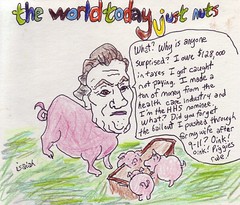
Isaiah's The World Today Just Nuts "The Greedy Pig" is another funny one about another one of Barack's tax cheats that he's trying to get put on the cabinet. Poor Barack. He knows so many tax cheats. What does that say about Barry?

Did anyone catch that awful Matt Lauer interview yesterday? C.I. covered some of it this morning in "Matt Lauer is not Barack Obama" and I wanted to cover a few things C.I. didn't. C.I. stuck with Iraq and also some of Matt Lauer's nonsense.

I want to first note Barack's nonsense. The man knows Jessica Simpson on site.

That's rather surprising. Or rather telling for a man his age. Second, who is he to repeat that Jessica Simpson is in a weight battle?

Staying with Barack, I guess it's that 'low key' look he's pushing for White House staff that led him to show up for the interview Sunday as if he were dressing Friday casual?

I really found that disappointing. I expect the president to try a little harder than that and on a Sunday?

I know Barack's not a Christian. But he pretended he was one to get votes. Barry, Christians put a little more thought into Sunday clothes.

(I am not calling Barack Muslim. I believe he's a non-believer in any religion. He's not a Christian because he wasn't baptized. In the Church of Christ, that is a requirement for salvation. By the way, has Barry rushed to find a DC church yet? Last I heard, it was a no but I haven't thought about that in weeks.)

Matt Lauer time. Matt, no one gives a damn about your son Jack except you and his mother.

You were a goon, an idiot and a loon. You didn't need to make it even worse by joking about (and with) your (off camera) son Jack. It wasn't funny.

And who goes for funny when they're interviewing the president of the United States?

Did Matt Lauer think he was Jon Stewart?

That whole interview was sad and unprofessional on both sides.

Sad and unprofessional is Diane Silver, a White lesbian who pens "Political I.Q. - What Gays Owe Black America." The title makes you think it might be worth reading and then you find out it isn't. Silver says that a faulty poll led to the impression that African-Americans had a responsibility in Proposition 8 in California but she won't explain that, she writes, she'll leave it to others. Because the damn asshole knows the polling was correct.

I've had it with that revisionary bulls**t. We know what happened and those 'polls' were promised -- the news ones -- and never showed up. Just a damn piece of crap item that all the Whiteys in the gay universe seemed to need to pimp.

I'm African-American and I'm a lesbian. Whitey, go tell someone else about the homophobia in the Black community. I know it exists, you damn liars.

But queer America needs to understand one other important fact, and we need to get it now. If the civil rights movement had never happened, we probably wouldn’t have the few rights we enjoy today.
[. . .]
Today you, I, and every other lesbian, gay, bisexual, and transgendered soul stand on their shoulders. (Let’s also not forget that civil rights activists who were both LGBT and African American, like Bayard Rustin, helped build that foundation. Among other accomplishments, Rustin organized the 1963 march on Washington.)

I love how Whitey Silver wants to excuse things on religion (read her crap article) if it's the Black church. No, you f**king ass, that excuse doesn't cut it and it hurts people. It may not hurt your White ass because you probably don't hang around people of color. But it hurts me. So stop your damn lying.

As for standing on shoulders, Ass, when people want to start admitting that the Civil Rights movement and Ghandi stand on the shoulders of the suffragette movement, I'll feel we've seen a change. Until then? Don't need to hear Whitey going on and on.

In fairness, I should note that if you live in Honky Town like Diane Silver, the article may seem 'progressive.' I'm sure many (though not all) Whites reading it would think it was 'progressive.' But informed Whites and most African-Americans will grasp why I think Diane Silver needs to find a topic to write about that she actually knows a thing or two about.

Here's C.I.'s "Iraq snapshot:"

Monday, February 2, 2009. Chaos and violence continue, a faux commission shuffles paper in public today, provincial elections took place Saturday in Iraq and the counting continues, and more.

Last year, Alex Gibney's amazing
Taxi to the Dark Side won the Academy Award for best documentary beating out the empire project builder No End in Sight. No End in Sight wasn't just a badly made documetary -- a director needs not a sense of the visual -- it was a bad documentary. Many alleged 'anti-war' types tried to praise that piece of garbage as 'anti-war.' The Council on/of/for Foreign Relations director of the propaganda film not only supported the illegal war before it started, he supported it while making the film, he supported it while promoting the film. It takes a real idiot to claim that film was 'anit-war.' No End in Sight argued not against the Iraq War or war itself. No End in Sight advanced the argument that the 'problem' with the Iraq War was that there wasn't 'better' planning. That argument is not an argument to stop illegal wars, it is an argument to work harder on them in the pre-war stage.

As someone who rallied friends to vote for Taxi to the Dark Side (and voted for it myself), I do take joy out of No End in Sight going down in flames. But there's a point to sharing that story (again) today. The Commission on Wartime Contracting (CWC) ("In Iraq and Afghanistan") held their first hearing. They would be, they insisted, like the Truman Committee. It was not like the Truman Committee. It was like the propaganda of No End in Sight. The Truman Committee, actually the Senate Special Committee Investigating National Defense, found fraud, graft and cost overruns and dealt with them, saving the United States billions. The
Institute for Policy Studies' Sarah Anderson explained in 2006 that the committee "called 1,798 witnesses for 432 hearings and issued 51 reports." This committee is only required to release two reports. It may exceed that, but that is all that's required. As for duties, CWC explains it this way, "The law establishing the Commission defines a broad and substantive mandate. The Commission is required to study, assess and make recommendations concering wartime contracting for the reconstruction, logistical support, and the performance of security functions in Iraq and Afghanistan. The Commission's major objectives include a thorough assessment of the systematic problems identified with interagency wartime contracting, the identification of instances of waste, fraud and abusue, and ensuring accountability for those responsible."

Karen DeYoung and Walter Pincus (Washington Post) reported before the hearing that among those offering testimony would be Special Inspector General for Iraq Stuart Bowen and the SIGR is publishing Hard Lessons, a new book by Bowen on the money wasted, today. Dieter Bradbury (Portland Press Herald) reported that US Senator Susan Collins will be among those offering testimony today: "Collins has overseen investigations into government contracting as ranking member and former chairman of the Senate Homeland Security and Governmental Affairs Committee."

What might have seemed promising quickly became the joke everyone in DC thought it would be. Commissioner Linda J. Gustitus at least attempted to make it appear there was some teeth to the commission. She noted that "it wasn't ignorance" that led to the waste of US tax dollars in Iraq, "the [Bush] administration knew from the very beginning that security was going to be a big issue." She went on to site Bechtel's pre-war study which found Iraq's crumbling security would result in huge costs. She noted that "half of the cost -- half of the fifty billion we've spent -- went to security." She noted years into the Iraq War, the Iraq Study Group would find "no clear lines establishing who is in charge of reconstruction -- that's four years in." The 'lessons' from the Iraq War were things "we already knew before we went into Iraq but the administration chose to ignore them."

If that statement bothers you, it should. The problem with the Iraq War is that it's an illegal war built on lies. It does not meet -- nor did it ever -- the definition of a just war. It was a war of choice built on deceit. The commission might try to argue, "We're looking into monies." You're making statements that go far beyond money.

A great deal of time was spent by the commissions spit-polishing Colin Powell -- known LIAR to the United Nations. Poor Collie, or Collie told us, or Collie said. Collie, Collie, Collie. Trash, trash, trash. His "blot" will not go away even when laughable "commissioners" spend all their time trying to pretend he's a respected voice of authority. He has no authority, he has what he's defined as a "
blot." His words about his lying performance before the United Nations in which he sold lies about the then-impending war, "Well it's a, it's a, of course it will. It's a blot. I'm the one who presented it on behalf of the United Nations, uh, United States, to the world. And it will always be, uh, part of my, uh, my record." Always be part of his record? The Commission on Wartime Contracting didn't think so.

But why would it? Look at the commissioners and marvel that such a bunch of losers -- so tied to the illegal war -- could be appointed to in any way review it. Throw a dart at the board and see it who it hits. Dov S. Zakheim! Dov is PNAC. Dov signed the PNAC statements (PNAC pushed the illegal war starting in the nineties, they are the neocon think-tank). Is the problem the Bush administration as Commissioner Gustituts indicated? Then why is Dov showing up as a commissioner and not as a witness? Dov was one of George W. Bush's foreign policy tutors in 1999 and 2000 -- along with Condi Rice, Richard Perle, Stephen Hadley, Paul Wolfowtiz and Robert Zoellick. When their pupil was elected, Dov found a job in the Defense Dept where he was the chief financial officer. And he's a commissioner? He was the chief financial officer in 2003 and he is a commissioner? He's evaluating the actions that include his own actions?
The commission is a damn joke.and putting people like Dov on it ensure that it remains one. But it's like No End in Sight, it's about building a better empire. That became clear repeatedly as Iraq was treated as nothing but a failed experiment to learn from. (What a joy to Iraqis! They were reduced to mice in the laboratory!) Clark Kent Ervin tossed around a lot of phrases ("unity of command," "coherent mission statement," "cost-plus contracts," etc.) and wanted to know what Iraq means for Afghanistan. Or as Dov put it, "What's already changed on the ground that could help us in Afghanistan? . . . what could be a big help in Afghanistan?"

SIGR's deputy Ginger Cruz gave testimony and managed to offer a little more about Iraq than many. She noted that the "the true costs are unknown" because reconstruction was done by private contractors working in Iraq and their work is done "in a pocket [of security] created by the US military." The cost of the reconstruction, Cruz noted, did not include the cost for the security provided by the US military. So "costs could escalate dramatically" if "we have to use private security" to create those safe 'pockets' for reconstruction to take place in.

One section of interest was during the opening statement by DoD Deputy Inspector General Thomas F. Gimble 's comments regarding Commander's Emergency Response Program (CERP):
CERP funds are appropriated through the DoD and allocted through each major command's sector of operations in Iraq and Afghanistan. Up to $500,000 can be allocated to individual CERP projects, and CERP beneficiaries often receive payments in cash. We have also identified occasions where soldiers with limited contracting experience were responsible for administering CERP funds. In some instances, there appeared to be scant, if any, oversight of the manner in which funds were expended. Complicating matters further is the fact that payment of bribes and gratuities to government officials is a common business practice in some Southwest Asia nations. Taken in combination, these factors result in an environment conducive to bribery and corruption.

Remember Gimble's claim that up to $500,000 in CERP funds can go to a single project, we'll come back to that in a minute. CERP was an issue during the
September 10th House Armed Services Committee hearing (and see this entry by Mike). This is Committe Chair Ike Skelton's exchange with DoD's Under Secretary of Defense for Policy Eric S. Edelman:

Ike Skelton: The department's understanding of the allowed usage of CERP funds seems to have undergone a rather dramatic change since Congress first authorized it. The intent of the program was originally to meet urgent humanitarian needs in Iraq through small projects undertaken under the initative of brigade and battalion commanders. Am I correct?Edelman: Yes, sir.Ike Skelton: Thank you. The answer was "yes." Last year the Department of Defense has used millions of CERP dollars to build hotels for foreign visitors, spent $900,000 on a mural at the Baghdad International Airport and, as I understand this second piece of art, that CERP funds were used for. I'm not sure that the American tax payer would appreciate that knowing full well that Iraq has a lot of money in the bank from oil revenues and it is my understanding that Iraq has announced that they're going to build the world's largest ferris wheel. And if they have money to build the world's largest ferris wheel why are we funding murals and hotels with money that should be used by the local battallion commander. This falls in the purview of plans and policy ambassador.Edelman: No, no, it's absolutely right and I'll shae the stage here -- I'll share the stage quite willing with uh, with Admiral Winnefeld with whom I've actually been involved in discussions with for some weeks about how we provide some additional guidance to the field and some additional requirements to make sure that CERP is appropriately spent.Edelman then tries to stall and Skelton cuts him off with, "Remember you're talking to the American taxpayer." Edelman then replies that it is a fair question. He says CERP is important because it's flexible. It's important because they're just throwing around, if you ask me. They're playing big spender on our dime.Skelton: The issue raises two serious questions of course. Number one is they have a lot of money of their own. And number two the choice of the type of projects that are being paid for. I would like to ask Mr. Secretary if our committee could receive a list of expenditures of $100,000 or more within the last year. Could you do that for us at your convience please?Edelman: We'll work with our colleagues in the controller's office and - and . . . to try and get you --Skelton: That would be very helpful.
The CERP funds are not being tracked. They haven't. Congress has repeatedly raised this issue. As for the claim of "up to $500,000," that's a confusing remark considering that the [PDF format warning]
October 30th report from the SIGIR declared, "The recent Duncan Hunter National Defense Authorization Act (NDAA) for Fiscal Year 2009 imposed a ceiling of $2 million on the amount of CERP money that DoD could allocate to a single project. The new NDAA futher requires the Secretary of Defense to approve CERP projects costing over $1 million, certifying thereby that the project will meet Iraq's urgent humanitarian relief or reconstruction needs." Why did no one follow up to ask exactly when the 2009 budget was 'updated'? Or, for that matter, how it was 'updated' after it was passed by Congress and signed into law by the White House?\

Overall the disappointing hearing was nothing but the Empire Project regrouping to figure out how to take the failed empire building in Iraq and turn it into a success in Afghanistan. The commission had their first hearing today and lived up to all the ugly whispers and jokes almost immediately. And if you're not getting how pathetic the commission is and how derelict in their duties the US Congress is being, let's note two things. First, from the
Jan. 27th snapshot: "Was the illegal war legal under international law? The BBC reports that the Information Tribunal has decided that the cabinet meetings (Tony Blair's cabinet meetings) must be released. Rosa Prince (Telegraph of London) adds, 'Downing Street refused to reveal whether it would comply with the ruling by the Information Tribunal, which follows a long-running legal battle to keep details of the meetings secret'." Second, Reed Stevenson (Reuters) reports today. "Dutch Prime Minister Jan Peter Balkenende ordered on Monday an independent commission to examine the government's decision to support the U.S.-led invasion of Iraq in 2003." Jurjen van de Pol (Bloomberg News) notes, "The independent commission, led by former Dutch Supreme Court President Willibrord Davids, will seek to complete the investigation before November and will inform parliament and government of the outcome". Radio Netherlands Worldwide adds, "The Prime Minister has consistently refused to agree to a full parliamentary inquiry in the matter, saying that all information about the decision to side with the Americans and the British is known already."

Yesterday,
Matt Lauer offered the equivalent of journalistic footsie with US President Barack Obama on NBC (link has text and video):

Matt Lauer: Let's talk about some of those men and women who are serving this country overseas in Afghanistan, other locations, in Iraq and I'm sure they're watching today. It's a big event for the armed services and a lot of those people have a vested interest in one of your campaign promises, to end this war and get home as soon -- within 16 months or so -- as humanly possible. So when you look at them, can you say that a substantial number of them will be home in time for next Superbowl Sunday?Barack Obama: Yes, uh, er, I mean we're gonna roll out in a very, very formal fashion what our intentions are in Iraq as well as Afghanistan. But in conversations that I've had with the Joint Chiefs, with people -- the commanders on the ground, uh, I think that we have a sense, now that the Iraqis just had a very significant election, with no significant violence there, that we are in a position to start putting more responsibilities on the Iraqis and that's good news for not only the troops in the field but their families who are carrying an enormous burden.

That's the entire Iraq 'exchange' and despite the efforts of reporters to put Lauer's words into Barack's mouth, Barack's reply does not indicate what they've endlessly hyped. Barack's words are also remarkably similar to the previous White House occupant's words -- in tone and the fact-free nature. There were tribal fights, bombings, and much more during the elections.

Saturday in Iraq, provincial elections were held in fourteen of Iraq's eighteen provinces. In his January 10, 2007 radio address, George W. Bush declared, "To empower local leaders, Iraqis plan to hold provincial elections later this year." Two years later and they still weren't able to meet the benchmark of provincial elections in all the provinces. Though the three provinces that make up the KRG did not hold elections, the
Kurdish Regional Government did issue a statement Saturday noting, "Although there are no elections scheduled in the three KRG goernorates and Kirkuk, the KRG supports all citizens who are voting today and is facilitating the voting process for those displaced individuals currently residing within the Region but casting absentee ballots for their original districts. In Suleimaniah, Erbil and Dohuk there are 15, 23, and 33 voting centres, respectively." Reuters reports today the Kurdish Naional Assembly Speaker Adnan Mufti announced that the Kurdish region will hold their elecitons May 19th. That would still leave Kirkuk out of the mix.

There were 14,428 candidates vying for 440 seats. Saturday the print version of the New York Times included a look at three of the candidates. Sam Dagher profiled Zeinab Sadiq Jaafar, an attorney running in Basra: "Over the last month, she hunted for votes in the city's worst neighborhoods. An independent, Ms. Jaafar makes the case that she is an 'authentic' daughter of Basra who better understands her city's anxieties and needs. She empahsizes that unlike many candidates, she is not backed by some big shot from Baghdad. She also wants to prove that women can compete and win in politics in Iraq on their own merit. Alissa J. Rubin profiled Haithem Ahmed Alam Khalaf who is a "38-year-old sheik" and is running in Abu Ghriab. He says: "There were many violations of human rights in our area by the Iraqi Army; it is better now, but honestly, the official departments of the government were not at the level we were expecting." He's an "Awakening." Timothy Williams profiled Khalid Shakar al-Dulaimi who is a 44-year-old man running in Baghdad and is running as a member of the Gathering of Iraqi Nationalists and Labor. He states: "The Sunnis and Shiite religious parties failed their opprotunity and involved the country in unrest. People want new faces and new ideas." The paper provided these
graphs regarding the elections. Timothy Williams predicted that the campaign posters will be the visual image of these elections (while the ink stained fingers were the visual in 2005). He covers expectations as well. Alissa J. Rubin and Sam Dagher explore Moqtada al-Sadr's low profile which includes no slate of candidates but "the movement is backing two parties." Those who prefer audio, click here and scroll down the left side of the page for Alissa J. Rubin offering analysis of the players.


The
New York Times live blogged the elections (the live blog is one continuous entry in terms of link, they break it up into sections but it's one link and you scroll through). Correspondent Mohammed Hussein wrote of walking over three miles and visiting four polling stations before he was allowed to vote -- repeatedly he was told he wasn't on that polling station's list. At the fourth station, he wasn't sure of the nominees listed. His wife gave up after repeatedly bing told she wasn't on that station's list to vote. Hatim Hameed tells the paper of experiencing similar problems in Falljua where it took trips to five polling centers "before I found my name. I had to walk for more than an hour." And, Abu Abdullah al-Jubouri explained, "There is no transportation to bring people to the voting centers. Don't they think about how the people will get to the places where they have to vote? I'm going to vote by myself because I won't bring my family that far." In today's paper, Stephen Farrell and Alissa J. Rubin report Nasreen Yousif went to three different polling centers in Baghdad before she gave up, "Now I am going home. Maybe there is a fourth school, but it is too far and I can't walk anymore." At the paper's blog, Timothy Williams explains western Baghdad voters were searched three times before they were even allowed to enter the polling center.

The paper's
Alissa J. Rubin observed Sunday, "In the United States, many Americans view the war as already over, even though more than 140,000 American soldiers remain on Iraqi soil." Omar al-Dulaimi offers his take on the illegal war, "The American military presence brought nothing to our streets but destruction and chaos." Stephen Farrell and Rubin noted of Saturday, "Driving was banned in most of the country to prevent suuicide bombers from attacking any of the more than 6,000 polling places and security checkpoints, often spaced just yards apart. The tight security, couples with confusion over where voters should cast their ballots, appeared to have reduced turnout in many districts across the country." They estimate Nineveh Province saw 75% turnout of registered voters while Basra saw only 50%. Deborah Haynes (Times of London's Inside Iraq) reported on one get-out-the-vote attempt: texting:I was being inundated, like everyone else in Baghdad, by mass text messages from hopeful candidates pitching for votes ahead of provincial elections tomorrow. A confusing array of more than 14,400 candidates from 407 different parties, independent entities and individuals are vying for just 440 seats on 14 provincial councils across the country. In a bid to make sense of the huge choice, the candidates are on lists -- either independent or for a party. The list has a number, which is what I stupidly mistook to be the varying price of my monthly phone bill.One voter-wooing text (received multiple times) read like this: "Vote for 302, the list of Prime Minister Maliki who achieved security and restored national sovereignty." Another one went: "With your vote we will hold them accountable and build our country. Elect from the list of Mithal Allusi, 292."A third message (I could go on forever) read:"Vote for a Baghdad with everyone living with freedom and security. Tawafuq 265." The votes are still being counted but AP notes election commission chair Faraj al-Haidari estimates turnout across the country to be at 51%. al-Haidari is an ass who won't take accountability, "It's not our fault that some people couldn't vote because they are lazy, because they didn't bother to ask where they should vote." If the percentage remains low when all votes are counted, that not only rejects the hype that the elections had captured Iraqi's fascination and that they were wild to vote. The reasons for the low percentage -- if that number holds -- may include not feeling vested in the puppet government or in their occupied country, not trusting the system or voter suppression. Votes can be suppresed, as 2004 voters in Ohio can attest, if you create chaos and frustration. Certainly having people forced to walk from polling station to another repeatedly and requiring they be frisked multiple times before enterting each polling center can be seen as security or as harassment. Leila Fadel (McClatchy Newspapers) pins it on reluctance to embrace 'democracy' on the part of Iraqis (how could they embrace what they don't have?) and she notes, "Voter turnout in Iraq's provincial elections Saturday was the lowest in the nation's short history as a new democracy despite a relative calm across the nation. Only about 7.5 million of more than 14 million registered voters went to the polls." It's cute the way the press reported nearly 15 million registered voters when they thought the turnout would be huge and now that it wasn't huge, they stop using "nearly 15 million" to run with "more than 14 million".Ahmed Rasheed, Waleed Ibrahim, Michael Christie, Missy Ryan and Katie Nguyen (Reuters) cite "voter registration problems and tight security" as the reasons for the low turnout. They also note that 2005's provincial vote saw 76% of registered voters participating. Remember that. Today the votes are still being counted. (Maybe some news outlet can live blog that?) Turnout was very low despite talk during the lead up. Monte Morin (Los Angeles Times) explains, "Just over half of Iraq's 15 million registered voters cast ballots in weekend provincial elections, with turnout as low as 40% in at least one province, but Iraqi and international officials insisted Sunday that they were satisified with the participation." Morin notes that "turnout failed to reach the 73% predicted by a recent government poll of 4,570 Iraqis." Alissa J. Rubin (New York Times) examines the preliminary results and notes winners appear to be "several secular parties" and Nouri al-Maliki, puppet of the occupation. These are preliminary results, as Rubin points out, not official ones. She explains, "The Americans had pushed for the provincial elections as a way to redistribute power more evenly throughout the country after many Iraqis boycotted the last elections in 2005. It was unclear whether a lower-than-expected turnout, at 51 percent nationwide, would curb hopes that all Iraqi sectarian and ehtnic groups could be more accurately represented." Rubin states that Sunni participation was higher throughout Iraq than it was in 2005 (but at 40% in Anbar -- we'll come back to Anbar at the end). So Sunni participating increased and Shi'ite participation drastically fell? That is the conclusion one would have to draw. Remember that 76% of registered voters participated in 2005. The results, when known, will be interpreted in various ways. Ernesto Londono (Washington Post) explains, "For the northern provinces of Iraq, the outcome of elections held Saturday will provide the first snapshot in decades of demographics and loyalties in areas that have become the subject of a visceral dispute between Arabs and Kurds. Newly elected leaders in these provinces, where Sunni Arabs are widely expected to gain political power, will be thrust into the debate over whether disputed territories, including the oil-rich city of Kirkuk, should be annexed to the Kurdistan Regional Government." Saturday, the KRG declared, "Unfortunately the KRG notes its great concern that thousnads of Kurds in Ninewah, Makhmour and Khanaqeen were unable to exercise their right to vote due to a logistical mix-up by the Independent Electoral Commission." Nineweh is a region the Kurds are thought to want, Mosul is the capitol of the province. The Los Angeles Times covered Mosul vote: "Hisham, an Iraqi Kurd, had watched as his city fell apart. His Kurdish, Christian and Shiite friends fled, but he resolved to stay on. Slowly, he came to resent the Kurdish parties that governed Mosul. So Hisham voted Saturday in favor of the Arab nationalist Hadba party. He saw the vote as a way to bring the city back to what it was before 2004, when he lived in peace with all his neighbors -- before Islamic militancy and ethnic tensions ravaged Mosul." Mosul is where Iraqi Christians were under attack in the second half of 2008 and had to flee. Kim Gamel (AP) also reported on Mosul and quoted Bassem Bello, "It's better at this point but we paid a high price for it. We're working very hard to make sure it doesn't happen again." Leila Fadel (Baghdad Observer, McClatchy Newspapers) quotes Nineveh Province's Leila Solaiman Mohammed who states, "I voted for the Fraternity of Nineveh (Kurdish slate) because it represents my race and we hope it would help us get our rights as Kurds. We want to live in peace like others." Meanwhile Fadel al-Badrani (Reuters) reports that, in Anbar Province, "Tribal sheikhs who helped drive al Qaeda militants out of Western Iraq threatened on Monday to take up arms against the provincial government because of what they said was fraud in Saturday's provincial polls."
Today's reported violence including many bombings . . .


Laith Hammoudi (McClatchy Newspapers) reports a Mosul roadside bombing today that claimed 3 lives ("the father, the mother and their son"), another Mosul roadside bombing that left two police officers injured and a Baji roadside bombing that left two Iraq service members wounded. The Los Angeles Times reports an Iraqi child and the father of the child are dead. They were killed by the US military when the US military struck their car. Why the convoy struck the car and whether six more Iraqis were wounded (US version) or nine more Iraqis were killed (Iraqi officials version) is not known: "There was no way to reconcile the different accounts."

And Sunday the
US military announced: "A U.S. Soldier died as a result of a non-combat related injury in Kirkuk, Iraq Jan 31. The name of the deceased is being withheld pending notification of next-of-kin and release by the Department of Defense. The incident is under investigation." The announcement brought the number of US service members killed in Iraq since the start of the illegal war to 4237.

In the United States,
Iraq Veterans Against the War announces:
IVAW Participates in Historic Iraqi Labor Conference
IVAW will be traveling with a U.S. labor delegation to participate in the First International Iraqi Labor Conference in Erbil, Iraq, which takes place from February 27-28. The conference will bring together trade unionists from across Iraq with international allies from labor movements around the world. The objectives of the conference are: (1) to unify the Iraqi labor movement; (2) to increase pressure on the Iraqi government to enact a labor rights law that conforms to all international standards in the International Labor Organization Conventions on the Rights of Workers; (3) to defend Iraqi national resources and public assets against foreign acquisition; and (4) to demand restoration of full sovereignty, which can only be accomplished by ending the occupation and removing all foreign troops and bases.


iraq
iraq veterans against the war
the washington postkaren deyoungwalter pincusdieter bradbury
the los angeles timesmonte morinthe new york timesalissa j. rubin
the washington post
sam daghertimothy williams
deborah hayneskim gamelstephen farrellleila fadelmcclatchy newspaperssahar issalaith hammoudimohammed husseinrick mazeahmed rasheedwaleed ibrahimmichael christiemissy ryankatie nguyenned parkerusama redha