Wednesday, September 30, 2009

Grab bag

Starting by noting Elaine's "FSRN, WTH?" which I just love. Elaine only does posts like these about every two weeks. She could do them every post; however, she's just not interested in picking up outsiders as readers. (Her posts that aren't like yesterdays? They're enjoyable as well. But they're more talking posts.)

Okay, let's turn to ObamaBigBusinessCare. Nicole Gaouette and Ryan J. Donmoyer (Bloomberg News) report:

U.S. Senate Finance Committee Chairman Max Baucus and fellow Democrats pledged to find a way to shield even more retirees and union workers from a tax on the most expensive health-care plans.
The panel, meeting for a sixth day to debate Baucus’s health-care legislation, discussed the issue at the request of Senator
John Kerry, a Massachusetts Democrat who proposed the tax in July. Kerry said he was concerned that the levy, already modified once by Baucus, would still affect too many people.
The “Cadillac” tax represents the next major battle for insurers, who won a victory yesterday when the panel rejected proposals to create a government-run insurance program to compete with them. Kerry today asked panel members to craft the tax in a way that wouldn’t hurt union workers in “high-risk” industries such as coal mining and firefighting.


I'm really lost as to when something is added that benefits us the people.

So they're going to add a tax and they're debating how much to tax us.

And who to tax.

And this is going to benefit us how?

And mandatory insurance is going to benefit us how?

Let me be Kanye, Barack Obama hates Black people.

I was laughing my ass off during Jay Leno's opening night, by the way. I don't know if people caught it but Kanye's a Barry O freak and he and that ugly ass Jay Zee (Beyonce's gotta be gay to be pretending to hit that -- Beyonce, call me). So at the end of the performance he's flashing the Barry O salute that they were trying to turn into the new Hitler salute back in 2008. And he's flashing like the biggest fool in the world cause Barack's already told John Dickerson or John Harwood (I get the Bobsie Twins confused) that Kanye was a "jackass."

Ha ha ha.

I love that.

Here's C.I.'s "Iraq snapshot:"

Wednesday, September 30, 2009. Chaos and violence continue, General Ray Odierno appears before Congress to discuss Iraq, US Ambassador to Iraq Chris Hill sends out foul mouthed e-mails to the press, and more

Today in DC, General Ray Odierno, the top US commander in Iraq, testified before the House Armed Services Committee. The chair of that committee, US House Rep Ike Skelton, offered opening remarks that had something worthy of highlighting in every paragraph. We'll focus on a paragraph near the end because it's one the immature don't want you to hear.

Chair Ike Skelton: Finally, the US and Iraq will have to determine our future relationship. Many view January 1, 2012, as a date when our relations will transform instantly to a normal bilateral relationship. In some ways, that will likely be true. But in other ways, it may not be. Iraq will be incapable of providing fully for its external defense. Iraq may well continue to need help developing some aspects of its security forces. And we will continue to have interests in ensuring a stable Iraq, that doesn't threaten its neighbors or undermine other regional goals.

You probably won't hear about that portion of Chair Skelton's remarks -- despite the fact that the opening statement was widely distributed to the press. It's more important to the press that sold you the illegal war to begin with that you be sold (repeatedly) on the (false) notion that the Status Of Forces Agreement (SOFA) means the war ends and all US troops come home (or all US troops come home except the ones guarding the US Embassy in Iraq). That's not what the SOFA means. It's never been what it meant. In some ways the press is trapped in their own lies. Only the Washington Post got the SOFA right in November of 2008. The Los Angeles Times came close, but it didn't grasp it as fully as the Post did. The New York Times completely misunderstood the agreement (though Elizabeth Bumiller's reporting a month and two months after would attempt to correct the paper's misrepresentations) and McClatcy didn't have a damn clue. Leila Fadel was over her head. She was on a high as she'd semi-confess in "
A reporter's farewell to Iraq," last August, too late to fix the immense damage she'd done in reports she filed and interviews she gave. "For a few months," she'd confess, "I had hope that things might work out." As many members of the Cult of St. Barack have discovered, hope doesn't pay the bills, hope doesn't put food on your table, hope doesn't put a roof over your head, and hope doesn't get the US out of Iraq. McClatchy gave us Leila The Hopeful when what the country most needed was a functioning reporter.

Let's quote Ike Skelton one more time, "Many view January 1, 2012, as a date when our relations will transform instantly to a normal bilateral relationship. In some ways, that will likely be true. But in other ways, it may not be. Iraq will be incapable of providing fully for its external defense." When you hear a liar telling you the SOFA means the war ends and the US comes home at the end of 2011, you need to ask, "Gee, then what did Ike Skelton mean?" In fairness to the Real Press, the bulk of the loudest and worst liars on the SOFA were beggars in
Panhandle Media -- at The Nation, at Pacifica, etc. Some are such liars and/or fools, they forget their own lies. Earlier this month, Ava and I wrote "TV: The Suckers" which included, "Now what the treaty (Status Of Forces Agreement) does is what it was meant to, ease heat in the US over the illegal war. It's done that. It's led to so many fools and liars proclaiming the Iraq War over or almost over: Tom Hayden, CODESTINK, Raed Jarrar, throw a dart at the fringe radical and you'll draw blood from a fool swearing the Iraq War is over or about to be."

This led to Raed Jarrar insisting that we had misunderstood him. No, we hadn't. If you can't keep track of your lies, that's probably the first sign that you have a problem. In "
Raed Jarrar tries to 'correct' Ava and C.I. (Dona)," Dona pointed out that even as she wrote, you could go to Raed's website and see X number of days to go until the Iraq War ended ("839" in Dona's screen snap). That's from Raed's site. He pimped the lie over and over that the SOFA meant the Iraq War ended and he added that tacky, lying counter to his website which provided a visualization of the lie. We knew what we were talking about, Ava and I. We always knew what the SOFA did and did not do. Raed? We'll be kind and just say he must be confused.

Today General Ray Odierno read word for word over the lengthy prepared statement that he and the White House wrote (the press may not tell you about White House involvement -- but first clue for those who can't grasp reality: If he wrote it, he wouldn't have stumbled over so many words while reading it). The thing to note from it is that Odierno lists Iraqi Security Forces of being "approximately 663,000 strong" with "245,000 soldiers and over 407,000 police." Otherwise, not much to note depite the fact that he was twenty-four seconds shy of 20 minutes when he finally finished reading his prepared remarks.

Odierno noted in reply to a question by Skelton that he has "the flexibility to speed up or slow down" the draw-down based on what he sees. Ranking Member Howard McKeon asked Odierno to walk through the election process in Iraq, noting that it is different than what those in the United States might be used to.

General Ray Odierno: I'll wal -- Congressman, I'll walk you through in general terms. First, the el - by the [Iraqi] Constitution, the election is supposed to occur no later than the 31st of January. Right now, it's scheduled for the 16th of January. Again, pending the passing of the election law. Once the election is completed, they take 45 days to certify the results of the election. And so what happens is we'll have hundreds of international observers -- maybe thousands, there's going to be quite a few international observers -- as well as the Iraqi High Electoral Commission will certify the results, they will take all complaints and then they will deem the elections to be credible, legitimate or not. That takes forty-five days. Once that happens, you then have thirty days to begin the formation of seating the Council of Representatives. You then have another thirty days to then select the leadership, the presidency, and then you have another time period to select the prime minister and then the Speaker [of Parliament]. So within that time period, we expect that it will take from January to June or so, maybe July, to seat the new government. In 2005, following the elections, the government -- the elections were in December and the government was seated in May of 2005 [C.I. note, he means May of 2006]. This is the Parliamentary system of government and it just takes time for them to do this. So it's -- there is timelines on it, they will follow those timelines strictly, but it will take time to seat that government.

US House Rep. Howard McKeon: Based on that timeline then, you're comfortable keeping combat troops in -- in the country until August and that will be sufficient and you're -- you're --

General Ray Odierno: I do.

US House Rep. Howard McKeon: -- comfortable with being able to pull them out securely at that time?

General Ray Odierno: I do, I do. You know I look at the first sixty days or so following the election as maybe the most critical time if we think there may be some form of violence following the election as the results are certified. Our experience in the past have been if -- within the sixty days, that's when you'd see some level of violence. So that allows us, I think, to make sure that we believe this will be a peaceful transition of power that we expect. But that will allow us to ensure this peaceful transition of power and then that allows us to draw-down as they seat the government.

US House Rep Michael Conaway would also follow up on the elections issue. He wondered what other risks might prevent elections from being held on time. "As I was going to say," General Ray Odierno began, "if we get the election law passed, I believe, unless there's some unforseen event that would happen -- and I have trouble getting my arms around what that might be, I really believe the elections will occur on time. Unless there's something that caused a large amount of sectarian violence to break out between now and the elections. But I just don't see it because the Iraqi people don't want to go there. They are tired of that and they want to move forward." The issue of the Kirkuk was discussed.

US House Rep Loretta Sanchez: General and Mr. Secretary, I'd like both of you to answer this question. General, at the end of July, you and Secretary [of Defense Robert] Gates visited with Kurdish leaders in Irbil and you were widely quoted saying that the Arab-Kurd tensions over disputed internal boundaries and natural petroleum policy were the biggest problem facing Iraq. In fact, you said, "Arab-Kurd tensions are the number one driver of insecurity." And yet this morning when you began and you talked about the drivers you didn't mention this. So my questions are: do you still believe that the number one driver is insecurity -- or do you still think it's up there -- and what measures have been taken to manage and to reduce the tensions that are going on? And, of course, Article 140 of the Constitution of Iraq provides for a phased process of normalization, census and referendum to determine the final boundaries of the Kurdish Region within a democratic process. But some have said to me that they think the US has to be more active in getting this 140 Article issue done, this process done. In fact, when I asked Secretary Gates in front of this committee, he said that, "The US fully supports Article 140." And so my question is: How involved are we in that? What are we doing to push these sides to get to a resolution under the Constitution? And if, in fact, we're going to have a responsible withdrawal, don't you think that getting that Article 140 process done is almost a pre-condition for us to be able to remove troops and make sure that these ethnic issues are taken care of? And, um, why is 140 stalled? And what are we doing to-to move it in the right direction?


General Ray Odierno: Thank you, Congresswoman. I still believe that Arab-Kurd tension is the number one driver of instability inside of Iraq. I mentioned it. I might not have said it was number one. But I did mention it. Uh-uh and this is long standing problems over land and resources and-and the distribution of those in these key areas that have been going on for hundreds of years in-inside of Iraq between the Kurds and the Arab population. The Article 140 process back in December '07 -- actually did not get finished by December of '07 which was the date on the original Iraqi Constitution -- was supposed to be finished. And when that happened what happened is we formed a UN -- uh -- the UN took over trying to renegotiate and get the sides together. So we have a UN commission now that is working very hard between the government of Iraq and the Kurdistan Regional Government to try to uh come to -- come to some agreement with these very difficult issues regarding disputed areas in terms of boundaries as well as a sharing of hydrocarbons and resources. So what we're doing -- what we're doing is we are fully in support of that effort. We support the UN, we engage with both the government of Iraq and the KRG on these issues to make sure they continue to participate in this -- in this process. And this process will ultimately follow, hopefully, and cause the implementation of the 140 -- Article 140 and the resolution of these issues. In addition, we are attempting to work with the government of Iraq and the Kurdistan Regional Government to reduce tensions in the areas. Over the last year or so, on several cases, it's the US forces who have helped to reduce tensions between these groups. We now have them in discussion and they are trying to come up with some sort of an architecture -- security architecture -- that would reduce tensions between the Arabs and Kurds. So we'll be at such level that everybody understands that-that they will solve this problem through the political processes of the UN. And this is something that Iraq has to solve. This is an Iraq problem that the Iraqis have to solve. We have to be engaged at all levels and we will continue to be engaged at all levels.

Yes, Odierno does grasp the issue and the tensions. No, US Ambassador to Iraq Chris Hill doesn't. (Loretta Sanchez grasps the issue very well, just FYI.) The response from Odierno above was in marked difference from the responses on the issue Chris Hill gave Congress earlier this month. We'll come back to Chris Hill later in the snapshot.

US House Rep Susan Davis: I wanted to ask you about the Wall St. Journal reported yesterday that the Iraqis are having difficulty with their budget crunch [see Gina Chon's "
Iraq Is Struggling to buy Equipment"] and oil prices decreasing in purchasing equipment that they had already requested from the US government. And there are a number of issued combined with that. How difficult and how high a priority is it for us to get this straight? And are their policies that we should in fact be looking at right now that would allow them to purchase more of those in advance?

General Ray Odierno: We are -- I think it's very important. We've been working this for quite some time. First the uh Iraqi budget uh, you know, I know because of the price of oil their budget has decreased quite significantly. They're-they're MO -- they're combined MOD [Ministry of Defense] budget's about $10 billion a year. About 85% of that is fixed, non-discretionary and it has to do mainly with salaries and other things. So that leaves them a very small piece left to invest in modernization. They have already purchased several things such as patrol boats, uh, and many other army and some airforce equipment that they have to still pay. So almost all of their even discretionary income is-is-is taken up. So what I want to be able to do is assist them in some small ways -- by using stay-behind equipment. Potentially leaving for them As well as improving their ability not to have to pay all costs upfront for foreign military sales, where they can spread it over a longer time period --

US House Rep Susan Davis: As I understand it, they don't meet a number of the criteria --

General Ray Odierno: That's --

US House Rep Susan Davis: -- that we have.

General Ray Odierno: That's exactly right. They have to meet -- the IMF bank has to certify them. And, of course, they're trying to get through that certification by having enough reserves so that they get certified. So it's a very complex problem and we have things competing against each other. So we're trying to come up with many different ways to help them to get them the equipment we think is necessary to have a foundational capability by 2011. And part of that might be is we might have to -- you know -- what we believe is -- there's about -- in Fiscal Year '10 and '11, we think we need -- we have an acquirement of about 3.5 billion dollars that we need to help them in order to finish getting the foundational capacity that they need in order to have -- to be able to have security by 2011. And then we'll have to continue some sort of an FMF [Foreign Military Financing] program through the State Dept after 2011. And if we're able to do that, that will allow them to slowly build up and have the security capability necessary to protect themselves.

US House Rep Susan Davis: Thank you. I appreciate that. One of the things that must be frustrating is that violence does continue to flare from time to time and I notice that one of the high ranking Iraqi army generals was recently killed as well. I guess that was reported yesterday. What effect does that have in terms of the government? The army? Do you -- or is that -- have we gotten so numb to that now in a sense that it doesn't have the kind of impact --

General Ray Odierno: I think -- I think for the Iraqis -- First of all, that was a Brigade Commander that was killed yesterday up in Mosul. It has a -- you know, it does have an impact. Uh, the Iraqi security forces -- like our forces -- understand what their duty is and what their mission is. And they are very dedicated to providing security to their people and I have seen many acts of bravery by leaders -- Iraqi leaders -- and their soldiers. And-and-and in a lot of ways, they're no different from our soldiers when it comes to that. So they see that as their mission and they're trying to root out these last remnants of al Qaeda and insurgents and some of these difficult areas. The sad part, Congresswoman, is we continue to see these attacks against innocent civilians absolutely mean nothing to the outcome and all it does is kill innocent people. And it's frustration to us and it's frustrating to the Iraqis. And that's what we're trying to stop inside of Iraq now, these-these-these last bombings that occur, although much less frequently than they used to -- they still occur and kill many innocent people. And those are -- those are the kind of incidents we're trying to stop.

US House Rep Susan Davis: Are our civilians able to move freely, go down, have a cup of tea, at all to engage in an informal fashion yet at this point?

General Ray Odierno: They can but they can't. I would -- they can in order to meet with Iraqi officials. I-I would say you can but it's still a little bit difficult to move freely because they're targets -- is part of the problem.

On the above exchange, Odierno's belief in transitioning equipment over to Iraqis? Great. No point in bringing all of it back when most brought back will be immediately phased out as out-dated. Make a gift to the Iraqis, fine. But this idea that the Iraqis are going to get a loan for weaponry and it's okay because the payments won't be immediate but will be spread out?

I knew Cindy Crawford was working for Rooms To Go, but I had no idea Ray Odierno was. Regardless of whether payments are "spread out" or not, payments are due. The bill still has to be paid. Iraq is currently trying to break their finanical obligation to Kuwait. That's one. Two, Iraq can't afford to make the purchases now. What makes Odierno believe that they will be able to afford it in the future? Does he know something about the oil market? No, I don't think he does. But the point is, if you can't afford it today, don't buy on credit thinking you'll win the lottery and be able to afford it some day in the future. The budget is the budget. Revenues are what they are. You don't loan to people who can't afford to pay back a loan. The next step would be to consider whether the US should make a gift of it? ("It" being new weapons, not the equipment Odierno is speaking of leaving over there.) That goes to the US economy as does a loan. A gift would at least not require all the faux outrage needed for a loan (when Iraq doesn't pay back the loan, US officials take to the TV monitors to wonder why, why, why!). But this is billions. Odierno, who is not an economist or even an accountant, is stating it would be $3.5 billion. Which means it would most likely be twice that amount. Why does the US need to fork over that money?

That's the question that did not get asked.

Why does Iraq need $3.5 billion it doesn't have in order to 'save' the country? Who's the big threat there? They've got bombings? Yeah, they've had them throughout this illegal war. So? Does someone think Iran's going to come stomping in? Syria? What's the point of all this equipment because what it looks like -- and the reason the House didn't touch it -- is that Nouri's illegitimate and unpopular government needs the money not to defend itself from outside forces but to hold down their own people. And that's the observation then US Senator Joe Biden was making in April of 2008. And he and Russ Feingold were insisting this was exactly the position the US did not want to be in -- arming one side against the other. So before the US government even explores how to fund or not to fun the request, what the Congress needs to do is nail down why anything is needed? Iraq has failed to establish need. Odierno couldn't do it today before Congress. No debate on whether to gift or loan needs to take place until the need for the equpiment is established.

Ideally, we'll return to today's hearing later in the week (hopefully tomorrow --
Kat's offering observations about Odierno's testimony at her site tonight) and we can grab some other exchanges. US House Rep Mike Coffman, for example, asked some solid questions -- which Odierno answered specifically -- about the ethnic make up of the army and police. But let's grab Chris Hill. Whether you agreed with Odierno's conclusions or not, he did have his facts down. So different from Chris Hill's rude and unprepared testimony to the Senate Foreign Relations and House Foreign Relations Committees earlier this month. This week, Thomas E. Ricks (Foreign Policy) finally stumbles upon the reality re: Chris Hill. Sort of. Chris Hill was unfit for the post -- and has a personnel record which demonstrates that. He lacked the qualifications. He had no experience in the region. He has a long (documented) history of ignoring supervisors. And the rumors about his manic depressive state was already legendary long before he landed in Iraq. (And his MD may be why, despite promising Senator John Kerry that he would be on the next plane to Iraq as soon as he was confirmed, he waited several days before departing for Iraq.) In his hearings, he demonstrated no knowledge of the issues despite several weeks of prepping with handlers. He has no concept of Kirkuk, for example. At the hearings on his confirmation, his responses on Kirkuk were laughable. They were barely better at the start of this month. Contrast them with Odierno's answers and you really grasp what a problem Hill has and, yes, what a problem Hill is.

Let's make the point really clear: The answer for Iraq is not military, it's political.

You've heard that how many damn times from how many damn people? So why is that Odierno -- a military general -- is doing more work currently in Iraq than the 'laid back' Chris Hill. Hill's confirmation was a mistake and the smartest thing the administration could do would be to ask for his resignation. Republicans opposed him. They questioned him hard and they knew -- as one on the Foreign Relations Committee told me -- that Hill was the fall guy (by which they take out Obama on the Iraq issue) if anything goes wrong. They knew it. You go back and look at their responses and you see they were all echoing one another. They were raising issues of trust and qualifications. And if the withdrawal happens and if it happens before the 2012 elections and if (a ton of ifs) it's bloody and messy, Chris Hill becomes one of the biggest talking points of the 2012 election.

He's unfit for the job and he's already repeatedly demonstrated he's not up for it. And his problems with Odierno even caused questions in today's hearings.

US House Rep Joe Courtney: How is your relationship with the ambassador, how often do you interact? I mean and what efforts are still being made by us to keep moving forward on the political end?
General Ray Odierno: Thank you so much for the question. First, I interact every single day uh, I, uh -- We probably meet personally three or four times a week. I have an office in the Embassy that I'm in. But I also have about 300 people the I'm with in MNF in I [Multi-National Force in Iraq] that are actually in the Embassy, that are in support of economic and training of other agencies, planning, that are there every single day working with the Embassy. So we're completely integrated at every level, we continue to be completely integrated.

At which point he began discussing (again) a report that is scheduled to be available in January. It will outline what US military tasks (current tasks in Iraq) are being passed on to the US Embassy in Iraq and which are being passed on to the central 'government' in Baghdad. Odierno squirmed throughout his response until he got to make a sport's joke. He did not squirm throughout the hearing. He did move around at many times (and his voice cut in and out as he moved his head away from the microphone). He jotted notes and did many other things. But he obviously and repeatedly squirmed when Hill was raised.

Thomas E. Ricks noted earlier in the week:What I am hearing is that Odierno is profoundly frustrated with Hill, who despite knowing almost nothing about Iraq has decided after a short time there that it is time to stand back and stop influencing the behavior of Iraqi officials on a daily basis. In addition, I am told, the ambassador believes the war is an Iraqi problem, not something that really concerns Americans anymore, despite the presence of 125,000 American soldiers. On the other hand, the diplomats respond, the military guys believe they have good relationships with Iraqi officials, but, the dips add, how would the soldiers really know? Because unlike Hill's posse, they don't speak Arabic. Which brings to mind my favorite saying of Warren Buffett, that if you've been playing poker for half an hour and you don't know who the patsy at the table is, you're the patsy. As I've noted before, Ava and I both lobbied for women (not one women -- for a number of women) to be in that position. When Hill became the choice, efforts to give him a chance were repeatedly defeated by Hill's own statements and presentation. Maybe Ricks should have focused on the lack of qualifications back during the hearings.

I believe Thomas E. Ricks is among those saying a political solution is needed and not a military one. Well why the hell didn't he think the position of US Ambassador mattered? Why the hell did he wait until months after the confirmation to suddenly be bothered by Hill's lack of qualifications? Hill's a problem, no question. But he was a problem back when he was confirmed. Thomas E. Ricks is late to the party and we've already put away all the food. Yesterday,
Ricks again explored Hill and noted responses to his earlier post:

This is one that was posted by Joel Wit, a longtime Korea expert who, according to his bio, "served as senior advisor to Ambassador Robert L. Galluci from 1993-1995, where he developed strategies to help resolve the crisis over North Korea's weapons program, and as Coordinator for the U.S.-North Korea's weapons program and as Coordinator for the U.S.-North Korea Agreed Framework from 1995-1999, where he was the official in charge of implementation":
["]As someone who follows Iraq only as closely as any foreign-policy generalist but who specializes in North Korea, I can tell you none of us would be surprised by the problems between Chris Hill and the U.S. military in that country. When he worked on North Korea issues at the end of the Bush administration, Hill was not willing to listen to anyone who knew the issues and had his own little team of groupies who worshipped the ground he walked on (or at least pretended to). While there are a number of reasons why we are in trouble with the North today, not the least of which is the North Koreans themselves, Hill wouldn't listen to experts or anyone else about how to deal with a country that he knew nothing about. Sounds like he is repeating his performance in Iraq. Lets hope the consequences arent as bad.["]
A word on the brackets around Joel Wit's quote, the snapshot is reposted at other community sites. In the reposting, Wit's quote will be lost without those brackets, it will all run together and no one will know which part was Ricks and which part was Joel Wit.
Today Ricks writes that most "with first-hand knowledge" are telling him there's a problem in the relationship between Hill and Odierno (gee, did one tell you about Odierno's red-faced -- but not screaming -- response to Hill's decision to let the oil draft law wait until after January elections which means until after April of 2009? Strong words were exchanged over that). But the best part of Ricks' post is this, "I've also gotten several e-missives from Hill himself, and seen some he launched to others. He certainly does like the word 'bulls**t.' His problem is that his rep with the diplomatic press corps is that the more accurate the story about him, the more he tends to use it." I've edited the word. Ricks doesn't (he's not work safe) and it's the word Hill uses. It's among the words Hill uses in e-mails. Most people have seen that repeatedly. Grasp this is not someone who should be working in diplomacy. Grasp that Ricks -- late to the story but breaking it for many -- is someone Hill needed to win over and "bulls**t bulls**t" over and over doesn't endear you to anyone. (I've noted before, my mouth is more foul than anyone. However, I'm not a diplomat and I don't work for the State Dept. There is a way you present yourself in certain positions and Hill's little outbursts to Ricks alone would indicate a problem.) Here's a thought, since the administration doesn't care for women, offer Joe Wilson the post. The former US Ambassador to Iraq, Joe Wilson (not the Congress member). Joe Wilson knows how and when to stand up and he knows how and when to avoid petty nonesense. He's a diplomat in every sense of the word. Chris Hill needs to go. If he doesn't, don't be surprised if the little nothing becomes one of the issues the 2012 election turns on. For The New Republic, Nicolaus Mills and Michael Walzer (link goes to NPR repost) explore the process of withdrawal. Notice that they're also talking about political issues. Too bad the US doesn't have a functional ambassador to Iraq.

We will try to come back to today's hearing later in the week and note several including US House Rep Carol Shea-Porter. Turning to some of today's reported violence . . .

Bombings?

Mohammed al Dulaimy (McClatchy Newspapers) reports a Baghdad sticky bombing that killed 1 man and left his wife wounded, a Baghdad ticky bombing that killed 1 person and left eight others injured. Reuters drops back to yesterday to note a Baghdad roadside bombing which injured five people and another Baghdad roadside bombing which also wounded five poeple -- three of whom were police officers.

Shootings?

Mohammed al Dulaimy (McClatchy Newspapers) reports an attack on a Baghdad military checkpoint that resulted in 3 Iraqi soldiers killed with another left wounded.

Corpses?

Mohammed al Dulaimy (McClatchy Newspapers) reports 1 corpse discovered in Basra, "a woman who apparently died of stab wounds". Reuters drops back to yesterday in order to note a woman's corpse was discovered outisde Mosul (shot to death).

Jane Arraf (Christian Science Monitor) reports on bonding exercises and experiences between US service members and Iraqi ones which include growing mustaches -- apparently only the males. For the record, I'm not making fun of women in the US military, I am noting that some stories might need to note that some bonding naturally excludes some members of the military. And maybe if that didn't happen so often, Iraqi women wouldn't be treated so poorly? And isn't it cute how we've stopped hearing of the Daughters Of Iraq? Isn't that interesting? When the next female bomber comes along, remember the hand wringing only takes place when there's a camera around to record it.

Delaware's 261st Signal brigade is back from Iraq.
Brian Montopoli (CBS News) reports that Vice President Joe Biden addressed them today in a welcome hom speech -- the brigade includes Joe's son Beau. Meanwhile the Winona Daily News carries an announcement regarding Iraq War veteran JR Martinez who will be speaking on "The American Dream: Inspiring Others Through His Amazing Story of Resilience, Perseverance and Optimism" at Winona State University Monay night at 7:00 pm (East Hall, Kryzsko Commons) and again Tuesday morning at Minnesota State College-Southeast Technical's Auditorium and Tuesday at 4:00 pm at WSU-Rochester's Memorial Hall. He will be sharing his experiences including a landmine explosion that left him wounded, badly burned and required 32 surgeries. The presentation is also part of Hispanic Heritage Month.

In other news, read Ruth's amazing "
Eilene Zimmerman Is No Feminist" if you haven't already.

iraqmcclatchy newspapersleila fadel
the wall street journalgina chon
the christian science monitorjane arraf
brian montopoli
cbs news

Tuesday, September 29, 2009

Love is the Answer says Barbra

Mitt Romney says he wants to return to Iraq and Afghanistan.
Eric Fehrnstrom, an adviser for the the former Massachusetts governor and 2008 Republican presidential candidate, tells CNN that "we are working through the appropriate channels to make this happen."
"I'm going to Afghanistan and Iraq in a couple of months," Romney declared in an interview published Sunday in the Washington Examiner. "I'll get an assessment of what's happening there and what the prospects are. But I certainly would support our troops with the additional troops which are being called for by General McChrystal, and provide the equipment and the manpower and the budgetary support which our troops deserve."


The above is from Paul Steinhauser's "Romney says he wants to return to Iraq and Afghanistan" (CNN Political Ticker). I'm noting that because? C.I. asked one of us to. In the Feast of Scraps e-mail that goes out (various things C.I. didn't have room for in the snapshot), C.I. asked, "Can someone grab that so I don't forget it?" I think I know what C.I. intends to do with it when she has time to cover it. But I sent everyone an e-mail (except Ruth, read her "Eilene Zimmerman Is No Feminist" by the way) (didn't send Ruth an e-mail because we're always on the phone discussing our posts for the night) to say "I grabbed it!"

The Iraq War really matters. Ehren Watada's victory (due to be discharged Friday -- first officer to publicly refuse to deploy to the illegal war) matters. A lot of the other stuff in the news? Not so much. But Barbra Streisand?


Having trouble viewing this message? Click here | Add to your address book

Barbra Streisand


OFFER

Love Is The Answer In Stores And Online Now!
Love Is The Answer, Barbra's latest collection of jazz standards is now available in stores and online everywhere. The new release features all time favorites like "In The Wee Small Hours of the Morning", "Make Someone Happy", "If You Go Away", "Gentle Rain" and more.

Buy from iTunes | Deluxe
Buy from Amazon | Deluxe
Buy from Barbrastreisand.com

Get More Details


Offer
Village Vanguard Performance
Weren't at the Vanguard?? Here's the next best thing. Five gorgeous videos from Saturday evening. Visit AOL.com now to watch them.

Watch Now »


Can't get enough Barbra Streisand? Visit the official pages:
Facebook Myspace iTunes Amazon Official Site


I downloaded the new album this morning. We wanted to help get Barbra on up there on the charts, Rebecca and I, and were talking about it and C.I. said, "Everyone download the album before the start of the business day Tuesday [8:00 a.m. EST] and it will move up steadily." So I was up at and downloading this morning and so was Rebecca and basically everyone in the community (we strong armed them). (C.I. even downloaded -- I got the text -- despite already having the hard copy that Kat's been listening to for weeks.) And as Kat blogged weeks ago, go with the deluxe version. That's what you want. You'll kick yourself it you don't.

I'm so in love with this album. And I was cursing Amazon out this morning. What the hell did Amazon do? I downloaded on the laptop. I had to do the whole install the amazon device over and over and over and finally it opened up Flock (a browser) and I didn't have to. Then I could download the album. Okay, WTF?

Amazon, you're pissing me off. If, like me, you're having trouble uploading your burned disc these days (after downloading from Amazon) because Windows Media Player and iTunes player both won't recognize it, pull up Real Player. Pull up Real Player and it will either ask you if you want to save tracks or just go over to "save" and click on it. It will save it on your computer (I did that with my work computer). "But I have to play it on Real Player!" No. It will now be in your library for all your devices.

But Amazon's starting to tick me off. That happened when I got Susanna Hoffs & Matthew Sweet's new album. And I couldn't get it to play on the work computer even. I was furious and put in a call to Kat who had no idea what to do but C.I. got on the phone and figured it out for me (the Real Player tip I just gave you -- and I couldn't remember it this morning for the longest and knew the gang was speaking and I think also attending a hearing so I couldn't call).

So that's that. But I honestly may end up buying a copy at Borders. I really love the cover and that's what I miss about burning CDs.

Regardless of cover or not cover, listen to the album. You will love it. I love it. The world will love it. It has become my favorite Barbra Streisand album of all time in a matter of mere hours.
Released today -- online for downloads and in stores.

Here's C.I.'s "Iraq snapshot:"


Tuesday, September 29, 2009. Chaos and violence continue, a British inquiry hears about abuse of Iraqis by British troops, the IMF gets closer to Iraq, Ehren Watada gears up for Friday's planned discharge and more.

Today in England, the inquiry into the death of Iraqi Baha Mousa (while in British custody) heard from two witnesses. Baha died September 16, 2003, after being beaten so badly that he had at least 93 injuries. His father gave testimony to the inquiry last
Wednesday and stated he believed his son had been killed because he (the father, Daoud Salim Mousa al-Maliki) saw British soldiers breaking into a safe and stealing money, "I believe that my son may have been treated worse than other people because I had made a complaint to Lieutenant Mike that money was being stolen from the hotel safe." D007, an Iraqi also taken into British custody September 14, 2003 testified for the bulk of the day. He explained his ordeal which started when he was driving a Ministry of Education car, with permission from the Ministry, and was car-jacked.

Gerald Elias: Yes. As you were getting to the Ministry, you tell the Inquiry in your statement that something happened. Just tell us briefly what happened please.

D007: As I contacted Mr C006 and I told him that I had dropped the director of the municipality and some of the Ministry of Oil's staff. He asked me to go with the car to the parking lot of the Ministry, which was close to the Ministry, and when I was close to the Ministry I faced that accident.

Gerald Elias: What did you see when you were close to the Ministry?

D007: I saw a car alongside my car that I had been driving and they attacked me at gunpoint. Instead of going to the Ministry, I then went very fast towards the street ahead of me. I got to a crossing in Basra and after that crossing I saw a big truck so I had to wait. I had to stop.

Gerald Elias: What happened then?

D007: In the meantime, they were alongside myself. They got off their car. One of them came to me with a Kalashnikov and put it at my head -- pointed it at my head -- and he ordered me to remain where I was, not to drive on. Two people got into the back seat of my car. The person who had me at gunpoint, next to me, he got into my car in the passenger seat.

Gerald Elias: Just pause there if you will. So there were now three people in the car, two in the back and one in the passenger seat. Is that what you are saying?

D007: Correct.

Gerald Elias: Did you see how many of them had guns?

D007: Yes, they had guns.

Gerald Elias: Each of them had a gun?

D007: Yes, yes, each had a gun.

Gerald Elias: Were they carrying the guns or were the guns slung around their necks or what?

D007: They were hand-carried and the ammunition was on their chests.

Gerald Elias: Hand-carried; the ammunition was on their chests. Do you mean the ammunition was on their chests because it was looped around their necks or what?


[. . .]

Gerald Elias: So, as you told us, you decided to drive faster and not to obey the orders of the armed men in the car. Is that it?

D007: Correct.

Gerald Elias: You took the opportunity to drive the car into a collision because you told the Inquiry that you thought that was the best way for you to escape; is that right?

D007: Correct.

[. . .]

Gerald Elias: So when you crashed the car it stopped, did it?

D007: That is correct and I ran away from the car.

[. . .]

Gerald Elias: I think it's right, isn't it, that shortly after British soldiers arrived on the scene where the crash had occurred?

D007: Yes, they got there.

Gerald Elias: British soldiers went to examine the car that you had been driving, didn't they?

[. . .]

Gerald Elias: It wasn't only the guns that they left in the car, was it? I am just going to tell you what else the soldiers found when they searched the car. These items were found either on the back seats or in the footwell behind the driver's seat, we are told. They found the three rifles; they found eight magazines containing, I think, 240 rounds each; they found one radio antenna, as well as some paperwork, documents, which I will come to in a minute. Had all those things been in the car before these men had come into the car or do you say they brought those things as well?

D007: What I know is that the papers were car papers --

Gerald Elias: Leave aside the papers for the moment. What about the eight magazines of ammunition? Do you say the men had left those as well?

D007: Yes. Yes.

[. . .]

Gerald Elias: Did the attitude of the soldiers change at any time at the police station?

D007: As we got to the police station, one of the soldiers -- the British Council -- the British troops -- he was make a contact. The policeman asked me what had happened and I explained to him. The officer understood English to some extent, so he went on explaining to one of the British soldiers and instantly the treatment changed, the treatment of the British soldiers changed and violence by the British troops started.

Gerald Elias: You say violence started. What was done to you?

D007: They immediately pulled me from behind my collar, took me to British Army vehicle. They got me there and the cars moved. I didn't know where we were going. On the road --

Gerald Elias: Just listen to my questions, if you will. When you left the police station, you say you were dragged by your collar to a vehicle. Was that to a Land Rover?

D007: Yes, it was a Land Rover, and which was close to the centre we were going, which would do, and that was close.

Gerald Elias: Are you sure it was a Land Rover, not a different army vehicle?

D007: I am sure because usually this car would be patrolling the province of Basra.

Gerald Elias: When you were taken to the Land Rover, were you restrained in any way?

D007: At the incident as it happened, I was tied up.

Gerald Elias: In what way were you tied up?

D007: With a plastic band and my hands were tied forward.

[. . .]

Gerald Elias: I want to ask you about that journey in the Land Rover: were you ill-treated in any way on that journey to the detention centre?

D007: I was getting some kicks from the soldiers who were in the back of the vehicle.

Gerald Elias: How many soldiers were in the Land Rover travelling with you?

D007: Two or three.

Gerald Elias: Where were you kicked? To which part of your body?

D007: My right thigh and my left thigh.

[. . .]

Gerald Elias: All right. Now I want to ask you about arriving at the detention centre where you were then kept until the Tuesday. This was the Sunday. You didn't know where you were going, did you, with the soldiers?

D007: I didn't know. I didn't know.

Gerald Elias: When you arrived at the detention centre --

D007: then I knew where I was.

Gerald Elias: You recognized the place, did you?

D007: In the beginning that place was well known in Basra.

Gerald Elias: What did you know it as?

D007: I knew it belonged to the Iraqi Intelligence Service.

Gerald Elias: Were you taken from the Land Rover when you arrived there?

D007: Until we got to the place where I had been put, they didn't get me right into the room immediately.

Gerald Elias: But they took you to a building, did they?

D007: Correct.

[. . .]

D007: When I got into the right-hand-side room, I saw people hooded. Part of those persons were on the right-hand side wall and the others were on the opposite side.

Gerald Elias: Were all the men that you saw hooded?

D007: Yes, all were hooded.

Gerald Elias: Can you remember how many men in total there were in that room hooded?

D007: Between five to six persons.

Gerald Elias: Five or six people. Apart from their heads being hooded, were they restrained in any other way that you see?

D007: I saw them restricted, tied up.

Gerald Elias: What in particular tied up?

D007: With a plastic band.

Gerald Elias: You are indicating your hands together. The wrists were tied with a band, were they?

D007: Yes, yes. [. . .] They were exhausted. Their condition was pitiful. In the beginning anybody would come in and see them, he would instantly recognise that they had been tortured.

Gerald Elias: I want a little bit more help, please, about that. Were any of them making any noise?

D007: It was moaning as a result of torture.

Gerald Elias: It was moaning.

D007: Yes.

He is hooded. His hood was removed only for meals and water (and a British soldier removed it once to give him a cigarette).

D007: They continued to beat me.

Gerald Elias: In what way did they beat you?

D007: On the right-hand side of my body at the kidney and then the right-hand side of my thigh -- on my right thigh. Then, with shoes on my head, they asked me to stand with my hands forward like this. [. . .] The blows were very hard and strong.

Gerald Elias: Do you know, for example, whether you were punched or kicked or hit with some object or don't you know?

D007: Kicks and with a device or a tool.

Gerald Elias: How soon after you were hooded did this beating start?

D007: After a short time.

And on his second night (Monday -- still not at Camp Bucca) he recalled, "Before my hood was lifted off my head, I was still receiving so many kicks -- so many beatings. One of the British soldiers strangled me -- that took around an hour or 20 minutes -- and then they left me. [. . .] His hands were -- thumbs, fingers, in my mouth, and the rest of his hands or palms around my neck with pressure. The second time he lifted my hood up to the middle of my face, to abvoe my eyes, and he also strangled me the same way." During the nearly 48 hours in custody (all before Camp Bucca), British soldiers refused to allow him to sleep, allowed him only one bathroom break, offered food only once. To keep him awake, he was beaten, "No sleep" was shouted in his ear and water was poured over his hood. It was at this detention center that Baha was killed. The witnesses were there at the same time. While he was still in detention (before being moved to Camp Bucca), the car was claimed by the Ministry of Education (the car he had wrecked) and they verified that D007 had permission. Yet D007 was not released. Another witness offering testimony today was brought in at the same time and an owner of the hotel Baha worked at (Baha was at his job when he was hauled off). He is known as D006 and he verified seeing D007 beaten and discussed the beatings he and his adult son received.

D006: As we entered the detenion centre, they had our hands tied up and made us stand toward the wall or by the wall. Then they brought a hood or hoods. Then they made us stand on one leg [. . .] Well, they were beating me all day on my head saying "No sleep, no sleep" -- always, also, hitting me on my side [. . .] they were hitting me with the torch on my head and then there was some beating with the boots.

Gerald Elias: And the beating with the boots, where were the boots

D006: My kidney area.

He and his adult son were beaten. A doctor arrived when he collapsed (CPR was given). He had a prior heart condition and had heart surgery before being taken into British custody. He had not been given his medicine. The doctor instructed that he be given medicine, attempted to have him taken to a hospital (British soldiers refused) and instead demanded he be kept unhooded and allowed to lie down. called his treatment "a crime against humainty. Even Israel wouldn't do such a thing. [Ariel] Sharon is more honourable than the army that did that, the British Army that did that. Sharon is more honourable than what the army did. It was a crime against humanity, a crime. What had we done? Can I be insulted at this age?"

The inquiry continues tomorrow morning. Yesterday the inquiry heard from D001.
BBC News reports that he testified to hearing Baha begging while being beaten: "I knew it was Baha because I had known him for a long time and could recognise his voice. It seemed as if he wasn't that far away from me and the toher detainees. I heard him crying out something like, 'I am very tired, I can tolerate no more, please give me five minutes. Have mercy on me, I'm dying. I'm about to die, help me.' Then after a while I did not hear Baha scream out any more."

The needs of the disabled aren't being heard in Iraq.
Salam Faraj (AFP) reports on the struggle of those wounded by the war to receive care and that "the legacy of disablement, rather than death, is now swinging into focus, as many families struggle to care for relatives who survived murderous attacks but were left with bebilitating, and often life-long injures." AFP calculates the number of wounded Iraqis "to be above 133,000" and notes that's based on reports and many are wounds are never reported.

That's an at-risk community that's emerging (for the press). Other at-risk communities include Iraqi Christians. Sunday
Laith Hammoudi (McClatchy Newspapers) reported Dr. Mehasin Basheer has been released after being kidnapped from her Bartala home. AFP revealed the "Chrisitan doctor [was] abducted by an armed gang overnight from her home" in northern Iraq and quote a police officer stating, "The gang kidnapped the doctor, Mahasin Bashir, in her home late at night, as her children watched." Hammoudi says a ransom was paid. Doctors and Christians have been repeatedly targeted in Iraq and, at this point, it's not known if Dr. Basheer was targeted for either of those reasons or something else. Thursday's snapshot included, "INA reports that Dr. Sameer Gorgees Youssif was released by his kidnappers following his August 18th abduction. The explain the fifty-five year-old man is at least the fourth doctor kidnapped in Kirkuk in the last two years. His family paid $100,000 for his release. His injuries include sever pressure uclers along the right side of his body, 'open wounds around his mouth and wrists' (from being bound and gagged) and bruises all over his body." Like Dr. Basheer, Dr. Youssif is both a medical doctor and a Christian. Jareer Mohammed (Azzaman) notes the kidnapping of Dr. Basheer and that "Basheer serves in a small hospital in the Christian village of Bartella, just a few kilometers to the east of Mosul. More attacks targeting the string of Christian villages to the east and north of Mosul have occurred recently. Christian liquor shops are attacked and owners either kidnapped or killed. The villages have preserved their Christian identity for centuries but the inhabitants now seriously fear for their future." John Pontifex (Aid to the Church in Need) writes:

CHRISTIANS in Iraq are beginning to flee the only place where they thought they were safe -- their ancient homelands in the Nineveh plains. Reports have come in from clergy in the north of the country that in the past few months, a slow but steady emigration has got under-way from the villages and towns close to Mosul city, which trace their heritage back to the earliest Christian centuries. It comes after warnings of another blow to the Church expected in the immediate run-up to the January 2010 general elections. With government ministers publicly expecting a surge in violence as people prepare to go to the polls, Church leaders fear that a new security crisis could spark another mass exodus of Christians, which in some areas may mean the departure of the last remaining faithful. In an interview with the Catholic charity Aid to the Church in Need, leading Iraqi priest Fr Bashar Warda made clear that Christians in the Nineveh region are now beginning to feel threatened by the kind of security problems which have blighted the lives of people in so many other parts of the country.
Speaking from northern Iraq today (Monday, 28th September), Fr Warda told the charity for persecuted and other suffering Christians: "I am sad to say that the emigration of Christian families that we have seen in places like Mosul and Baghdad has now begun to affect the Nineveh area. "We are not seeing -- at least not yet -- a large emigration from places like Alqosh and other [Nineveh] villages but it is definitely happening." Fr Warda said he could not give precise estimates of the number leaving the region but he said that a number of exclusively Christian villages have each been losing 30 or 40 faithful every month, sometimes more. The news has added significance because the many almost completely Christian villages in the region had become a refuge for faithful under threat in other parts of the region.

Mosul's become a targeted region for all.
UPI and Official Wire report that al-Qaida in Mesopotamia has "issued death threats to truck drivers attempting to deliver goods in the northern city of Mosul" according to Ninawa Province leader Ali Malih al-Zawbaie. Nada Bakri (Washington Post) observed this morning that Mosul is "a region where many insurgents are believed to have regrouped after they were driven from Baghdad and other provinces."

Afif Sarhan (IslamOnline.net) reports on another persecuted group in Iraq, Iraqi Blacks who can trace back their history in the region to the seventh century. Ibraheem Abdel-Rassoul tells Sarhan, "After centuries since the first Black community, coming from Africa, arrived in Iraq, discrimination has been part of their daily lives, differening only in the place, or the way used to exclude them from daily social routines. In many schools children suffer discrimination and in the beginning of a new millennium, mixed marriages are still seen with bad eyes by many members of the local socity." A number, such as Jalal Diyab, are seeking official recognition for their minority status. Diyab explains, "Discrimination against Black people is a crime in the majority of countries worldwide but in Iraq there isn't a law that punishes such attitudes. A law should be drafted to prohibit racism in Iraq and a quota created like the existing quota for Christians, Assyrians and other minorities in the country. It won't end all problems but will help to build a new society without discrimination."

Another targeted and at-risk population is Iraq's external refugees. In a surprising development, the
Copenhagen Post reports that Nouri al-Maliki, thug of the occupation, is insisting that Iraqi refugees should not be forced to leave Denmark and return home. al-Maliki also denied any agreement with the Danish government on the issue but the agreement was signed in May, as the Post notes, and the Immigration Minister states that the bilateral agreement remains in force.

Turning to some of today's reported violence.

Bombings?

Mohammed al Dulaimy (McClatchy Newspapers) reports a Baghdad sticky bombing claimed the life of 1 man, a Mosul sticky bombing claimed the life of Basheer al Jahishi ("member of Al Hadbaa the ruling bloc in" Nineveh Province), a Mosul roadside bombing left three police officers wounded and a Baladrouz sticky bombing wounded an Imam and a civilian.

Corpses?
Reuters notes the corpse of a man ("hanged, with the rope still around his neck") was discovered in Mosul.

Meanwhile
Thursday, there was a prison break in Tikrit with sixteen prisoners escaping and, by yesterday, 6 of the 16 were said to have been captured. Saturday CNN reported 2 more escapees were captured this morning during "house-to-house searches" for a total of 8 prisoners now captured. Fang Yang (Xinhua) reports three more have been captured (9 total) and that, with the latest three, all five who were on death row have been captured. Yang notes Col Mohammed Salih Jbara ("head of anti-terrorism department of Salahudin province) has been "sacked" as a result of the prison escape.

In economic news,
Gina Chon (Wall St. Journal) reports Iraq is claiming "sever budget crunch" as the reason why they lag in buying equipment -- military equipment. How very telling that they're never asked why they continue to be unable to deliver basic services such as potable water. For some strange damn reason, no one thinks it's out of bounds for "American commanders" to ask "the U.S. government to give Iraq what is known as 'dependable undertaking' status as part of Washington's Foreign Military Sales program." That would be overstepping their bounds if anyone paid attention. Equally true is that only an idiot would grant such a status to a 'government' which is currently claiming they do not have to pay their debt to Kuwait because that was under another 'regime' that's now 'gone.' Saddam Hussein was run out of power in March of 2003. That's six years ago. So in six years will another 'government' in Iraq attempt to welch on their debts as well? That's crazy and US "commanders" have no business attempting to facilitate the sales of weapons -- not even to prop up the cash-cow that is the weapons industry in an otherwise flat economy. (US economy is what I'm referring to.) They're not trained in economics and they're are supposed to answer to the civilian government. It's not their job and in a real democracy that would explained a long damn time ago. Hassan Hafidh (Dow Jones) reports that Mudher Kasim, Iraq's Central Bank Advisor, declared today that the International Monetary Fund has extended "$1.8 billion to help it emerge from the global downturn." Those hearing the ominous strains of the cello strings aren't cracking up, they just know what follows the $1.8 billion. As repeatedly noted, the Status Of Forces Agreement that replaced the United Nations mandate ended Iraq's "ward of the state" position. That curtailed the current regime from doing many things with their economy. And it also protected them. The protection is gone and the sharks are circling.

Three Americans who were in Iraq are being held by the Iranian government.
CBS News' The Early Show (link has text and video) reports vigils are planned throughout the US tomorrow for Sarah Shourd, Josh Fattal and Shane Bauer who have been held by the Iranian government for two months now. The three were in Iraq, allegedly hiking in the northern region when they allegedly crossed into Iranian terrain. They were detained near the border and then, a little over a week later, moved to Tehran. Maggie Rodriguez interviewed Alex Fattal (brother of Josh), Laura Fattal (mother of Josh) and Nor Shourd (mother of Sarah). Sarah's mother explained, "We worry about their day-to-day, you know, like if they're well and if they're healthy, if they're comfortable, how they're taking it mentally. We just worry about it all the time." Josh's mother explained, "It is very difficult. It is a day-by-day difficult situation. We all know Shane, Sarah and Josh are composed individuals, they're calm indviduals, and we get reassurance from that. But of course we want to hear from them. We want to hear their voices." CNN reported earlier today that the Iranian government agreed to let the Swiss government send represenatives to speak to the three Americans. Stephanie Nebehay and Andrew Dobbie (Reuters) report that Siwss diplmats did visit with the three today.

In peace news, the
Honolulu Star-Bulletin editorializes on the announced discharge of 1st Lt Ehren Watada: "From a legal standpoint, there is no doubt that Watada won. The Army failed in its attempts to court-martial the first U.S. officer to refuse to fight the Iraq war. After a three-year legal battle, the Kalani High School graduate will leave the Army in early October, discharged under 'other than honorable conditions,' as the Army recognizes the insurmountable double jeopardy threat raised by his earlier mistrial." Ehren is the first officer to publicly refuse to deploy to Iraq. He is scheduled to be discharged this Friday (Ehren's pictured above with his father Bob Watada and his step-mother Rosa Sakanishi). Ehren knew the Iraq War was illegal and that put him in an ethical bind as an officer because he would be issuing orders to those serving under him. As 2005 drew to a close, he considered the various options and then made his decision not to deploy. He phoned his mother Carolyn Ho as the new year began to inform her of his decision. When he informed his superior officers of his decision, they gave the impression that they wanted to work something out -- in reality, they just wanted to attempt to keep the matter hush-hush, delay any decisions and hope that when the deployment came in June (2006), Ehren would depart with his unit. After proposing several alternatives -- including resignation as well as deploying to Afghanistan instead, Ehren went public in June 2006. His service contract ended in December 2006 but the US military kept him on to court-martial him. When that was obviously not going well, Judge John Head (aka Judge Toilet) gifted the prosecution with a mistrial over defense objection. Toilet thought that's how the law worked. The Constitution -- and US District Judge Benjamin Settle -- begged to differ. Kim Murphy (Los Angeles Times) quotes Kenneth Kagan, one of Ehren Watada's two civilian attorneys (Jim Lobsenz is the other), "I think the Army came to the conclusion that it was not going to be able to prevail in a prosecution. And I think when the new solicitor general came in, her office had a fresh look at it, and it was not bound by any of the decision that had been made previously, they saw fit to put a stop to the appellate process."

On the checks from the new GI Bill that veterans continue to wait for, we'll again note this mailed to the public account yesterday from the VA:
Secretary of Veterans Affairs Eric K. Shinseki announced the Department of Veterans Affairs (VA) has authorized checks for up to $3,000 to be given to students who have applied for educational benefits and who have not yet received their government payment. The checks will be distributed to eligible students at VA regional benefits offices across the country starting October 2, 2009. More information on
emergency checks. Information on VA regional benefits offices.


Independent journalist
David Bacon (at Political Affairs) reports (photos and text) on the thousand plus people protesting in San Francisco to win health care benefits for hotel workers. David Bacon's latest book is Illegal People -- How Globalization Creates Migration and Criminalizes Immigrants (Beacon Press) which just won the CLR James Award. Bacon can be heard on KPFA's The Morning Show (over the airwaves in the Bay Area, streaming online) each Wednesday morning (begins airing at 7:00 am PST).

iraq
mcclatchy newspaperslaith hammoudi
the washington postnada bakri
xinhuafang yangupi
the wall street journalgina chon
david baconkpfathe morning show
ehren watadathe honolulu star-bulletinthe los angeles timeskim murphy

Monday, September 28, 2009

Barry Does Copenhagen
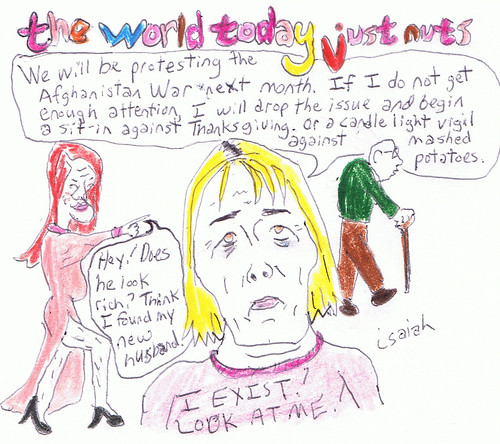
New 'Action' from 'We Forgot Iraq'

That's Isaiah's The World Today Just Nuts "New 'Action' from 'We Forgot Iraq'" and don't you love it? I love it. And it captures Medea perfectly -- from the thin nose to the messages on her t-shirt.

AP notes that Barry O's back on "the camp trail." Where? Copenhagen. Why? He's running for president there too.

Joke!

He's there to campaign to get the Olympics to come to Chicago in 2016.

Anyone else wondering WTF?

I thought Barry had two admitted wars to continue and Pakistan as well. I thought he was 'busy' on ObamaBigBusinessCare. I thought he had so much to do.

But he can jet off to Copenhagen?

AP reports, "Obama will be the first sitting U.S. president to personally lobby the IOC at a host city vote. When New York City bid for the 2012 Games, then-Sen. Hillary Rodham Clinton was the highest-ranking U.S. official to attend."

Good to know his priorities are in order. Or something.

I'm so tired of these men who 'want' to be president. We had Bush, now we've got Barack. They want the title and they want the attention. They just don't want to do the work. Sickofit.

Here's C.I.'s "Iraq snapshot:"

Monday, September 28, 2009. Chaos and violence continue, Nouri gets even cozier with his 'friends,' former Ba'athists in Syria get some press attention, Ehren Watada gets some good and long overdue news, and more.

Violence in Iraq today gets attention.
Timothy Williams (New York Times) says 18 dead and fifty-eight injured -- actually the numbers higher -- and that "both Shiite and Sunni areas of the country" were attacked.

Bombings?

Sahar Issa (McClatchy Newspapers) reports two Baghdad roadside bombings which resulted in the deaths of 3 Iraqi soldiers and twenty-nine people wounded, a Saqlawiyah house bombing (home belonged to "an intelligence employee"), a Mosul roadside bombing which claimed the lives of 2 police officers (two more wounded) and an Anbar Province suicide bombing in which a man took his own life and the lives of 6 police officers (eight more wounded). Imad al-Khuzaii, Mohammed Abbas, Missy Ryan, Dominic Evans and David Stamp (Reuters) note the suicide bombing involved "water tanker truck packed with explosives". Xinhua adds, "The bomber rammed his explosive-laden car into the entrance of the police station in the city of Rawa, some 250 km northwest of Baghdad". Reuters notes a Tal Afar bombing in which 2 people died (one person was injured), a Riyadh mortar attack left three people injured and, dropping back to Sunday, a Kirkuk bombing which injured a police officer. Imad al-Khuzaii, Mohammed Abbas, Missy Ryan and Dominic Evans (Reuters) report a minibus sticky bombing has led to 3 deaths and two people injured in Saniya.

Shootings?

Sahar Issa (McClatchy Newspapers) reports 1 elderly man (retired police officer) was shot dead in Mosul. Reuters reports 1 man shot dead in Baghdad (according to Iraqi police) and that Iraqi forces shot dead 2 'suspects'.

Corpses?
Iran's
Press TV reports the corpses of 4 "Kurdish militiamen" were discovered "between Mosul and Tal Afar with gunshot wounds in the head."

Thursday, there was a prison break in Tikrit with sixteen prisoners escaping and, by yesterday, 6 of the 16 were said to have been captured. Saturday CNN reported 2 more escapees were captured this morning during "house-to-house searches" for a total of 8 prisoners now captured. Xinhua reported Saturday that a US military drone crashed in Mosul. Jamal al-Badrani, Mohammed Abbas and Robin Pomeroy (Reuters) added "that the drone struck the local offices of the Iraqi Islamic Party, Iraq's biggest Sunni Arab political group, the military said." Timothy Williams (New York Times) explained, "The American military said it was not clear why the small remotely operated plane fell from the sky in the Ghizlani neighborhood in west Mosul, one of the most violent areas of a multiethnic city contested by various religious and ethnic groups." September 14th, US Air Force announced: "An Air Force MQ-1 Predator unmanned aircraft crashed in central Iraq at approximately 12:45 p.m. Baghdad time on Sept.14. The crash was not due to hostile fire. The crash site has been secured and there were no reports of civilian injuries or damage to civilian property. The aircraft is a medium-altitude, long-endurance, remotely-piloted aircraft. The MQ-1's primary mission is conducting armed reconnaissance. A board will be convened to investigate the incident." Mike noted that in real time. So this is at least the second drone crash this month.

As violence continues, Nouri al-Maliki, thug of the occupation, continues to hold hands with those who traffic in violence.
Friday's snapshot included Anne Tang (Xinhua) report where she quoted Nouri al-Maliki, thug of the occupation, stated of allegedly violent prisoners in Iraqi prisons, "Those people, who had been involved in killing Iraqis must be punished. [. . .] We hear voices calling for release of criminals under claim that they have been defending rights of minorities and (religious) sects, forgetting that those criminals had been behind catastrophes." Nouri's words were laughable then and only more so after the weekend's news. So happily in in bed with the League of Righteous that no only will he sleep in the wet spot, he'll also release them from Iraqi prisons. For those late to the party, the League of Righteous has claimed credit for the deaths of 5 US service members and for the deaths of 4 British citizens (three confirmed dead, four assumed) and they continue to, presumably, hold a fifth. Let's go to the June 9th snapshot:This morning the New York Times' Alissa J. Rubin and Michael Gordon offered "U.S. Frees Suspect in Killing of 5 G.I.'s." Martin Chulov (Guardian) covered the same story, Kim Gamel (AP) reported on it, BBC offered "Kidnap hope after Shia's handover" and Deborah Haynes contributed "Hope for British hostages in Iraq after release of Shia militant" (Times of London). The basics of the story are this. 5 British citizens have been hostages since May 29, 2007. The US military had in their custody Laith al-Khazali. He is a member of Asa'ib al-Haq. He is also accused of murdering five US troops. The US military released him and allegedly did so because his organization was not going to release any of the five British hostages until he was released. This is a big story and the US military is attempting to state this is just diplomacy, has nothing to do with the British hostages and, besides, they just released him to Iraq. Sami al-askari told the New York Times, "This is a very sensitive topic because you know the position that the Iraqi government, the U.S. and British governments, and all the governments do not accept the idea of exchanging hostages for prisoners. So we put it in another format, and we told them that if they want to participate in the political process they cannot do so while they are holding hostages. And we mentioned to the American side that they cannot join the political process and release their hostages while their leaders are behind bars or imprisoned." In other words, a prisoner was traded for hostages and they attempted to not only make the trade but to lie to people about it. At the US State Dept, the tired and bored reporters were unable to even broach the subject. Poor declawed tabbies. Pentagon reporters did press the issue and got the standard line from the department's spokesperson, Bryan Whitman, that the US handed the prisoner to Iraq, the US didn't hand him over to any organization -- terrorist or otherwise. What Iraq did, Whitman wanted the press to know, was what Iraq did. A complete lie that really insults the intelligence of the American people. CNN reminds the five US soldiers killed "were: Capt. Brian S. Freeman, 31, of Temecula, California; 1st Lt. Jacob N. Fritz, 25, of Verdon, Nebraska; Spc. Johnathan B. Chism, 22, of Gonzales, Louisiana; Pfc. Shawn P. Falter, 25, of Cortland, New York; and Pfc. Johnathon M. Millican, 20, of Trafford, Alabama." Those are the five from January 2007 that al-Khazali and his brother Qais al-Khazali are supposed to be responsible for the deaths of. Qassim Abdul-Zahra and Robert H. Reid (AP) states that Jonathan B. Chism's father Danny Chism is outraged over the release and has declared, "They freed them? The American military did? Somebody needs to answer for it."Those are the names of the 5 US service members that the League of Righteous claim credit for killing. Let's name the five British citizens kidnapped in Baghdad May 29, 2007: Alec Maclachlan, Jason Crewswell, Alan McMenemy, Peter Moore and Jason Swindelhurst. All but Alan McMenemy and Peter Moore have been turned over dead. The British government assumes that Alan McMenemy is dead while his loved ones continue to hope otherwise. Peter Moore is considered to be alive at this point by the British government. Today BBC News reports that an inquest has been informed Alec Maclachlan died of "a gunshot wound to the head.""Those people, who had been involved in killing Iraqis must be punished. [. . .] We hear voices calling for release of criminals under claim that they have been defending rights of minorities and (religious) sects, forgetting that those criminals had been behind catastrophes," asserted Nouri. But killing US service members and British citizens is apparently okay? And did we mention that the theory in the British press is that the five British citizens were kidnapped because Peter Moore's work was revealing corruption in Nouri's ministries?Sunday Muhanad Mohammed, Suadad al-Salhy, Mohammed Abbas, Missy Ryan and Sonya Hepinstall (Reuters) reported that more members of the League of Righteous were released from jail this weekend: "Many of a total of around 100 prisoners released in recent days were part of the Shi'ite militant group Asaib al-Haq, or Leagues of Righteousness, said Jassim al-Saedi, a senior member of the group. He said negotiations were ongoing to secure the release of up to 500 more Asaib al-Haq detainees. " He's quoted saying 200 members of the group will be released when they're done but only 97 have been released so far. The group differs over the numbers. AFP quoted League of the Righteous spokesperson Salam al-Maliki who states, "I can confirm the release of a number of our group last night . . . 23 were freed yesterday. Eighty-seven of our group were released last week, and 120 are supposed to be freed this week." He brags about all the "negotiations we are holding with the Iraqi government." Xinhua adds, "Salm Al-Maliki, former Transport Minister, representing al-Sadr's bloc in former Shiite Prime Minister Ibrahim al-Jaafari's government, said the release is 'part of an accord between the group and the current Iraqi government, led by Prime Minister Nuri al-Maliki.' He did not elaborate the accord."

Today
Richard Spencer (Telegraph of London) sums prior events this year, "Earlier this year, there were reports that negotiations linked to attempts to bring the League of Righteousness into the political process might secure the release of some or all of the five men. Three senior figures in the group, including Laith al-Khazali, the brother of its leader, were released by the Americans at the time. Instead, the bodies of three of them were handed over while the fourth security guard, Alan McMenemy, from Glasgow, was also said to be most probably dead by the government."Reached for comment, Brian S. Freeman, Jacob N. Fritz, Johnathan B. Chism, Shawn P. Falter, Johnathon M. Millican, Alec Maclachlan, Jason Crewswell and Jason Swindelhurst said . . . Oh, they can't speak. They're dead. And their governments' alleged 'leaders' have chosen not to speak in defense of them. Instead it's make nice with Nouri and his friends who kill civilians and US service members. That's what happens when the US government decides to install thugs into leadership. And let's not pretend that this move doesn't betray everyone sent over to fight an illegal war in Iraq.

While Nouri rushes to big-tent with members of the League of Righteous, he continues to block efforts at bringing in former Ba'athists. This animosity is at the root of his efforts to create an international incident between his country and Syria where many former Ba'athists have moved to.
Andrew Lee Butters (Time magazine) observes that "Maliki's government has shown little interest in even opening a dialogue with Syria or the former Baathists about their eventual return to Iraq." [Time has video of displaced Iraqis residing in Syria here.] Andrew Lee Butters notes that there are basically "two factions: a hard-line group led by a former vice president in Saddam's government, Izzat Ibrahim al-Douri, and a more moderate but less powerful group led by Muhammad Younis, a former adviser to Saddam's executive council. Younis's group began reaching out to the Iraqi government in 2007, holding a conference to reevaluate the mistakes of the Saddam regime, reject their old Baathist ideology, and adopt more democratic policies. (See pictures of Saddam Hussein.) Following the August bombings in Baghdad, al-Douri's faction has also shown signs of moderating. In an interview with TIME earlier this month, the unofficial spokesman for the group, Nizar Samra'y, said it is more concerned about the growing Iranian influence on Iraq's government than in forcing U.S. troops out of the country." Stephen Starr (Asia Times) quotes scholar and author Fadhil Rubayieh on the assertions by Nouri that the August 19th Baghdad bombings result from former Ba'athists in Syria, "I don't think any Iraqi Ba'athist people were responsible for the bombings -- there's no way they could have pulled off something as big as that. [It was] the biggest [bombing] in Iraq for six years. [. . .] Maliki does not want to see the Ba'athists succeed in regaining any sort of political legitimacy, and as such, blamed them for the bombing." Starr also notes what many avoid: the day before the bombing, Nouri was in Syria and demanding 179 former Ba'athists be handed over. His demand was rebuffed. Immediately after the bombings, Nouri begins insisting former Ba'athists were responsible and floating the laughable notion that the secular Ba'athists were now in partnership with the religious fundamentalists in al Qaeda of Mesopotamia.

Nouri's 'leadership' and other topics were addressed in the most recent episode of
Inside Iraq which Al Jazeera began broadcasting Friday night.

Jasim al-Azzawi: To discuss the UN Commission to Human Development report in Iraq, I'm joined from Baghdad by Mahdi Hafedh -- a former Iraqi planning minister and one of the participants in the Paris roundtable discussions -- and from Washington by Stuart Bowen -- the special inspector general for Iraq reconstruction -- and from London by Sami Ramadani -- a senior lecturer of sociology from the London Metropolitan University. Gentlemen, welcome to Inside Iraq. Mahdi Hafedh, you participated in this UNESCO roundtable discussion in Paris and the word "progress" was repeatedly mentioned by you as well as by other participants as well as the UNDP report. So what is the definition of "progress" when comes to Iraq?

Mahdi al-Hafedh: You see actually it is quite clear now. It is not easy to say this is a progress or not. The only thing I can say is that the report was not only about the sustainable development in Iraq but it was in general about the document itself. That is why I think that this matter has to be defined in a very clear way. This is what I understand from the progress in the report.

Jasim al-Azzawi: If we tackle the political aspect, Mr. Bowen, and you are a seasoned politician, you know this is an election season in Iraq so everybody is trying to say, "Iraq has left the woods, we are out of the tunnel and progress is all over the place." You are a frequent visitor to Iraq. Your organization is sanctioned by the US Congress. You elevate a quarterly report to Congress. From what you have seen, and you were in Iraq recently, can you say progress is at hand?
Stuart Bowen: Well there is progress but it is fragile. I was in Baghdad just over a month ago when the recent car bombings occurred. It reminded me of what I felt and saw in 2006 and 2007. Certainly one of the largest attacks in years in Iraq. Very devastating on the ministries effected. And-and I think it's-it's emblematic of the continuing challenges that the Iraqi security forces are going to face through this fall, through this very volatile election season.

Jasim al-Azzawi: And yet, Sami Ramadani, with two power centers in Iraq -- one in KRG and one in Baghdad -- and the constant tension between the two regions, let alone between the parties, the most critical thing for the Iraqi national reconciliations and yet it is not even on the horizon.

Sami Ramadani: Doesn't look like it. In fact, it's receding into the distance even further. And the two centers of power you mentioned are the two main centers of power. You could talk about even more centers of power. If you take the state of the country in general you'll find really practically there is no such thing as a proper central government in Iraq which has tremendous influence in the various regions. There is a state of disintegration in the country, I feel, administratively which reflects itself on the economic, political, social levels. There is a degree of chaos which is escalating rather than improving the country in general, Jasim.

Jasim al-Azzawi: And yet, Mahdi Hafedh, this period between now and the January election, when there is a general election, as well as when American forces start pulling en mass perhaps by summer of next year, is the most critical in the history of Iraq after 2003. As a politician and a member of the Iraqi list and a member of Parliament, do you see Iraqi politicians and power leaders and elites coming together to solve the issues?

Mahdi al-Hafedh: I don't think so because of all the problems in the country is depending upon how the other forces be able to cooperate with the others. For the time being, I feel that there is a bigger problem now and that's why I think it is still at the beginning and I feel that this will not be suddenly happen unless there is something to-to create those who are well understand each other.

Jasim al-Azzawi: Stuart Bowen, what is needed to break this deadlock that Madhi Hafedh alludes to?

Stuart Bowen: Well there are four issues that are confronting Iraq. They're not new ones but there very serious and they -- and they threaten the state. And they threaten -- they impede progress. Security, services, corruption and the Kurdish-Arab problem. On-on security, the August attack is-is just the most serious evidence of what has been a gradually increasing spate of attacks. Especially around Mosul and in the Kirkuk area in recent weeks. On services, I met with Deputy Prime Minister [Rafi al] Issawi during my August trip and he said that services, in his view, he's the -- he's the director of services for the Iraqi government, are worse now than they've been since 2003. That's a very serious concern for the Iraqis across the country, especially regarding access to electricity. He said in Baghdad, it's one to two, three hours a day. It's difficult to manage your business --

Jasim al-Azzawi: It makes you wonder whether it's lack of money, it's incompetence or, as you termed it once, this corruption which is eating the very fabric of Iraqi society as --

Stuart Bowen: Yes.

Jasim al-Azzawi: -- the second insurgency.


Stuart Bowen: That is the third issue, corruption. And -- and uh-uh-uh, Mr. Isawwi told me, as well as the members of the Council of Representatives who I met with on the Integrity Committee, those that work in the corruption fighting organizations in Iraq, that corruption is endemic, it effects every ministry and as Minister [Ali Gahlib] Baban the Minister of Planning told me at the end of last year, it's getting worse. And is certainly worse now than it has ever been. Uh, that coupled together with Kurdish-Arab conflicts in Iraq -- I went to Sulamaniyah [Province] during this August trip. I saw really an other Iraq. All the signs in Kurdish, Kurdish flags flying. For an Arab Iraqi to travel to Kurdistan, [they] have to show papers at the Green Line. These are little known facts that are evidence of, I think, a deep fissure that needs reconciliation and-and uh as-as was just said, reconciliation is slow in coming.

Jasim al-Azzawi: Sami Ramadani, listening to the two gentlemen, that must send shudders into your back.

Sami Ramadani: Well I think they're underestimating the problems in fact, Jassim. I think they're even worse. I mean, Stuart Bowen, for example, called them four-four problems. I see them as consequences. They might be problems in themselves now and they are obviously the four or five or six or seven main reasons for what is going on but ultimately all of these problems -- and Stuart alluded to some of them -- are consequences and they are consequences of the sanctions regime, thirteen years of sanctions, and the occupation of Iraq. The United States, having failed to control Iraq, relied on all manner of politicians who are self-seeking. Their political forces do not have genuine popular base in the country. And they rely on clans, on cliques and nepotism as a consequence as well. Corruption becomes a parallel. Corruption runs parallel to the fact that the United States increasingly relied on political figures and political forces which acquiesced with the occupation. And, by the way, Jasim, when we talk about services, we're talking about clean water. Clean water doesn't exist for most of the population now. Open sewers in the streets. I don't know if Stuart managed to visit some of the streets in Baghdad or the provinces. He would see the level of misery is unbelievable. The unemployment. Half of Iraq's doctors --

Jasim al-Azzawi: As a matter of fact, Sami Ramadani, --

Sami Ramadani: -- have left the country.

Jasim al-Azzawi: -- some of the people though have visited Iraq recently. I don't know whether it's their exaggeration but the way that they termed it, they said that it's "hell on earth." But Madhi Hafedh, would -- let me go on a limb and let me point a finger at perhaps the very cause of all this and correct me if I'm wrong. Is it the sectarian quota system that is ruling Iraq under the facade of democracy, is the mother of all problems?

Madhi al-Hafedh: Yes, it is. One of the reasons for that is that sectarianism has . . . [played the growth?]. And, in my opinion, this was one of the reason for this. I think that unless there is some measures to be taken, the problem will continue and then, in the meantime --

Jasim al-Azzawi: What measures? Like what?

Madhi al-Hafedh: I believe --

Jasim al-Azzawi: Like what? The Iraqi government including the Prime Minister is impotent in throwing anybody behind bars for stealing billions of dollars, so what is it -- what is it needed? I mean, al-Maliki himself says, "I cannot prosecute anybody."

Madhi al-Hafedh: Yes, this is true. I mean, al-Maliki is one person, although he is the most important person in the government, but there are several powers inside the government. You cannot speak anything now about Kurdistan. You cannot speak anything about the ministries where the other ministers from this or that group are ruling. In my opinion, that this has to be taken into consideration and this cannot be solved until the election takes place in January next year.

Meanwhile
Steven Lee Myers (New York Times) reports continued problems luring foreign businesses to 'safe' Iraq: "A deal to lure $60 million in foreign capital -- one of only a handful of foreign investments in Iraq's state-owned industries -- collapsed. The American government recently gave the company $2.5 million to keep its main production line operating and its workers out of penury and, perhaps, insurgency." This as the International Business Times reports, "Oil and gas explorer Petrel Resources says its Subba and Luhais oilfield development in Iraq is at a standstill. Petrel generated no revenue in the six months to June 2009, against 8m in H1 2008. The company reported an interim loss of 0.228m, down from 0.417m." RTE Business quotes Petral's chair John Teeling stating, "Petrel is determined to stay in Iraq to participate in the growth."

Turning to peace news, Saturday
Gregg K. Kakesako (Honolulu Star-Bulletin) reported that 1st Lt Ehren Watada will not "seek a second court-martial" and that they've "accepted the resignation of" Ehren and quotes Ehren stating, "The actual outcome is different from the outcome that I envisioned in the first place, but I am grateful of the outcome."In June 2006, Ehren Watada became the first officer to publicly refuse to deploy to the illegal war in Iraq. June 22, 2006, his unit deployed at 6:45 am and, as he had stated, he refused to deploy. For perspective, that was also the day the US Senate voted to end the illegal war by July 2007 -- a proposal made by US Senators Russ Feingold and John Kerry. Only 13 US senators voted to pull all troops by July of 2007.Back then, the death toll for US service members in Iraq stood at 2512. It currently stands at 4346 and, no, the Iraq War has not ended.In August 2006, an Article 32 hearing was held. Watada's defense called three witnesses, Francis A. Boyle of the University of Illinois' College of Law, Champagne; Denis Halliday, the former Assistant Secretary General of the UN; and retired Colonel Ann Wright. These three witnesses addressed the issue of the war, it's legality, and the responsibilities of a service member to disobey any order that they believed was unlawful. The testimony was necessary because Watada's refusing to participate in the illegal war due to the fact that he feels it is (a) illegal and (b) immoral. Many weeks and weeks later, the finding was released: the military would proceed with a court-martial.On Monday, February 5, 2007, Watada's court-martial began. It continued on Tuesday when the prosecution argued their case. Wednesday, Watada was to take the stand in his semi-defense. Judge Toilet (John Head) presided and when the prosecution was losing, Toilet decided to flush the lost by declaring a mistrial over defense objection in his attempt to give the prosecution a do-over. Head was insisting then that a court-martial would begin against Watada in a few weeks when no court-martial could begin.January 4, 2007, Head oversaw a pre-trial hearing. Head also oversaw a stipulation that the prosecution prepared and Watada signed. Head waived the stipulation through. Then the court-martial begins and Ehren's clearly winning. The prosecution's own military witnesses are becoming a problem for the prosecution. It's Wednesday and Watada's finally going to take the stand. Head suddenly starts insisting there's a problem with the stipulation. Watada states he has no problem with it. Well the prosecution has a problem with it and may move to a mistrial, Judge Toilet declares. The prosecution prepared the stipulation and they're confused by Head's actions but state they're not calling for a mistrial or lodging an objection. That's on the record. Head then keeps pushing for a mistrial and the prosecution finally gets that Head is attempting to give them a do-over, at which point, they call for a mistrial.The case has already started. Witnesses have been heard from. Double-jeopardy has attached. The defense isn't calling for a mistrial and Head rules a mistrial over defense objection and attempts to immediately schedule a new trial.He's ignoring the US Constitution which forbids double-jeopardy. He thought he could give the prosectution a do-over. That's not how the justice system works in the US, double-jeopardy is banned. In November of 2007, US District Judge Benjamin Settle ruled, "The same Fifth Amendment protections are in place for military service members as are afforded to civilians. There is a strong public interest in maintaing these rights inviolate." The military stated then that they would appeal. October 22, 2008, Judge Settle ruled there could be no retrial on the charges of missing deployment, participating in a news conference or participating in the Veterans for Peace conference. That left two charges up in the air which were questionable because the strongest charge was always going to be "missing deployment."Watada was kept in the military all this time. His service ended in December 2006. Or should have. He was kept in the service to prosecute him. He was kept in the service and kept in limbo. His service contract expired in December of 2006 and instead of discharging him then, the military wasted his time and countless US tax payer dollars to conduct a nearly three-year assault on him. Audrey Mcavoy (Breaking News 24/7) reports that October 2nd is when the US military will discharge Ehren. At which point, Ehren can finally get on with his life. Michael Tsai (Honolulu Advertiser) quotes Kenneth Kagan, one of Ehren's two civilian attorneys, stating, "When the Army realized they could not beat him in court, they threw up their hands and looked for some way to handle the situation quickly and quietly." Iraq Veterans Against the War's T.J. Buonomo reflects on Ehren's news:

I am moved beyond words to hear of the imminent release of Ehren Watada from the Army. Ehren's exemplary moral courage was a great inspiration to me as a young Army officer struggling with how to respond to the Bush administration's abuses of power- from their manipulation of prewar intelligence and deception of Congress to their sanctioning of torture to their efforts to subjugate the Iraqi people under foreign multinational corporations and financial institutions.
I recall signing a petition in support of Ehren while still an Army officer -- a document that later ended up in my personnel file while under investigation for exercising my First Amendment rights. Five months later I was involuntarily discharged from the Army and joined Iraq Veterans Against the War. I have since followed Ehren's case and was elated to read that a federal court had intervened on his behalf, reaffirming his constitutional right not to be held in double jeopardy.

From news of a service member to veterans news,
Friday, the VA was in the news cycle for still, STILL, not sending the checks to veterans participating in the education programs under the new GI Bill. These checks would cover tuition, would cover books, would cover living expenses. The news media ran with the month of September but, in fact, as e-mails have reminded, for some universities, the fall semester started in August. At one point early in the day Friday, the VA was attempting to lie that they were waiting for adds and drops. That was a lie. First off, many veterans are having to take out emergency students loans at their universities. These are short term loans and, no, this was not planned. Second of all, drops don't end this week. Many universities allow people to drop throughout October and into November. The VA is not doing its job and has attempted to spin. The VA notes the following in a release sent to the public e-mail:

Secretary of Veterans Affairs Eric K. Shinseki announced the Department of Veterans Affairs (VA) has authorized checks for up to $3,000 to be given to students who have applied for educational benefits and who have not yet received their government payment. The checks will be distributed to eligible students at VA regional benefits offices across the country starting October 2, 2009. More information on
emergency checks. Information on VA regional benefits offices. Meanwhile Cynthia Henry (Philadelphia Inquirer) quotes Robeen Billings who is among the veterans who have not received their payments, "The GI Bill is a mess. I'm struggling because my first semester is not paid. I'm commuting from Newark to Camden, living off my credit card." Who's going to pay the interest on the debt that Billings and others are having to run up because the VA dropped the ball? Henry reports:Former Marine James Hambley, 25, of Maple Shade, has been caught short by the delay. Between his savings and GI Bill living allowance, he figured he could quit his job and attend CCC full time. Without the benefits coming in, Hambley has applied for a two-month deferment on his car and personal loans. He looked into a government student loan, but that money wouldn't be available until November, he said.College advisers have told him that he shouldn't work more than 20 hours a week while taking 14 credits toward his engineering-science degree, Hambley said, but "that's not going to cut it" until the first check arrives -- in November, the government now tells him. He's out looking for work.

iraqbbc news
muhanad mohammedsuadad al-salhymohammed abbasmissy ryansonya hepinstallreuters
the telegraph of london
al jazeerainside iraqjasim al-azzawi
stephen starrthe asia timesimad al-khuzaiidominic evansdavid stamp
the new york timessteven lee myersthe international business times
ehren watadagregg k. kakesakothe honolulu star-bulletinaudrey mcavoy
mcclatchy newspaperssahar issa
timothy williams
the philadelphia inquirercynthia henry

Friday, September 25, 2009

Hillary's important speech

This is "Women: Opening Remarks at Combating Violence Against Girls Event," which are Secretary of State Hillary Clinton's remarks today in a speech:

I want to start by saying something that I believe with all my heart, and, obviously, those of you who are here believe it also, that the issues related to girls and women are not an annex to the important business of the world and the United Nations, they’re not an add-on, they’re not an afterthought; they are truly at the core of what we are attempting to do under the Universal Declaration of Human Rights that is the guiding message of this organization and what each of us in our own countries is called to do on behalf of equal opportunity and social justice.
So for me, this is a tremendous opportunity to speak about an issue that has basically been relegated to the backwaters of the international agenda until relatively recently: violence against girls and women, and particularly today, violence against girls.
I wish that we could transport ourselves into a setting where we could be in the midst of girls and women who have been suffering from violence, but we don’t have to because it’s all around us. It is in the home, it is in the workplace, it is on the streets of many of the countries represented here, including my friends Maxine and Celso. And it is in the places that make the headlines from time to time, and then in the very bottom paragraphs, there’s a reference to the violence that is a tactic of war and intimidation and oppression to prevent girls from going to school by throwing acid in their faces, by raping girls as a way of intimidating them and keeping them subjugated and demonstrating power.
So this, for me, is one of the most important events that I’ve done at the UN. I worked this week with President Obama on our agenda, on everything from nonproliferation and the threats posed by Iran to the P-5+1, to the ongoing challenge of the Middle East, and so much else. But oftentimes, my press – I’ll only speak for the American press – will pose a question that goes something like this: “Why are you spending so much time on these issues that are less important or not as significant as the ones that are really at the heart of foreign policy?”
And I usually patiently explain, for about the millionth time, that this is the heart of foreign policy. Because after all, what are we doing? We’re trying to improve the lives of the people that we represent and the people who share this planet with us. And we do it through diplomacy, and we do it through development, and occasionally we have to do it through defense. But violence against any one of our fellow beings is intolerable. And when it is part of the cultural fabric of too many societies, when it is an assumption of the way things are supposed to be, then it is absolutely a cause for our action collectively.
As some of you know, I traveled to Goma in the Eastern Democratic Republic of Congo last month. I went to a refugee camp that is home to 18,000 people in a very small plot of land; in fact, land that is covered by lava from a volcanic eruption. And it was a stark reminder of a conflict that has left 5.4 million people dead since 1998. And walking through that refugee camp was, as I’ve often felt walking through camps in other places, both the best and the worst of humanity: the worst because of what drove these people to this extreme measure of fleeing their homes, leaving their fields, running from danger; and the best because of the international response.
But the people leading me through the camp – they had a man who was the president, a woman who was the vice president – were talking about what life was like day to day, because the camp provides no security. You are there, but if you venture out, as too many of the girls told me, for water or firewood, or literally just to breathe because you’re living arm-to-arm with thousands of other people, you put your life at risk. Something like 1,100 rapes are reported each month in the Eastern Congo; that’s an average of 36 women and girls raped every day.
I heard a lot of terrible stories. A 15-year-old girl who looked younger than her years, who was fetching water from the river, when two soldiers – she wasn’t sure who they were, were they irregulars, were they militias, were they the Congolese army. They were just soldiers who told her if she refused to give in to them they would kill her. They beat her, ripped her clothes off, and raped her.
I met one of the nine-year-old girls who was nabbed by two soldiers, who put a bag over her head, and raped her repeatedly in the bushes; and a woman who was eight months pregnant when she was attacked, and after being so brutalized and losing her baby, she was no longer accepted in her own home.
And then I met a woman who was about my age, who had four children and a husband. They were farmers from one of the small holding farms that so many of the world’s poor try to survive by. And she called them bandits. They took her husband out, shot him. Two of her children ran out to try to help their father, shot them, came into the house, shot the other two children all in front of her, and then repeatedly gang-raped her, left her for dead. And she told me she wished that she had died.
Well, these are the most extreme examples, but there are so many that we could point to. And since I believe that the progress of girls and women holds the key to sustainable prosperity and stability in the 21st century, this is a matter of great concern to me and to my country. When women are accorded their rights and accorded equal opportunities in education and healthcare and employment and political participation, they invest in their families, they lift them up, they contribute to their communities and their nations. When they are marginalized, when they are mistreated, when they are ignored, when they are demeaned, then progress is not possible, no matter how rich and well-educated the elite may appear.
The problem of violence against women and girls is particularly acute in conflict zones, but that’s not the only place we find it. The UN has done some excellent work in the last years in war-torn areas. And while boys are pressed into service as child soldiers and trained to kill, and often drugged to do so, girls are raped and often forced into becoming sex slaves. And this has happened to thousands and thousands of children. We also know that despite the best efforts of those of us in this room, all too often these acts of brutality and de-humanity do not just affect the individuals, they affect the fabric that weaves us together as human beings.
Next week, I will chair a Security Council session here in New York on the epidemic of sexual violence against women and girls in conflict zones. And the United States will introduce a resolution to strengthen our efforts to curb these atrocities and hold all those who commit them accountable. We will call for a special representative of the Secretary General to lead, coordinate, and advocate for efforts to end sexual and gender-based violence in armed conflict.
But violence against women and girls happens everywhere. You have not only domestic violence, but female feticide, dowry-related murder, trafficking in women and girls. It’s quite alarming that even among well-educated people in some countries, the rate of selective abortion against girls is alarming. There are millions – some estimate as many as 100 million – missing girls. And they are missing because they’re either aborted or they are still subjected to infanticide or they are denied nutrition and healthcare and allowed to die in alarming numbers before the age of five.
In Thailand in the 1990s, I met girls who’d been sold into prostitution by their fathers, when they were as young as eight. And by the time they were 12, many of them were dying of AIDS. I drove around the area in northern Thailand, and one of the people with me said, “You can tell which homes have sold their girls, because they’re the ones with the satellites” and that there’s a lot of peer pressure; it would go satellite, satellite, then you’d have no satellites, and then satellite, satellite.
So we know these statistics. A third of all women will face gender-based violence at some point in their lifetime. In some parts of the world, the number is as high as 70 percent. The United Nations estimates that at least 5,000 so-called honor killings take place each year. Nearly 50 percent of all sexual assaults worldwide are against girls aged 15 or younger. And more than 130 million girls and young women have been subject to genital mutilation.
All over the world, you find a higher value on male children, girls being coerced into early marriages, denied access to schools, adequate nutrition and healthcare, and enslaved in forced labor. And so there are many stories. We have two young women with us today, and we have many more who they represent.
The problem is that very often there is no legal action taken against those who perpetuate this violence, even when they are members of a nation-state’s armed forces. We are pressing the government of the DRC very hard to bring to justice five officers of the military who have been implicated in either these actions themselves or in a permissive environment for them.
And there are many young women who are standing up and who need our support. The story of Mukhtar Mai, a young woman who I’ve come to know, who was gang-raped in 2002 on the orders of her tribal council in rural Pakistan because of something her brother had done. She was forced to walk home naked in front her village, and she was expected to kill herself. I mean, that’s what you do. You get humiliated, you get shamed, you get attacked. It’s your fault, you go kill yourself. And the crime, the best we could determine, was her brother was seen walking with a girl from an upper caste village.
So what happened to her? She refused to kill herself, and she refused to hide, and she refused to give in to the cultural milieu in which this attack had taken place. And her case became something of an international cause. And people began asking: What can we do for her? They donated money. She built the first school in her village. She herself enrolled in that school. And now, because of the money that has come in since she was courageous enough to speak out, the school has an ambulance service, a school bus, a woman’s shelter, a legal clinic, and a telephone hotline.
Now, she’s a remarkable young woman, but she’s not alone. And what we need to do is support those who are standing up. I have a friend here, Molly Melching, whom I first met and worked with more than 10 years ago in Senegal, where she very deliberatively began to build community rejection of female genital mutilation by going from village to village and making it a health issue, making it an issue that the tribal elders and the imams began to recognize was not in keeping with their views of themselves or of Islam. And this is possible. It takes time, and we can’t, can’t give up.
So let me just end with a call to action from the leaders of many religious faiths who came together last year to advocate for an end to violence against women, and here’s what they said: Each of our faith traditions speaks to the fundamental value of all human life. Violence against women denies them their God-given dignity. We cannot afford to remain silent when so many of our women and girls suffer the brutality of violence with impunity.
So this meeting could not be more timely or important. Now, we’ve got to follow up. And hopefully, in UNGAs to come, we will fill larger and larger rooms. We will have people making commitments. I know the Dutch Government is very intent upon trying to make sure that action follows. And we can work with our friends not only from Brazil, but I see many of my other colleagues here today. And I hope that we will be the voices for those women who will never appear before the Security Council, they will never leave Goma, they will never leave rural Pakistan, they will never leave their village in Latin America or anywhere else, to come and plead their case before us. So it falls to us to make sure their voices are heard.
Thank you very much.


That's an important speech. C.I. forwarded it to me when I said I wasn't sure what I'd write about tonight. And I'm looking at the speech and thinking, "Great, but is it Hillary?" There was no identifying paragraph, the whole e-mail was just the text of the speech. So I checked to be sure. C.I. said, "Yes, that's Hillary's speech. Honest. I'm not pulling a fast one on you and forwarding you a speech Michelle [Obama] gave." I laughed.

But that's a really important speech and we're very lucky that Hillary Clinton is heading the State Department because who else would give it?

I can't think of many who could or would. And after 2008, Hillary has the gravity to really speak on these subjects. Both because of what was done to her to steal the nomination and because they had to steal it since she got the most votes. She is the most popular member of the current administration.


Here's C.I.'s "Iraq snapshot:"

Friday, September 25, 2009. Chaos and violence continue, Talabani buries a prized request in his UN speech to emphasize a momentary one (already addressed as it turns out), the VA has a really, really bad week and ends the week on a bad note, Nouri's forming his own coalition and right now it's . . . well Nouri, and more.

Yesterday (6:18 pm EST), Jalal Talabani, Iraqi President, addressed the United Nations General Assemnbley. He tapped the microphone four times before he began reading his prepared speech for the next 17 minutes and four seconds

The most important challenges we face in the near future is the legislative elections due to be held in January 2010 for which the political parties have already started preparations. The success of these elections will put the current political regime based on democracy, pluralism and the peaceful transfer of power on the right path. The success of the elections will transfer the political process from the establishment stage to one of permanence and stability and will promote stability and security in Ira. The elections will strengthen our capabilities in building national institutions qualified to fulfill the requistes of a strong state based on law, living peacefully with its own people and neighbors and to be a key factor in the security and stability in the region. This will reflect postively on Iraq's Arab, regional and international relations and its active return to the international community.
The real danger currently facing Iraq is outside interference in its internal affairs which has committed the worst crimes against innocent Iraqis from various segments of society, men, women, children and the elderly. In an attempt to destabilize security and stability achieved in Iraq during 2008 and 2009, Iraq has witnessed recently a series of bombings and terrorist attacks, the last of which was the Bloody Wednesday explosions that targeted the Iraqi Ministry of Foreign Affairs and Ministry of Finance which targeted the country's sovereign institutions on 19 August 2009. This led to many innocent victims, including many employees of the government, diplomats and administrators. These criminal acts and large number of victims have reached the level of genocide and crimes against humainty subject to punishment under international law. We believe these acts at this level of organization, complexity and magnitude cannot be planned, funded and implemented without support of external forces and parties and primary investigations indicate the involvement of external parties in the process.
Therefore, the government of the Republic of Iraq puts this important matter on the table of the Secretary-General of the United Nations and requests its submission to the Security Council for the purpose of forming an independent international investigation outside the jurisdiction of Iraq and bring those found guilty to a special international criminal court.
The Iraqi government finds itself obliged to resor to the United Nations to protect its people and stop the bleeding of innocent Iraqis and we are looking to the assistance of the international community and its support ot the Iraqi positions in the formation of an independent international commission to investigate the crimes of terrorism against the Iraqi people we request the United Nations Secretary General to name a senior offficial to evaluate the extent of foreign intervention that threatens the security and integrity of Iraq and to consider terrorist crimes as genocide. We also look for better cooperation and coordination with the neighboring countries and other concerned states to control Iraq's boraders, exchange information, coordinate efforts and prevent the groups that support terrorism and work against Iraq under any cover.

It was a far cry from his speech to the United Nations September 25, 2008 when he was speaking of the importance of ensuring that women were able to participate in "all spheres of influence". This year, almost 12 months to the day, he stood before the United Nations and wanted to open with what can be seen as an attack on Syria. Bloody Wednesday, Black Wednesday, August 19th, whatever you call it, no one knows who was responsible. Nouri al-Maliki had been in Damascus and met with Bashar al-Assad, president of Syria, to demand that Syria turn over 179 Iraqis residing in Syria to Iraqi authorities. This demand wasn't new. When Nouri was hiding out for 18 years in Syria, there were many calls from Saddam for Syria to turn Nouri and others over to Iraqi authorities. Syria refused then to turn over anyone without proof and Syria stands by that policy today. The demand for the 179 to be turned over came before the August 19th attacks.

Like George W. Bush, Nouri used an attack to push through things he already wanted. Nouri and others thought Turkey would be the one to lean on because Turkey does conduct raids in (and assaults on) northern Iraq. Their 'right' to do so was just renewed and the hope of Nouri and his allies was that the desire to renew would mean Turkey would automatically side with Iraq against Syria. That's why Iraqi officials made idiotic statements in the last few weeks on Arabic TV claiming that Turkey agreed with Iraq and said the 'proof' offered by Iraq that Iraqis in Syria were responsible for the August 19th bombings was irrefutable. Turkish officials didn't say that, nor did they feel that. Their role was to get the two sides to come together. That's how they saw it. It's doubtful that Turkey's desire for continued raids could have been leveraged by Nouri to begin with but the fact that Iraq suffers from a drought and needs Turkey for water further undercut any hopes that Iraq could strong-arm Turkey.

So yesterday Jalal Talabani took the matter to the United Nations. Not to the Arab League. They don't want to take it to the Arab League because a Cairo meeting this month did not go well for Iraq and indicated that other governments saw Iraq's 'evidence' to be as weak as did Syria. Despite attempting to bypass the Arab League, Talabani claimed to the United Nations yesterday that "we seek to establish better relations with the Arab and Islamic countries and we are committed to the decisions of the Arab League and the Organization of Islamic Conference."

How much can one person beg for? Traditionally, you beg for one thing. Jalal was begging non-stop. After demanding an international inquiry, he then went into how Iraq should be spared of its debts and obligations. Is Iraq a new country? No. And the 20 million-plus Iraqis that lived there before the start of the illegal war (approximately 26 million was the CIA estimate in 2002; they estimate 28 million today which apparently includes external refugees and corpses in the count) are still in Iraq. So what's going on?
Under a United Nations mandate authorizing the foreign occupation of Iraq -- issued after the illegal war started (no UN mandate was issued on the illegal war) -- Iraq was seen as a ward that needed protection -- not only from foreign forces but also from the international community. The treaty masquerading as a Status Of Forces Agreement was wanted by the White House and by Nouri. Nouri wanted it so that Iraq was no longer a 'ward of the state'. As such, Jalal Talabani pressed the UN to lift Iraq's debts, "Therefore, we request a clear resolution issued by the Security Council to terminate all resolutions issued under chapter VII which affected the sovereignty of Iraq and led to financial obligations which are still binding on Iraq because the situation which necessitated the adoption of those resolutions no longer exists. We and the Iraqi people look forward to the day when Iraq is released from chapter VII sanctions."

To some degree, Talabani's second round of begging will most likely be met. However, he will forever be criticized historically for making that his second request and not his first and only request. Nouri's petty-grudge war resulted in the Iraq basically being taken out of receivership on the internaional stage becoming request number two and not the primary one. This request was the one the non-representative government in Baghdad had worked the last three years on and suddenly it became a secondary issue in Talabani's speech.
With news from Alsumaria that Foreign Minister Hosheyar Zebari has declared Syria, Turkey and Iraq have agreed "to form a Turkish-Syrian-Iraqi investigtation committee," Talabani's decision to emphasize August 19th over the economic issues looks like an even bigger mistake.

Yesterday, there was a prison break in Tikrit with sixteen prisoners escaping -- one of whom was later caught, five of whom had been sentenced to death. Steven Lee Myers (New York Times) notes the curfew and that "American search dogs and aircraft" are being used to hunt for the escapees. Ned Parker and Saif Hameed (Los Angeles Times) reported this morning that two of the sixteen have now been captured and that 4 "prison guards were under investigation on suspicion of helping the detainees escape. The prison director was dismissed and detained while under investigation, officials said." BBC News reports 5 of the escapees have now been caught and that the "police detain 100 staff for questioning about the breakout." Nada Bakri (Washington Post) adds, "Authorities said Friday that at least 100 prison officials and guards, including 10 officers, have been arrested and three special committees formed to investigate the prison breakout in Tikrit." Bakri also notes that with 5 of thte 15 escapees back in custody, the curfew in Tikrit has been lifted. Iran's Press TV notes that posters of the escapees "have been distributed across Tikrit and other cities in Salaheddin province to ensure that the 10 remaining jail breakers will not remain long at large." Reuters notes Iraqi officilas are now saying 6 of the 15 escapees have been captured.

In other prison news,
Anne Tang (Xinhua) reports Nouri al-Maliki, thug of the occupation, stated of allegedly violent prisoners in Iraqi prisons, "Those people, who had been involved in killing Iraqis must be punished. [. . .] We hear voices calling for release of criminals under claim that they have been defending rights of minorities and (religious) sects, forgetting that those criminals had been behind catastrophes." Nouri's words are laughable since he's so tight with the League of Righteous (responsible for an assualt on a US base in which 5 US service members were killed, responsible for the kidnapping of 5 British citizens in Baghdad -- four of whom are known to be dead -- those are the crimes they've claimed credit for). He's so tight with them that he got their leader (and the leader's brother) released from a US prison earlier this year and has met with them repeatedly. Despite the fact that a fight British citizen is either still held hostage or dead. Thug Nouri runs with his own. And his pretense to care for Iraqi lives is laughable when he sits on billions and Iraqis struggle for something as simple as potable water.


In Iraq today 15 Iraqi soldiers were killed in Baashiqa.
Xinhua reports that the 15 were in northern Iraq attempting "to blow up a large arms and ammunition depot" but things went horribly wrong. In addition to the 15 dead, another is reported injured. BBC has the bombing taking place while the soldiers were transporting "confiscated bombings to a disposal area". However, Nada Bakri (Washington Post) reports, "The explosion took place in a lot where security forces store and detonate explosives and ammunition confiscated from insurgents." Steven Lee Myers (New York Times) explains, "Officials described the blast as an accident but provided few other details." Gulf News adds, "Witnesses said American soldiers had cordoned off the area. The US military did not immediately respond to queries for additional details."

In other reported violence today . . .

Mohammed al Dulaimy (McClatchy Newspapers) reports a Baghdad roadside bombing injured two police officers. Reuters notes two other Baghdad roadside bombings from yesterday which injured four people and an attack on a Mosul military checkpoint which claimed the life of 1 Iraqi soldier and left another injured.

Moving to political news.
September 11th on Al Jazeera's Inside Iraq (a transcript excerpt is in this snapshot), Kassim Daoud repeatedly insisted to host Jasim Azzawi that there was still the possibility that Nouri al-Maliki might join the Shi'ite alliance.

Jasim Azzawi: al-Maliki has refused to join the new bloc that has been created and you are a member of that bloc, the Iraqi National Alliance primarily because of the presence of Ibrahim al-Jaafari and perhaps because of Moqtada al-Sadr. Can Maliki win without your bloc?

Kassim Daoud: Well that's a very difficult question. I mean it's premature to answer the question like this to comment that the Alliance, actually, is still open to everybody. We announced it as a bloc which has to be the foundation for the national mandate or the national enterprise. We cannot say that Maliki didn't join us so far, the negotiation is still going on.

Jasim Azzawi: Kassim Daoud, it seems to me that his answer is final. He wanted to be the sole candidate to run for the premiership as well as he wanted a limitation on to Ibrahim al-Jaafari and Moqtada al-Sadr blocked. That has become amply clear.

Kassim Daoud: Well the problem before you is clear but for me since I'm an insider, actually, I'm not looking at the situation as it is. The guy having sort of a political mandate, he would like to pursue with his mandate. The Alliance would like to -- their own mandate so I cannot say the negotiation terminated. I think still we have room although the room is probably slim but I think that we cannot give such a sharp answer till we have to wait for probably too more weeks.

Jasim Azzawi: Slim indeed it is.

Slim indeed.
Alsumaria reports that Nouri has revealed he's creating his own coalition and "will announce" it in the next week. The coalition will be Dawlat al-Qanun (State of Law) and will be a mixed coalition as Nouri attempts to paint himself more secularist due to the January 2009 elections in 14 of Iraq's 18 provinces indicating that fundamentalists were not popular with the people. Caesar Ahmed and Ned Parker (Los Angeles Times) report on the plans by the politicaly party SIIC (Supreme Islamic Iraqi Council) which include recruitment and appearing open (possibly being open, but time will tell on that) and to point out the current government's broken promises: "The cleric critiqued the government's management of electricity and vowed his list would improve basic services. He heaped scorn on the country's current electricity minister, Kareem Wahab, for failing to improve power." Alsumaria also reports that the Kurds are calling for elections to take place in Kirkuk and not be postponed "under the pretext of voters' register incomplete scrutinizing." The upcoming elections are scheduled for January 2010 and the fate of Kirkuk will not be, according to Nouri, addressed then. Despite the Iraqi Constitution long ago calling for a referendum on Kirkuk (disputed territory claimed by both the KRG and the centeral government in Baghdad).

On the topic of the elections, they're often presented as the saving moment for Iraq that will change everything. Last week
Marc Lynch (Foreign Policy) offered another take after recounting the US government's distaste for the recent elections in Lebanon, Iran and Afghanistan:

The similarity in American thinking about the role assigned to elections in the Iraqi and Afghan case bears particular attention. In each case, the elections are supposed to do very specific things for American strategy: legitimate the political order, bring excluded challengers into the political process, resolve enduring political conflicts, create a political foundation for the counter-insurgency campaign. In Afghanistan, the opposite appears to have happened. Should this worry those assigning the same hopes to Iraq?
This is not to say that the scheduled Iraqi elections don't matter (even if it were an American decision to hold them, which it most assuredly is not). The looming elections have very clearly profoundly shaped Iraqi politics. The jockeying over electoral coalitions, questions about Maliki's power or vulnerability, and reshaping of both intra-communal and inter-communal politics have dominated the Iraqi political arena for months. The outcomes will matter in important ways-- Shia politics could fragment or reunite, Maliki could emerge as the power broker many hope for or fear, Sunni groups might find a better entree into the ruling coalition, particular groups may rise or fall --- and in contrast to most Arab elections, the outcomes are not pre-ordained.
But things could go in bad directions as easily as in good directions -- or, even more likely, could shuffle the deck without producing any miraculous breakthroughs in national reconciliation. Certainly the 2005 elections produced their fair share of negative results -- worsening the spiral towards civil war, locking in communal representation, and paralyzing the government for months over the inability to agree on a Prime Minister. The January 2009 provincial elections were seen, by contrast, as a great success. But as the Times pointed out the other day,
disillusionment with the results of the provincial elections -- which carried similar weight in U.S. thinking -- has grown in Anbar as new leaders fall into old habits.

Scholar
F. Gregory Gause (Abu Dhabi's The National Newspaper) also questions whether too much emphasis is put on the elections:

But neither immediate security concerns nor short-term electoral politics will determine the future of Iraq. Ultimately, political stability in Iraq will depend on how Iraqis (and, for the near future, the American government) define the kind of state they want to have. Do they want a strong centralised government? Or do they want to empower regional governments and carefully divide and circumscribe power in Baghdad? Neither quantifications of terrorist violence nor the 2010 parliamentary elections will answer that question.
[. . .]
There is certainly an argument to be made that what Iraq needs now is strong leadership. State-building is rarely done effectively by committee, and Iraq is still in the midst of rebuilding the institutions that were hollowed out by Saddam Hussein and then upended by the American occupation. The core of al Maliki's appeal, and his argument for a new term as prime minister, is that only a strong leader can build the institutions necessary to maintain security, promote economic development and prevent the political fragmentation of Iraq. Of course, a strong leader is no guarantee of such progress. Plenty of kleptocratic states are headed by strongmen; Zimbabwe is no model for state development. But it is hard to see how al Maliki's rivals in the Kurdish leadership or in the sectarian Shia Islamic Supreme Council of Iraq (ISCI), which in the past has advocated a Shia regional government on the model of the KRG, could rally Iraqis across ethnic and sectarian lines to support the rebuilding of the state.
But after the disastrous experience of Saddam's rule, perhaps Iraqis would prefer a central government that is both weaker, in terms of its authority over the provinces, and more divided, with a separation of powers in Baghdad – so that no single figure can consolidate power, even if that means relatively inefficient governance. The risk of a new dictatorship, in this view, trumps arguments about security and efficiency and the logic of centralised state power. The political groups forming coalitions against al Maliki will make that argument in the upcoming elections. The major Kurdish parties, invested in their own autonomy in the KRG, certainly see things this way. Even Arab parties that in the past have advocated strengthening the centre are reluctant to ally with al Maliki, at least right now.

Turning to the US where
Gregg Zoroya and Mary Beth Markelein (USA Today) report, "Nearly a month into the fall college semester, the Department of Veterans Affairs has paid benefits for fewer than half the former Iraq and Afghanistan veterans requesting under the new post-9/11 G.I. Bill, according to a VA estimate." And they quote the director of the VA Education Service, Keith Wilson, stating, "We realize we're not meeting everybody's expectations." David Zucchino (Los Angeles Times) notes Amber Oberg's expectations. The army veteran has been attending UC Davis for a month. And the promised funding? Hasn't arrived. Oberg states, "I didn't expect to get out of the military and then have to wait and wait for the education money that was promised me. Now she and her kids are in danger of being homeless as she waits for the promised monthly housing payment of $1,736. Across the country, veterans check the mail looking for the promised funding. Audrey Hudson (Washington Times) reports John Kamin has been waiting and thought he had good news yesterday only to open the envelope and discover he was being notified that he might "be called back into active duty." He tells Hudson, "It felt like salt in the wound. That was really disheartening." Jessica Calefati (US News & World Reports) explains that "some 70,000 eleigible veterans who filed claims for this school year are still waiting for their first checks." After a very bad week for the VA, they knew it was time to spin into action. Kimberly Hefling (AP) reports that the department stated late today "that checks will be issued starting Oct. 2." That link, by the way, also includes an earlier report by Hefling on VA Secretary Eric Shinseki making statements. I am saying this, he is either ignorant of what he is speaking on or he is lying through his teeth. He pushes the problem off on the colleges. The VA program is no different than the US Pell Grant program. There is no delay in the Pell Grants so for him to claim it's the colleges screw up reveals extreme stupidity on the subject matter or a gross eagerness to lie. He also tries to hide behind drop and add periods. What an idiot. Drop and add periods. Anyone who has gone to college and received assistance is damn well aware that the assistance starts at the start of the semester. They're also damn well aware that students have many, many more weeks to drop classes. We'll go with stupidity because it wasn't just college tuition, it was book allowances, living allowances and more. Shinseki embarrasses himself and that's also part of the reason for the late announcement that checks will be out starting October 2nd. They don't want people digging to deep into his spin. When the entire department already looks incompetent, it's not a good idea to go into the weekend with the focus on the director's stupidity. If you're late to the party on the VA's bad week, you can refer to Wednesday's "Iraq snapshot" covering a hearing which Kat covers in "Crooks in the VA" and there was more on Congress addressing veterans issues in Thursday's "Iraq snapshot" and Kat's "House Veterans Affairs Committee."

The homeless problem continues to grow while the VA offers excuses and, no doubt, promises of a toll free number on the way that will be the 'answer' to everything.
Thom Patterson (CNN, link has text and video) reports on the homeless veterans and notes the numbers for Iraq War and Afghanistan War veterans could be over 7,000 with the VA estimating "about 10 percent of all homeless veterans are women." Iraq War veteran Angela Peacock shares her story with Patterson which includes raped while serving, PTSD, self-medicating leading to a drug addiction, loss of spouse, eviction from apartment. For more on the issue, we'll drop back to the June 3rd snapshot, when US House Rep Bob Finer chaired the House Committee on Veterans Affairs committee for the hearing entitled "A National Commitment to End Veterans' Homelessness:" The number of women veterans who are homeless is rising. [Vietnam Veterans of America's Marsha] Four observed, "There certainly is a question of course on the actual number of homeless veterans -- it's been flucuating dramatically in the last few years. When it was reported at 250,000 level, two percent were considered females. This was rougly about 5,000. Today, even if we use the very low number VA is supplying us with -- 131,000 -- the number, the percentage, of women in that population has risen up to four to five percent, and in some areas, it's larger. So that even a conservative method of determinng this has left the number as high as [6,550]. And the VA actually is reporting that they are seeing that this is as high as eleven percent for the new homeless women veterans. This is a very vulnerable population, high incidents of past sexual trauma, rape and domestic violence. They have been used, abused and raped. They trust no one. Some of these women have sold themselves for money, been sold for sex as children, they have given away their own children. And they are encased in this total humiliation and guilt the rest of their lives." About half of her testimony was reading and about half just speaking to the committee directly. Click here for her prepared remarks. We'll come back to the issue of homeless women veterans in a moment. [. . .] Marsha Four: I believe, sir, that there are very few programs in the country that are set up and designed specifically for homeless women veterans that are seperate. One of the problems that we're run into in a mixed gender setting is sort of two-fold. One the women veterans do not have the opportunity to actually be in a seperate group therapy environment because there are many issues that they simply will not divulge in mixed gender populations so those issues are never attended to. The other is that we believe, in a program, you need to focus on yourself and this is the time and place to do your issue, your deal. In a mixed gender setting, let's say, interfering factors. Relationships are one of them. Many of the veterans too come from the streets so there's a lot of street behavior going on. Some of the women -- and men -- but some of the women have participated in prostitution and so there's a difficult setting for any of them to actually focus on themselves without having all these other stressors come into play. So we feel that's an important issue.

While some veterans go homeless, efforts are made to deport the spouses of some deceased veterans. Most recently, the
September 17th snapshot, we noted Kristin M. Hall (AP) report Hotaru Ferschke, a military widow. Her husband, Sgt. Michael Ferschke, died serving in Iraq August 10, 2008. They had tried to have children for some time and when they learned she was pregnant, he was already in Iraq so they got married by proxy and the US military recognizes the marriage but the US Immigration and Naturalization Service plays dumb. She and their son Michael "Mikey" Ferschke III, are now facing deportation. INS is stating that the proxy marriage could be a fake because it wasn't consumated. Consumated? He remained in Iraq and they're not counting their long relationship prior to the proxy marriage. Her mother-in-law, Robin Ferschke told Hall, "She's like my daughter. I know my child chose the perfect wife and mother of his child."Bob Yarbrough (Volunteer TV.com) observes, "Too bad we can't legislate common sense. If we could, Hotaru Ferschke would be raising her son in Maryville without fear of being kicked out of America." Tim Morgan (National Ledger) adds, "What should become of her and her son - should they not get to stay in the US for her husband's ultimate sacrifice? Right now Hotaru Ferschke, and the baby are living in Tennessee with his parents." Matthew Stewart (Daily Times Staff) reports that Second Battle, a documentary about Hotaru's struggle and those of another military widow, was shown at Maryville College and Stewart notes, "Ferschke and his bride had been together in Japan for more than a year, and she was pregnant when he deployed. They married by signing their names on separate continents and did not have a chance to meet again in person after the wedding" and he quotes immigration attorney Brent Renison stating, "She is being denied because they are saying her marriage is not valid because it was no consummated -- despite the fact that they have a child together."

Winding down, we'll note the opening of Sherwood Ross' "
PENTAGON TAKING OVER U.S. FOREIGN POLICY" (Veterans Today):The Pentagon has virtually replaced the State Department in making U.S. foreign policy, The Nation magazine charges. "Quietly, gradually---and inevitably, given the weight of its colossal budget and imperial writ---the Pentagon has all but eclipsed the State Department at the center of US foreign policy-making," reporter Stephen Glain writes in the Sept. 28 issue. In addition to new weapons and war fighters, the Pentagon's budget "now underwrites a cluster of special funds from which it can train and equip foreign armies---often in the service of repressive regimes---as well as engage in aid development projects in pursuit of its own tactical ends." Although these programs technically require State Department approval and are subject to Congressional review, Glain writes, "legislative oversight and interagency coordination is spotty at best." Meanwhile, the Pentagon "is pushing for full discretionary control" over large sums that Glain points out "would render meaningless the 1961 Foreign Assistance Act, which concentrated responsibility for civilian and military aid programs within the State Department."


This is the opening to "
'We Made them Millions, and they Complain About Insurance,' Lupe Chavez, a housekeeper at the San Francisco Hilton, tells her story to David Bacon" (ColorsNW):I was born in Santa Tecla, near San Salvador. My father was a big rig driver and my mother was a stay at home mom. We had a big family -- four brothers and two sisters. When I was old enough, I worked in the Armando Araujo coffee and soap factory. We Salvadorenos are hard working people. From the time I was twelve my aunts took me with them whenever they had a demonstration. They were teachers, and taught me that we have to fight for what we need, because that's the only way to achieve anything. Even before the war, it was dangerous to be involved with a union. After the war started, many died protesting.I was nineteen years old when I came to the U.S. to care for an elderly woman. My family was very poor and when the opportunity came I didn't hesitate. The woman eventually returned to El Salvador, but I stayed on with her family. I thought I was going to earn money and help my family, but they didn't pay me for an entire year. They told me I had to repay the transportation fee and all the money they'd spent on me. A friend of my grandmother told me I was being treated as a slave. She said she'd rescue me, so I found my passport where they'd hidden it, grabbed my bag and left. But my rescuer took me to another home, to care of another elderly woman. They hardly paid me anything -- just $100 a month. When I said I wanted to go to school, they told me immigration officers would get me.David Bacon's latest book is Illegal People -- How Globalization Creates Migration and Criminalizes Immigrants (Beacon Press) which just won the CLR James Award. Bacon can be heard on KPFA's The Morning Show (over the airwaves in the Bay Area, streaming online) each Wednesday morning (begins airing at 7:00 am PST).

TV notes.
Washington Week begins airing tonight on many PBS stations and joining Gwen around the table are John Harris (Politico) Doyle McManus (Los Angeles Times), Karen Tumulty (Time) and Nancy Youssef (McClatchy Newspapers). Meanwhile Bonnie Erbe will sit down with Linda Chavez, Melissa Harris Lieface, Irene Natividad and Genevieve Wood to discuss the week's events on PBS' To The Contrary. Check local listings, on many stations, it begins airing tonight. And turning to broadcast TV, Sunday CBS' 60 Minutes offers:
McChrystal As the news from Afghanistan moves to the front pages of Americans' newspapers, Gen. Stanley McChrystal, tasked with turning things around there, tells 60 Minutes that the spread of the violence in Afghanistan was more than he expected. David Martin reports. Watch Video
The Liquidator The man in charge of recovering assets from Ponzi scheme king Bernard Madoff says there is about 18 billion still out there that he hopes to recover for victims of the scam. But it won't be easy. Morley Safer reports.
A Living For The Dead Marilyn Monroe, James Dean and Elvis are dead and now, so is Michael Jackson. But as Steve Kroft reports, they are very much alive when it comes to earning money for their estates.
The season premiere of 60 Minutes, this Sunday, Sept. 27, at 7 p.m. ET/PT.


iraqthe new york timessteven lee myersthe los angeles timesned parkersaif hameed
caesar ahmed
the washington postnada bakri
gulf newsalsumaria
usa todaygregg zoroyamary beth markleindavid zucchinothe washington timesaudrey hudsonkimberly heflingthom pattersoncnn
tim morganbob yarbroughmatthew stewart
60 minutescbs newspbsto the contrarybonnie erbe
sherwood ross
david baconkpfathe morning show

Thursday, September 24, 2009

Iraqi women

This is from Nadeem Majeed "Internet cafe in Baghdad caters to women" (USA Today):

Sara Jaafar is a typical 16-year-old high school student who loves surfing the Internet. But she quickly discovered that women aren't usually welcome in the dirty, smoky Internet cafes that have cropped up around the Iraqi capital in recent years.
Sometimes it's the embarrassing images men have posted on their screens. Mostly it's the rude response from men if she needs help with a computer problem.
"They keep joking, and all I get is laughter at my question. They never answer," Jaafar explains.
So she switched to an Internet cafe that caters only to women, set up in a safe neighborhood near the University of
Baghdad.

It's good to know that Iraqi women in Baghdad have an internet cafe -- have anything. Women in Iraq have lost so much. This is a drop in the bucket -- a drop in bucket that has a hole in it. But it did cheer me up a little.

Iraqi women are what I worry about. Their lives have been destroyed. You may be thinking, "All Iraqi lives have been destroyed." Yes, but those who go on living? Women were kicked to the back of the bus because the US government wanted to get in bed with thugs. Fundamentalist thugs who have no appreciation for women's rights. But neither does the US government which is why it could turn back the clock on Iraqi women.

When you consider where they were and where they are now, it's really hard to not wonder if it could happen here.

Here's C.I.'s "Iraq snapshot:"

Thursday, September 24, 2009. Chaos and violence continue, things get hot in a House Veterans Affairs subcommittee meeting today, a new report is released on Iraqi refugees, a family tries to raise money to travel to Iraq for the hearing of the men accused of forcing their son to take his own life, and more.

"From the Revolutionary War to the current conflicts in Iraq and Afghanistan, American service member have given their lives for this country," declared US House Rep John Hall as he brought the US House Veterans Committee's Subcommittee on Disability Assistance and Memorial Affairs to order this morning. Among the problems Hall cited is that there's no space for needed cemeteries. At least 31 more cemeteries are estimated to be needed and 2015 is the soonest that for a location "that will meet the current criteria for the establishment of a new national cemetery." The requirement is that a region's population have at least 170,000 veterans before it can have a national cemetery. Subcommittee Chair Hall also noted that the VA's $300 for a funeral plot and $300 for burial does not begin to cover the costs.

There were three panels. The first panel included former US Senator and Vietnam veteran Max Cleland who is the Secretary of the American Battle Monuments Commission, Arlington National Cemetery's John C. Metzler , DoD's Lynn Heirakuji and Dept of Interior's Katherine Stevenson. The second panel was composed of American Veterans' Raymond C. Kelley, Ft Logan National Cemetery's John Nicolai, Gold Star Wives of America's Vivianne Cisneros Wersel, Disabled American Veterans John Wilson and National Funeral Directors Association's Lesley Witter. The third panel was the VA's Steve L. Muro (with VA's Ronald Walters). We'll cover the strongest moment of the hearing.

During the first panel, US House Rep Steve Buyer opened with a visual display showing various cemeteries.
Normandy American Cemetery, Arlington National Cemetery, Fort Rosecrans National Cemetery. These were "beautiful" and up to standard. He then went to a national cemetery run by the Department of the Interior, Andersonville National Cemetery. Pointing to the dingy, dirty headstones, "This should not matter that this is the marker of someone who died in the Civil War. It shouldn't matter. It shouldn't matter if it was someone who died in the Revolution or someone who died that's interned in Mexico City." He then "So when you said in your testimony that you gently, finely clean the markers, well that's going to take you a lot of time. This is not a standard for which we should have in America. I think Mr. Cleland, if you saw that in one of yours, you would just freak out." Buyer explained that he complained about the weeds and the result was they pulled out everything, including the grass.

US House Rep Steve Buyer: Let me ask you something, Ms. Stevenson, tell the committee here, what are your needs? What do you believe your needs are to raise the standard within the Dept of Interior?

Katherine Stevenson: The report that I just mentioned [in opening statement] will have some recommendations for funding and it will have recommendations for increased treatment of, uh, cleaning and so on.

US House Rep Steve Buyer: What are your goals?

Katherine Stevenson: Our goals are the same as the goals set by the National Cemetery Administration. We have the same three standards, height and alignment, clean stones and level grave sides as they do.

US House Rep Steve Buyer: How many cemeteries did you go to in the review?

Katherine Stevenson: Four.

US House Rep Steve Buyer: How many do you have in your system?

Katherine Stevenson: Fourteen.

US House Rep Steve Buyer: Why wouldn't you go to all fourteen cemeteries?

Katherine Stevenson: We wanted to do it as quickly as we could and get some sense of uh what was going on -- in the ones that you mentioned, for example, Andersonville was one of them. So we took ones that were fairly close to Andersonville.

US House Rep Steve Buyer: Did you go to -- what are the four that you went to?

Katherine Stevenson: Andersonville, Andrew Johnson, Fort Donaldson and Stones River.

US House Rep Steve Buyer: Andrew Johnson? Is that the -- that's the one in Tennessee? That's the one in Tennessee? [Stevenson nods.] Have you sent inquiries out to the other ten?

Katherine Stevenson: No, sir. No more than usual. I mean, we-we talk to them a fair amount.

US House Rep Steve Buyer: Alright. You've got fourteen. Alright, there's a disconnect here. I'm not going -- I'm not in a fight with you here, okay? I want us to raise the standards, so when this review -- this report -- comes out, I'm going through it.

Katherine Stevenson: Good.

US House Rep Steve Buyer: The light's on you, okay? So what I -- what I -- My immediate sense here is is when I think the Secretary tells me he's going to do a review, that it's going to be of all 14 cemeteries. I don't want something done quick and easy. Alright? I want this to be done correctly. And if your sense is and your counsel to us is that four is going to be sufficient well [shrugs] that's fine but is what you're asking me is, "Steve, just pause here. When you get the report, you're going to be satisfied?"

Katherine Stevenson: [speaking very slowly] You know, you can choose a photograph in any of these cemeteries and [picking up speed] any, I bet, of the veteran cemeteries that are managed by other people and we will have some scenes that are perfect and some scenes that are not. And I know that that's true in the cemeteries that we manage. We are trying to do our very best for the veterans and for their burial places.

US House Rep Steve Buyer: Alright. Well your standard of very best doesn't meet the standards established by others. So we're going to take your standard of very best and we're going to raise it. We're going to raise your very best even higher. Okay? And, uh, I didn't go out and selectively choose to find what I think would be the worst photograph. It's easy to go out there and take that photo. And I was extremely upset the day I saw a veteran being buried in a cemetery like I saw. It's one thing -- it's one thing, you know, we've all been to cemeteries and we've seen the conditions of some of them but to think that this was an active cemetery under the stewardship of the federal government was extremely disheartening. I-I-I'm going to pause here, Mr. Chairman, give it back to you under the time.

Subcommittee Chair John Hall asked when the report would be finished and Stevenson stated it was complete but "it just needs to go through formal review." From the third panel, we'll note two exchanges. First up, an informative exchange between US House Rep Deborah Halvorson and the VA's Acting Under Secretary for Memorial Affairs, National Cemetery Administration Steve L. Muro covering outsourcing issues and homeless veterans.

US House Rep Deborah Halvorson: I'm really concerned with something that just came up with the fact of this outsourcing of jobs. Can you explain to me what's happening with outsourcing of our jobs? Are they truly being taken away from veterans and going to other companies and not our veterans?

Steve Muro: Well, let me explain what we've done. As we open new national cemeteries, we keep certain jobs in-house: the internments, the rep work. And we do the headstone and mowing, we contract that out. We have increased FTEE [Full Time Equivalent Employee] in our system, we're up to 1600. So we're doing in-house work and some contract -- same thing at some of our closed cemeteries where it is more difficult to get employment. The gentleman spoke about south Florida, it actually took us two years to fully staff that cemetery with-with veterans, those that were willing to apply. We had a high turnover there because of the cost of living. So in many areas, the cost of living has forced us to look at other ways to get the work done. But we still, each year we've increased our FTEE, all our new cemeteries open with approximately 15 FTEE to manage the cemetery so we are keeping the-the internment work in-house, we're keeping the rep work and all of the public affairs type work in-house. The mowing, the trimming and the setting of headstones, we do contract out.

US House Rep Deborah Halvorson: Well because we're doing everything in our power to create opportunities for veterans, I don't want to be embarrassed when I hear that veterans' cemeteries and groups like yourselves are going outside of our veterans groups. So --

Steve Muro: And those -- those that we're hiring are disabled veterans companies. We are hiring with disabled veterans companies.
US House Rep Deborah Halvorson: Because?

Steve Muro: So we are giving the work to veterans. We work with VBA [Veterans Business Association] to hire OIF [Operation Iraqi Freedom], OAFs [Operation Afghanistan Freedom] instead of going through different training programs. Each network -- we have five networks throughout the system -- are required this year and last year to hire 5 OAF and OIFs. So we are hiring vets. You know, 70% of our employees are veterans.

US House Rep Deborah Halvorson: Okay, I just want to make sure that that's happening. I mean, as you know, we're doing everything to make sure that, because we're having more and more veterans come back, and I just want assurances that we're doing everything we can to make sure that we're hiring veterans, we're giving incentives to hiring veterans. I don't want to be talking about our Veterans Administration, of all people, aren't doing what -- We can talk all the time, but until we practice what we preach, you know, that's not doing us any good.

Steve Muro: And I understand that and we are.

US House Rep Deborah Halvorson: Great. One last question is one thing that I know that we're interested in exploring and something that the Secretary is very interested in, you know, is homelessness among our veterans. But also where you're concerned with, can you take us through some of the situations. What happens with burial issues with regards to those who are homeless veterans and what happens when a veteran doesn't have any family members? How do you deal with that situation?

Steve Muro: Our cemetery directors work closely with the different coroners' offices and they -- we try to determine eligibility, we work with the regional office to determine eligibility so that if we do find that they are a vet -- those that they find on the street, the homeless -- so that we can ensure that they can be buried in a national cemetery.

US House Rep Deborah Halvorson: How do you know that they're a veteran if they don't have --

Steve Muro: We get finger prints. So long as they haven't cremated, we can get finger prints. And as long as they have finger prints, we go to FBI with the finger prints and we can find files. And we've been really successful throughout the country doing that. Working with the coroner's office.

In the final minutes of the hearing, Subcommittee Chair John Hall would follow up to ask if Muro was stating that the contractors hired were all veterans and whether they used veteran workers? Muro replied that they are all veteran contractors and they are encouraged to use veteran workers. Next up, music. If a veteran's getting a burial, he or she is entitled to the send off expected. Instead, many are being buried without bugles.

Subcommittee Chair John Hall: I just wanted to ask you, Secretary Muro, in the -- continuing and following up on a comment that was made by the Ranking Member of the full committee, Mr. Buyer, when he was here earlier, talking about artificial or digital bugle machines. As the token musician on the panel, I [laughter] -- a French horn player and a decent, at one time anyway, a decent trumpeter and bugler, there are many very accomplished high school band bugle players -- or trumpet players who can play a bugle just as well -- does the, uh, is this in your purview? Is this something that the NCA in the process of working with the families handles? I just came from a 9-11 ceremony -- as did many of us recently -- where there were two buglers calling-answering backing and forth to each other, playing real bugles and it's a very moving moment with the Color Guard standing attention and the crowd and survivors in our -- in my, one of my five counties, 44 family survivors of 9-11 victims and I can only imagine how much less moving the moment would have been if someone had pushed a button on the tape or a CD, you know, had an artificial reproduction. So I'm just curious, have you contacted, do you work with local schools or find people who actually play the instrument?

Steve Muro: Yes, well, couple of things we're doing to get real buglers at the cementeries for not only services but for ceremonies. We worked closely the last three years with Taps Across America,
Bugles Across America, to get more interest in buglers to come and volunteer. We work with the local school districts, the ROTC that may have buglers and we try to get them scheduled for our services so that we can utilize them to support the families. The artificial bugle? It's actually a real bugle with -- with an electronic device that goes in, instead of looking like a --

Subcommittee Chair John Hall: That's not a real bugle, I'm sorry.

Steve Muro: You're right. But it is better than the boom box.

Subcommittee Chair John Hall: Well it looks better. It's a boom box that's shaped like a bugle.

Steve Muro: But we are trying to get volunteers.

Subcommittee Chair John Hall: I understand, sir.

Steve Muro: And there are those that charge the families, unfortunately. You see the papers, people advertise, "I can do a bugle for this amount." We don't encourage it, but we can't stop the families from hiring them. So we try to work with the VSOs and the schools --

Subcommittee Chair John Hall: I appreicate that, sir. I used to get paid to pay organ at Mass when I was a teenager but it didn't mean that maybe I shouldn't have volunteered but they offered and I was mowing lawns and doing other things to. But anyway.

A funeral is not a spur of the moment elopement in Vegas. While you might endure a recording of a wedding march being played at your elopement ceremony, a burial isn't last minute and there's no excuse for using a recording. With the bases across the US, all the bases, there's no reason a veteran's funeral on a national cemetery or a private ceremony can't be supplied with a bugle player. High school (and middle school players as well) are very talented and can be used in a pinch but why, when the military has countless bugle players, they're not dispatching them automatically to ceremonies is a question that needs to be asked. And the word for using an 'electronic' bugle is tacky. It's tacky and it's beneath the service that's been given by the veteran. It'd be cheaper to use flag decals on the coffins instead of cloth ones. But the point of veterans funerals isn't do do them on the cheap. Survivors shouldn't have to hire a musician for a military funeral nor should they have to endure canned music.

"A loss in any family is hard to take,"
Shane Wilhelm, father of Keiffer P. Wilhelm, tells Cary Ashby (Norwalk Reflector). Keiffer Wilhelm died of "a gunshot wound to the head" in Iraq August 4th. It is thought he took his own life and that this resulted from abuse he suffered from other soldiers. The US military has charged four soliders in the matter and the military states a date has been set for the hearing, however, it isn't giving out the date. Ashby explains, "Shane and Shelly Wilhelm, Keiffer's stepmother, want to attend the hearing. The couple said Sept. 14 they're not sure if the military will allow them to attend or testify, but they want the chance to share their side of the story and the impact Keiffer's death has had on them." Marcia noted earlier this month that the First Merit Bank of Willard has set up a Memorial Fund for Keiffer Wilhelm to raise money for the family to attend the hearing (419-935-0191, Cari McLendon for more information and donations can be sent by mail to First Merit Bank, 501 Ft. Ball Road, Willard, OH 44890). Dropping back to the August 21st snapshot for details on the death:
Today the
US military announced that Staff Sgt Enoch Chatman, Staff Sgt Bob Clements, Sgt Jarrett Taylor and Spc Daniel Weber are all "charged with cruelty and maltreatment of subordinates . . . The four Soliders are alleged to have treated Soldiers within their platoon inappropriately." CNN states they are accused of "cruelty and maltreatment of four subordinates in Iraq after a suicide investigation brought to light alleged wrongdoing, the military said Friday." Michelle Tan (Army Times via USA Today) reports, "The alleged mistreatment consisted of verbal abuse, physical punishment and ridicule of the subordinate soldiers, Lt. Col. Kevin Olson, spokesman for Multi-National Division-South wrote in an e-mail to Army Times."

Chris Roberts (El Paso Times) has reported that Keiffer Wilhelm "was abused by his 'first-line supervisors,' Sgt. Brandon LeFlor wrote in an e-mail. He is a spokesman for Multi-National Division-South in Basra, Iraq."

Turning to some reported violence . . .

Bombings?

Sahar Issa (McClatchy Newspapers) reports two Baghdad roadside bombings with no casualties reported.

Shootings?
Reuters notes an attack on a Mosul police checkpoint in which two police officers were wounded.

AINA reports that Dr. Sameer Gorgees Youssif was released by his kidnappers following his August 18th abduction. The explain the fifty-five year-old man is at least the fourth doctor kidnapped in Kirkuk in the last two years.His family paid $100,000 for his release. His injurries include sever pressure uclers along the right side of his body, "open wounds around his mouth and wrists" (from being bound and gagged) and bruises all over his body.

The big news of the day? Prison break.
Xinhua reports that 16 prisoners have escaped from a Tikrit prison after they "broke through a ventilation duct in the prison" -- five of the sixteen were on death row. Al Jazeera cites Maj Gen Abdul-Karim Khalaf claiming six "are considered dangerous." Reuters notes one of the escapees was captured post-escape. Qassim Abdul-Zahra (AP) adds that Tirket is now under "complete curfew" and that "The facility from which the inmates escaped was a makeshift prison, built on the compounds of one of Saddam's former palaces. Inmates were housed in a former school of Islamic studies, surrounded by tall concrete blast wallas and guard towers." Sabah al-Bazee and Missy Ryan (Reuters) report, "Mutashar Hussain Allawi, governor of Salahuddin, said an investigation had been opened into the matter and that it appeared there may have been police involvement or negligence."

Negligence describes the Iraqi government's treatment of refugees.
Alive in Baghdad's Omar has had to leave Syria and go to Sweden due to threats. Threats keep many refugees on the run. Minority Rights Group International has released a new report, written by Chris Chapman and Preti Taneja, entitled [PDF format warning] "Uncertain Refuge, Dangerous Return: Iraq's Uprooted Minorities." The 37 page report focuses on conditions in and out of Iraq for refugees. It notes the minority groups in Iraq: Baha'is, Black Iraqis (ancestors "believed to have migrated from East Africa"), Christians, Armenians, Chaldo-Assyrians, Cicassians, Faili Kurds, Jews, Palestinians, Roma, Sabian Mandaeans, Shabacks, Turkmen and Yazidis. Yes, that is a bit more complex than the Sunni-Shi'ite pimped by the media repeatedly. (Yes, sometimes they'll toss in Sunni-Shi'ite-Kurd and they really seem eager for Arab v. Kurd.) The minority groups are repeatedly targeted and have been since the start of the Iraq War: Many of Iraq's minority communities have been present in the country for more than two millennia. Others have made their homes there over generations. During the conflict that began in 2003, minorities had suffered disproportionate levels of targeted violence because of their religions and ethnicities, and have formed a large proportion of those displaced, either by fleeing to neighbouring countries or seeking asylum further afield. Today, the survival of Iraq's minority communities remains at high risk, even as the focus of international attention shifts from Iraq to conflicts elsewhere. Inside Iraq, the threat of violence against minorities is still very real. Across Kirkuk and the Nineveh Plains where Christians, Yazidis and Turkmen have historical roots, violence shows no signs of abating. Recent attacks have particularly targeted Turkmen villages. This is connected to the struggle over Kirkuk and Nineveh, which is escalating between the Kurdistan Regional Government (KRG) and the federal government. Minorities are caught between the two, and their relatively smaller numbers and lack of recourse to justice contribute to their vulnerability.The report notes the minority communities have left Iraq and "scattered across the world" -- a dispersion that puts the communities at risk of losing many traditions and rites as well as at risk of host governments with little grasp of the communities. Host governments also are feeling an economic pinch -- the report does not note that Nouri al-Maliki publicly boasted that Iraqi money would be sent to those hosting refugees and that it still hasn't happened -- which further leaves Iraqi refugees at risk. On the press loved but factually unsound Myth of the Great Return, the report notes:This has led some asylum countries to start deporting rejected asylum-seekers back to Iraq. Returns, however, must be viewed in the context of refugee situations. Many refugees find it difficult to afford to stay in the countries to which they have fled, not least if they have not been granted permission to work. Meanwhile, the Government of Iraq, in collaboration with host governments, is providing incentives for people to go back. But the United Nations HighCommissioner for Refugees (UNHCR), the International Organization for Migration (IOM) and other organizations, including MRG, do not yet consider it safe to return to Iraq. The verdict of minorities, according to testimony collected in Jordan, Syria and Sweden, three countries where the Iraqi minority presence is particularly high, is striking: despite incentives, none of those from minority communities interviewed for this report said they would ever return to reintegrate in Iraq. I know it's Thursday and that the US' manic depressive Ambassador to Iraq peaked some time ago, but could someone please consider reading the above paragraph to Chris Hill who continues to insist not only that Iraqi refugees must return but that the fate of Iraq hinges on their return. You have to wonder how Chris Hill would have handled Germany if he'd been the US Ambassador there post-WWII?If Hill still can't get it, read him this testimony from a 55-year-old Armenian now living in Damascus:"In Baghdad there was unlimited suffering -- fear of kidnapping, killing. When you go to work it's like going to fight in a war. I didn't get a mobile because I was afraid of receiving threats by mobile. On my son's birthday, I went to get a cake, I was surrounded by four people with masks, threatening me with a gun. They were from the Islamic parties. They told me that they are investigating me, my work with the Americans. They told me to pay $50,000 or be killed; my cousins paid $15,000. After they released me, I decided to leave Iraq; next time they might kill me. They also told me to leave the house because it wasn't mine. "First we came to Syria, then Armenia. There is a foundation that helps you settle in Armenia, but you have no rights there, they just give you temporary residence. Armenia is very poor. My salary was $250, working eight a.m. to midnight, seven days a week. It was better than Iraq, at least we could sleep well. "They put my daughter and son in classes two years below their age. I asked why; they said Maths is in English, they have to learn it from scratch. Then the support from the foundation ended, my wage was too little, so I came back to Syria. "The kids are confused. They were studying in Russian in Armenia, here in Arabic, possibly another language if resettled. They lost three years of studies. They will suffer in the future."The report notes that Iraqi's minority communities account for a large number of the external refugees and that this is due to "specific forms of persecution suffered by these communities". A table offers a look at some destinations for Iraqi refugees. We'll note the top five neighboring countries and then compare it to the US.Syria has 1.1 million refugees with 174,000 being Christians, 8,400 Yazidis, 9,500 to 11,000 Sabian Mandaeans and 742 Palestinians. Jordan is second ranked with 450,000 Iraqi refugees of which 56,000 are Christians, 900 are Yazidis, 3,100 are Sabian Mandaeans and 386 are Palestinians. Coming in third is Lebanon with 50,000 refugees -- at least 17,000 are Christians (only group ranked). Fourth is Turkey which houses 8,000 refugees and breaks down three groups: 5,000 Christians, 100 Yazidis and 100 Sabian Mandaeans. Fifth place is Egypt with 30,000 (600 of which are Christians).Of the ten countries listed, the two who have accepted the least number of Iraqi refugees are the US and Canada. Australia beats the two indidivually and Australia beats the US and Canada if you combine the two. Sweden and Germany also have accepted more Iraqi refugees. And all the five neighboring countries in the previous paragraph have accepted more (than the US and Canada). [For any wondering, about the numbers for Western countries, the endnote for the table reads: "Figues of total Iraqi refugees in Australia, Canada, Germany, Sweded and US from UNHCR, Statistical Online Population Database, http://www.unhcr.org/pages/4a013eb06.html accessed 18 August 2009.]Chris Hill appears to think Iraq's external refugees just decided, "Hon, let's summer in Syria!" A Sabian Manadaen couple in Amman, Jordan share their story. [Husband] "An American patrol came into my jewellery store for 10 minutes, and then said they would come back. After they left, three of the Mahdi Army came and called me a dirty Mandaean. They asked, 'Why did you let the Americans come into your shop -- why are you dealing with them? You must be a spy'."[Wife] "Afterwards, they sent a threat, then they broke into the house. They held my daughter with a knife to her throat and threatened to kill her if I didn't tell them where my husband was. I didn't know what to do. They tore at my clothes, they were going to rape me. I said I was pregnant. They kicked me and said, 'This is what you deserve, you filthy Mandaean.' I bled, I fainted. I miscarried after the trauma. It is hard for me to talk about this. "We have lost hope here, but at least we are secure. When I hear loud voices I feel traumatized and scared. I wake in the night and I am afraid, even when someone just slams the door. This is reflecting on my daughter. I don't let her go out. She is always asking me, 'Why don't you let me go and play?' I embrace them even when I am sleeping." [Husband] "I pressurize my wife because I am so tired. When I go out she gets angry and I get upset. We have thought of separating because of the pressure we have been through. I am supposed to support her, look after her and the kids and prepare for her delivery. I see myself unable to do anything. Everyone has left. Why not us? We are stuck here." The report concludes: In the long term, the objective must be to maintain that diversity by ensuring that minorities, who said that they would not go back 'even if they beg' or 'even if I were President,' can learn to see the country as their home again. The Iraqi government must do more than make rhetorical gestures about safeguarding minorities in order to recreate a sense of belonging. It must pass laws guaranteeing minority rights, building on Article 125 of the Constitution, and set up mechanisms for minorities to participate effectively in decisions that affect them.Security must be provided, by involving minorities themselves in policing, and by strengthening discipline and accountability. As UNHCR notes, that stage has not been reached, and it is not an option to return Iraqi refugees, minorities or not. The international community must therefore provide genuine access to protection. Asylum procedures must be fair and asylum adjudicators must recognize the continued instability and uncertainty facing minorities in Iraq. The international community must therefore ensure that the principle of non-refoulement is respected. Resettlement must remain available for the most vulnerable Iraqi refugees in the region, including minorities. Additionally,the world community must give more support to the already overburdened countries in Iraq's neighbourhood that are home to the vast majority of the displaced. The report's release comes as Xinhua reports Asghar Abdulrazaq al-Moussawi, Deputy Minister of Immigration, states that "30,000 families have been displaced from northern Iraq's Nineveh province since the U.S.-led war in 2003". And for the tiny number of Iraqi refugees who are granted asylum in the US? Hannah Allam's "Web forums help Iraqi refugees adapt to America" (McClatchy Newspapers) explains: One of the best-known Iraqi forums is Ankawa.com, which draws about 30,000 visitors a day, or nearly a million a month. Ankawa, named after a small town in northern Iraq, began 10 years ago as an online meeting place for Iraq's Christian minority, said the site's Sweden-based manager, Amir al Malih. Malih, responding by e-mail to questions from McClatchy, said the site's popularity had soared with the exodus of Iraqis displaced by the U.S.-led war and sectarian violence. In the early days, Malih said, a volunteer legal adviser monitored refugee-related forums to ensure accuracy. Now, he said, so many resettled Iraqis of all backgrounds visit the site that the community is self-policing.

Joan Lownds (Wilton Bulletin) reports on one Iraqi refugee family that relocated to Connecticut, "The Wilton group worked with the Integrated Refugee and Immigrant Services (IRIS), a New Haven nonprofit group, which has sponsored 112 refugees from 19 countries in 25 years, according to the IRIS Web site. The families are carefully vetted under a U.S. government program 'for suitability and for the legitimacy of their refugee status as victims of persecution in their native land,' according to Stephen Hudspeth of Glen Hill Road, housing committee chair of the Wilton Interfaith Refugee Resettlement Committee. Both church and individual donations have helped to sponsor the family, and volunteers give them rides to lessons in English As A Second Language, medical appointments, and other activities."


Those who remain in Iraq face additional problems this summer.
UPI notes that Iraq's water crisis not only continues but worsens and beyond the issues of the Tigris and Euphrates' natural flow being circumvented by dams to supply more water to Turkey, a new problem has emerged: "encroaching tidal waters from the Gulf that are poisoning vital farmland, the result of climate change." Raheem Salman (Los Angeles Times) focuses on the drought which is destroying farms as well as the fish, " Vast lakes have shriveled. River beds have run dry. The animals are sick, the birds have flown elsewhere and an ancient way of life is facing a new threat to its existence. The fabled marshes of southern Iraq are dying again -- only this time the forces of nature, not the hand of man, are to blame."

Meanwhile
WUWM reports that the Wisconsin Air National Guard is en route to Iraq, this will be their fourth deployment and the WNG "currently has 32-hundred soldiers and airmen serving in Iraq." Delaware News Journal reports the state's Air National Guard's 261st Signal Brigade is scheduled to return on Friday after a year in Iraq (this is the brigade that Beau Biden, son of US Vice President Joe Biden, serves in). Bernie Quigley (The Hill) reports on a movement to get all National Guard troops home, "The Bring the Guard Home movement brings state-based opposition to the Cheney/Bush/Obama/Biden war now meandering through Afghanistan. Bring the Guard Home is a national movement of state campaigns to end the unlawful overseas deployment of the National Guard, their ewebsite states."


Socialist Workers Party notes a photo exhibit in Dublin running from September 25th through October 9th (Monday through Friday, 1:15 p.m. to 4;15 p.m.) at 55 Middle Abbey Street. The exhibit is on the futility of war and includes images from Iraq, Afghanistan and Palestine. "We plan touring with this exhibition in countries that have any involvement in any wars or the arms industry and also other Irish locations to highlight the use of Shannon Airport being used as a stopover by the American military." At Foreign Policy In Focus, Erik Leaver reviews IraqiGirl (Diary of a Teenage Girl in Iraq) and notes:

A new book now joins that list of must-reads, IraqiGirl. This compilation of blog posts stands out from the rest because of the age of the writer. Hadiya published her first post on July 29, 2004 at the age of 15. Her writing focuses far more on her family and school than on the politics and battlefield that consumed the writing of Riverbend and others. On one hand, it makes the book less useful for scholars of the war but on the other, it is an essential tool for activists and those teaching younger generations in the United States and around the world about what it's like to live with war surrounding you.The daily trauma of war is illuminated in nearly every blog post. Hadiya writes, "At the beginning of the war, when we heard an explosion we called all the family to make sure that they are fine. But now because the explosions don't stop all day, we stopped calling each other."
As the war goes on, the writing and story lines remain a constant. Hadiya worries about school, her family, and her friends. One keeps reading hoping to see a change on the ground. After all, President George W. Bush repeatedly assured the American public that we were "succeeding". But one of Hadiya's most oft-repeated phrases of the book is that "things are getting worse." Indeed, even in her final few posts in November 2007, she writes, "The basic fact is that we are still insecure and in danger even when we are in our own homes."


iraq
michelle tanel paso timeschris roberts
xinhuaqassim abdul-zahraminority rights group internationalupithe los angeles timesraheem salmanmcclatchy newspapershannah allam

Wednesday, September 23, 2009

ACORN's latest stunt

ACORN is suing the conservative activists behind the hidden-camera video showing ACORN employees giving advice on taxes the filmmakers, who were posing as a pimp and prostitute.
[. . .]
ACORN CEO Bertha Lewis has said in the past that she thanks the filmmakers, James O'Keefe and Hannah Giles, because they have "done us a good service" by finding the organization's bad apples. ACORN fired the two employees seen in the Baltimore video.

That's from Brian Montopoli (CBS News). Bertha Lewis is such a damn liar. She's a fake and a fraud who has minimized and excused illegal, ILLEGAL, actions.

If someone comes to you in your official capacity and explains they are opening up a brothel with underage children as sex workers, you tell them you can't help them. You do not sit with them and entertain ways for them to circumvent the law. Her employees are a disgrace. ACORN is a disgrace. Instead of trying to get her house in order, she wants to sue the two people. As if whatever they did or didn't do wrong will cleanse her organization.

It's not happening. ACORN is an embarrassment and anyone who defends it is saying, "If it's just Latino children, it's okay to sexually exploit them." That's the reality. That's what ACORN workers were 'helping' with, were advising on.

There's no excuse for it and no distraction will change it.

There is no need for additional training because if you know a damn thing, if you're even a semi-functioning adult, you not only know that prositution is illegal, you know that child prostitution is wrong. We can debate whether adult sex workers should be considered criminals or not and I can see both sides to that issue.

For adult sex workers.

Not for children.

ACORN needs to get their act together. Bertha Lewis is an idiot. C.I. called Lewis' nonsense out last week.

Here's C.I.'s "Iraq snapshot:"

Wednesday, September 23, 2009. Chaos and violence continue, an inquiry into the death of an Iraqi in British custody resumes, the US Congress hears how th VA regularly employes friends and family and violates every ethical rule -- as well as labor laws -- on the book, the VA's prescription mail program has little to no oversight, CBS Evening News wins an Emmy for veterans coverage, and more.

"This is a hearing on SES bonuses and other administrative issues at the US Department of Veterans Affairs," US Rep Harry Mitchell explained as he brought the US House Veterans Affairs Subcommittee on Oversight and Investigations hearing to order this morning. The SES bonuses? Bonuses awarded by the VA. Are they being awarded fairly? What's the process? Who's overseeing? In addition, there is concern over hiring practices including issues of nepotism. "Since 2007," US House Rep John Hall said, "I have been -- and this committee has been -- deeply concerned about this issue of bonus awards at the Department of Veterans Affairs. I hope that this hearing will demonstrate the steps that the VA has taken to make bonuses about rewarding excellence not about helping out friends or families."

At a time when the country's experiences an economic crisis, the bonus issue has already gotten headlines in the corporate world. Now it comes to the public sector and does so at a time when many are surprised top officials in the VA still have jobs with all the problems veterans face attempting to access care. Hall put it more nicely.


US House Rep John Hall: Recent news articles and reports from the VA's Inspector General have shed light on rampant nepotism and abuse by those in a position of power. The Associated Press detailed an embarrassing episode in which a VA employee, having an affair with their superior, was reinbursed for 22 flights between Florida and Washington. One office at the VA received $24 million in bonuses over a two year period. $24 million is a lot of money in this economic climate, with many veterans living on an ever tightening budget, and it's irresponsible for us to allow this to continue without taking a careful look at who is earning the bonuses and who is not. As many of you know, I introduced a bill in the last Congress that required no bonuses to be paid out to senior VA officials until the claims backlog was under 100,000 claims. I think we can all agree that our first priority is to the veterans that served our country and paid the price. In this Congress, I'm considering other ways to make sure that bonuses are awarded fairly and within reason and, to me, an increasingly backlog indicates that there are some at VA who should not be receiving bonuses?

Today's hearing follows multiple reports of veterans struggling to get needed care. Friday,
Tom Philpott (Stars and Stripes) reported on a forum and noted Army Cpl Kevin Kammerdiener's mother Leslie Kammerdienr explaining how her son, a veteran of both the Iraq War and the Afghanistan War, suffers when attempting to receive care:

One of their worst experiences occurred Labor Day weekend last year when she and Kevin, who was severely burned and lost the left side of his brain to an explosion, arrived at the VA Polytrauma Center in Tampa, Fla., for follow-up treatment and no one knew he was coming. "We had no medications for him. We had no bed for his burned body and we had no food for his feeding tube -- for 30 hours," Leslie said. "My son suffered for 30 hours because this system was not ready." Just a week ago, she said, Kevin signaled that he wanted to take his own life by hanging. She called the VA hospital for help. "Days went by and nobody called me." Finally, she confronted VA doctor at a social event "and said, 'Look, you guys have to help us ... I'm not trained. I'm not a nurse. I'm not a neurosurgeon. I'm not a psychologist. I'm not a therapist. I'm just a mom. And I don't have any help with this'."

Elaine noted that article on Friday and observed how common these type of stories are, "At a certain point, I don't think you can be immune to these stories (nor do I believe you should), but I do think it gets to a level where you can no longer pretend that it's an isolated incident or a series of isloated incidents. The VA isn't doing their job. Why is that? It goes to the top and it goes to a disrespect of veterans at the top."

Today's hearing certainly backs that up -- as have other hearings. Subcommittee Chair Mitchell explained, "We all know that the Department of Veterans Affairs has some of the hardest working and dedicated employees; however, there are concerns about the VA bonus process and how the VA matches pay to individual and organizational performance." Again, the problem's at the top. It's not the workers having direct contact with the veterans. But there is a culture of neglect at the top, a culture of abuse as well. US tax payers fork over money for any number of things and among those things that hopefully only a small number would complain about is veterans health care. However, when the money that is supposed to go to veterans health care goes elsewhere, there's a serious problem which should result in serious investigations.


The subcommittee heard from two panels. The first panel was James O'Neill from the VA's Inspector General's Office (joined by Joseph G. Sullivan and Michael Bennett). The second panel was the VA's Deputy Secretary W. Scott Gould (joined by John Gingrich, John U. Sepulveda and Willie L. Hensley). Subcommittee Chair Mitchell put the witnesses under other before they testified.

In his opening statement, James O'Neill observed, "Federal law states that a public official may not apoint, employ, promote, advance or advocate for the appointment, employment, promotion or advancement in or to a civilian position any person who is a relative of the public official." That seems pretty clear.

But some officials at the VA seem confused. O'Neill detailed attempts by a VA official to get a contractor to hire her friend, the same official passing on "nonpublic VA procurement information" which the friend could use in seeking employment from a contractor, anoter woman working for the VA broke policies and used preferential (illegal) treatment to hire five friends, she went on to then give two of them higher pay than was warranted, a male manager used his position and influence to see that an unqualified family member was hired in the same division, he also abused his position (and the rules) by getting an additional family member appointed to the Austin Human Resource staff, another official informed her subordinates involved in hiring that she wanted her friend hired, to ensure that this friend working for a contractor was 'familiar' with the job, the official began bringing her "into government day-to-day business," closed the job because, by rules, a veteran was ahead of the friend in the relisting and then had the job relisted so her friend could reapply, three employees pushed friends to the top of the applicant pool by falsifying information and spreadsheets. Education? VA officials helped one another attend George Washington University at the tax payer expense despite the degrees not being related to their positions, they 'curiously' failed to track the spending and the Inspector General's Office had to get the information from GWU. Despite a departmental shortfall -- a known shortfall -- senior managers awarded $24 million in retention bonuses and awards over two years.

As O'Neill noted, "OI & T officials broke the rules to hire, favor and financially benefit their friends and family in so doing they wasted VA resources that could have been put to better use and they failed to ensure that the best qualified individuals were hired so veterans can receive the best possible service that they deserve and have earned."

Subcommittee Chair Harry Mitchell: Why did you go to OI & T [Office of Information & Technology]? How did you happen to pick that? Have you done other divisions or departments? Was it tipped off or what?

James O'Neill: It was an allegation that we received, sir. Specifically about certain individuals in OI & T. That launched our investigation.

Subcommittee Chair Harry Mitchell: And this is the only section that you've looked into? Was OI & T?

James O'Neill: In this matter, sir.

Subcommittee Chair Harry Mitchell: In this matter. But you don't know if nepotism or the bonuses or anything other departments you'd find the same type of behavior in other departments?

James O'Neill: That would be speculation because I don't have any data to support it. We periodically have conducted investigations relating to allegations of nepotism in the past but, frankly, I can't recall the last one we had. It's been awhile.

Subcommittee Chair Harry Mitchell: I guess I was saying that a lot of your investigations are based on somebody coming forward and allegating, making some sort of allegation of some misuse or improper procedure.

James O'Neill: Particularly administrative investigations, yes, sir.

Subcommittee Chair Harry Mitchell: What are the top three recommendations that you've made for the VA to ensure that the procedures that you've outlined and that we know that are there are actually enforced?

James O'Neill: Well in this particular matter -- uh -- we recommended that they determine and apply the appropriate administrative actions against the eight individuals that were cited in the report, that they issue bills of collection where appropriate for improper payments related to the graduate degrees in particular, determine what corrective actions would be appropriate to deal with the problems we identified during our investigation. Someone hired under an expired direct hire authority? They -- VA has to take some corrective action. Uh -- provide training on hiring and the provision of awards throughoout OI & NT. And review the use of the hiring authorities and the funding for academic degrees and retention allowances to ensure compliance with applicable standards.

Subcommittee Chair Harry Mitchell: I guess maybe you've kind of answered this but what oversight function in the VA broke down in the Human Resources process?

James O'Neill: I would say that um the leadership of OI & T did not pay adequate attention to the awards that were being distributed, the hiring practices that we cite in our report and uh and of course the payment for academic degrees so I would lay it at the feet of management of OI & T at the time and whatever oversight HR would provide would also need addressing.

Ranking Member David P. Roe was bothered by the awards and bonuses and twice noted the case of one VA new hire who had not completed her first 90 days but was given $4,500 award/bonus from a supervious who now claimed not to remember why that was. As Roe noted, when this happens, others know and it destroys morale. Roe noted that it was difficult to grasp "how this wasn't picked up," the various violations including hiring your family.

US House Rep John Hall: Does the Department have guidelines for administrative action to cover this type of behavior, for instance, hiring multiple members of one's family?

James O'Neill: Certainly, sir.

US House Rep John Hall: Good. Glad to hear it. Is there a timeline for the implementation of your recommendations by the Office of Human Resources

James O'Neill: Well as I mentioned earlier, I belive the timeline request came in to extend -- in order to, uhm, take the recommen -- the recommend action, the individual against whom the action is recommended has a period of time for an appeal so I think that the request is to allow that time to pass to provide a formal response to us. We -- I have reasion to believe this is pursuing on track.

US House Rep John Hall: I will take that -- I will take that to mean we shouldn't have to worry that the VA is looking at this with the seriousness with which the public and this committee sees it.

James O'Neill: I am absolutely confident they are looking at it with quite serious eyes.

US House Rep John Hall: What do you think is the top number one action out of your report that would improve the way bonuses are given out? We're all expressing a concern that they reflect performance rather than just being automatic, yearly, like a Christmas gift.

James O'Neill: Well we made a specific recommendation to review retention bonuses within the Office of Information and Technology. Retention bonuses make up a large portion of the "bonus" [C.I. note, he made air quotes when saying bonus] pool that is expanded in that area and perhaps elsewhere in VA. But they -- our recommendation, I think, is very specifically directed at retention bonuses. Uh, we didn't make a formal recommendation to look at, uh, awards beyond that but it would be clear to me that, after reading this report, that the current management would feel required to look at it. This is pretty appalling when you talk about a $4500 award for GS5, I've been administrating awards for a long time and we have GS13s that risk their lives and don't get anything close to that so it's glaring. I think that our report will prompt a close review of these processes.

Last week.
Julia O'Malley (McClatchy's Anchorage Daily News) reported on Iraq War veteran John Mayo who was on multiple medications and was charged by the military with shoplifting -- an crime Mayo can't even remember taking place. As a result he was discharged and he and his family became homeless when the military immediately showed up, during dinner, at their base home and kicked them out. Mayo suffers from PTSD. His mother Cathy Mayo feels Iraq change her son, 'broke' him and, "What they did to him, you don't do it to a dog. I lost my son."

It's in that climate, where veterans are struggling for help and not getting it or getting the wrong kind of help and the realization that this comes down to economic issues resulting not from an attempt to spend generously on veterans or a bad economy but from abuse and misuse by the VA that Congress really needs to launch an investigation. This is a disgusting misuse of tax payer money -- and Congress controls the purse. In addition, it should be criminally prosecuted when the VA money is misused. Regardless of whether or not, for example, the money going to bonuses was from a special section of the budget and didn't take away monies already budgeted for care, it's still a misuse and it should result in criminal penalties. Not simply firing, not simply making someone pay it back. It's criminal and it should be treated as such. Bonuses are far from the VA's only problem as Congress learned on Tuesday. Before that, a correction to
yesterday's snapshot. This appeared "(Ranking Member Dan Rohrabacher attempted to follow up on Berman's question and got the same run around)". That is wrong and incorrect and it is my mistake and I apologize. US House Rep Ileana Ros-Lehtinen is Ranking Member and my apologies for my mistake.

Now from
yesterday's snapshot, "At a US House Veterans Subcommittee hearing today, US House Rep Debbie Halvorson declared, 'We need to make sure that we truly do care and don't just give it lip service'." As promised, we're covering yesterday's House Veterans Affairs Subcommittee on Health which was chaired by US House Rep Michael Michaud and the hearing was composed of two panels. The first panel was made up of Georgetown University's Jack Hoadley, Columbia University's Frank Lichtenberg, Vietnam Veterans of America's Richard F. Weidman and the National Council on Patient Information's William R. Bullman. The third panel was VHA's Michael Valentio (with Paul Tibbits and Chester Good also of the VA). The meeting explored the pharmaceutical needs of veterans and the need for the hearing was outline early on.

US House Rep Deborah Halvorson: This is one of the issues that is probably brought up more and more every time I get together with my veterans so I appreciate having the opportunity to ask questions. Many times people will come to me and say, 'How come these drugs are covered and all the sudden I get a notice saying that this will no longer be covered anymore?' So again, I thank the chairman for putting this together because this is one of those important issues that we need to get to the bottom of and make sure that we take care of our veterans. Our motto here is "If you were there, we care." And we need to make sure that we truly do care and don't just give it lip service.

Richard F. Weidman noted that the process is flawed with "most" of the decisions taking place behind closed doors which, he noted, is not how it goes at DoD. He noted that the metrics need to be reviewed and updated. The first panel was making recommendations, many of which have been made before. We'll focus on the second panel which was composed of US HHS' Iyasu Solomon, VA's Office of Inspector General's Belinda J. Finn (with Irene Barnett). VAOIG issued a
report this year on the inability of the VA to track their inventory of drugs they mail out. Belinda Finn explained that the VHA and CMOP delivered "126 million prescriptions" and "We reported VHA medical facilities and CMOPs could not accurately account for non-controlled drug inventories because of inadequate inventory management practices, record keeping and inaccurate pharmacy data. VHA needs to improve its ability to account for non-controlled drugs to reduce the risk of diversion and standardize its pharmacy inventory practices among its medical facilities and CMOPs. Without improved controls, VHA cannot ensure its non-controlle drug inventories are appropriately safeguarded -- nor can VHA accurately account for these expensive inventories." We'll focus on the exchange between Finn and US House Rep Vic Snyder who is also a medical doctor.

US House Rep Vic Snyder: Ms. Finn, I need you to educate me here. Is this an inventory problem or is it a record keeping problem at the time drugs are prescribed? I mean is the -- where's the accuracy and inaccuracy? When you go in and count up the number of pills and drugs available in the storeroom, do we think that's accurage and that the record keeping was wrong? Or do we think that the record keeping is right but somehow either too many pills were sent in or some are walking out the door unannounced? Which is the problem? Or do you know?

Belinda Finn: The problem I think is we can't tell which is really accurate because the physical inventories --

US House Rep Vic Snyder: Is different than the record keeping.

Belinda Finn: -- are different from the records. We know there are problems with the transactional records and we know there are problems with the actual taking and recording of the physical inventories.

US House Rep Vic Snyder: Now -- okay, there are problems on both ends. Now if somebody had asked me an hour ago when I got to the airport do I think that somebody could make a phone call to a VA pharmacy and say, "How many Lipitor, 40 mg, prescribed last year?" -- I would say, "Yeah, they can probably do that within an hour." But apparently that's not right. I thought because of the electronic record keeping there would be an ability to come up with those numbers fairly quickly. Is that right or wrong?

Belinda Finn: They may be able to give you an answer. I couldn't vouch for its accuracy.

US House Rep Vic Snyder: Accuracy. So let's suppose it was inaccurate. Where would the inaccuracy come from? Prescriptions are written and they never get sent to a patient? What would be . . .

Belinda Finn: Part of the problems that we saw is that the pharmacy may dispense pills using a reprint function which may not actually hit the pharmacy records so there could be prescriptions dispensed that aren't being recorded because they're using an informal method.

US House Rep Vic Snyder: Now in terms of the inventory, you had quite a range of potential problems, right? Do we think at any time that this interferes with veterans getting medication because of the inaccuracies or inefficienes? Or veterans getting prescriptions, they're told by the pharmacist, 'Well this one isn't in, we didn't order it in a timely fashion' or not?

Belinda Finn: No, sir, we didn't see any evidence of any harm to veterans because the pills were not available.
US House Rep Vic Snyder: Well I don't necessarily mean harm. I mean just kind of inconvenience?

Belinda Finn: No, none of that either.

US House Rep Vic Snyder: Okay, so then it becomes an issue of cost.

Belinda Finn: It becomes an issue of cost and accountability.

I don't see any coverage of yesterday's hearing. (There's a lot more to cover than what we emphasized with one highlighted exchange.) The press needs to utilize their oversight power. And when the press is suffering from bad images, you'd think they'd run with an issue like this. Not only does it improve their images, it can result in awards.
CBS Evening News with Katie Couric just won an Emmy for Outstanding Investigative Journalism in a Regularly Scheduled Newscast. The award was for the series of reports on veteran suicides. Armen Keteyian, Pia Malbran, Keith Summa, Rick Kaplan, Ariel Bashi, Craig Crawford, Matt Turek and Catherine Landers worked on that series (Armen was the on air journalist for the reports). From their award winning coverage, CBS Evening News notes these reports:

Suicide Epidemic Among Veterans Veteran Suicides: How We Got The Numbers Congress Vows Action On Vets' Suicides VA Admits Vet Suicides Are High VA Says E-mail Was "Poorly Worded" VA Official Grilled About E-Mails Soldier Suicide Attempts Skyrocket


Turning to some of today's reported violence . . .

Bombings?

Sahar Issa (McClatchy Newspapers) reports a Baghdad sticky bombing targeting "a senior tribal leader" that injured his bodyguard and a Mosul roadside bombing which claimed the lives of 3 Iraqi soldiers. Reuters notes another Mosul roadside bombing which claimed the life of 1 police officer and left another wounded.

Shootings?

Sahar Issa (McClatchy Newspapers) reports a Mosul attack in which 1 police officer was killed and another left injured.

Corpses?

Sahar Issa (McClatchy Newspapers) reports 1 corpse was discovered in Mosul home with "signs of stabbing".


In England today, the inquiry into the death of Iraqi Baha Mousa (while in British custody) resumed. (See
Monday's snapshot for opening remarks.) Sangita Myska (BBC News) reports that Daoud Mousa, Baha's father, declared today that "he had reported Queen's Lancashire Regiment members for breaking into a safe" and that he believed his son may have been killed in retaliation. Baha died September 16, 2003. Adam Gabbatt (Guardian) explains Baha's father was forced out of the police by Saddam Hussein and that he and his family saw the arrival of British troops in 2003 as a good thing, "We welcomed the troops; we gave them flowers. They were walking about everywhere in the markets, quite free of any concern. That was in light of the good relationship between the people of Basra and the British troops." The Telegraph of London emphasizes that Daoud saw "three or four British soldiers breaking into a safe and taking out packets of money which they stuffed into the pockets of their uniform and inside their shirts." The London Evening Standard also emphasizes that aspect of the testimony and adds that Daoud lodged a complaint with a British officer whom he knew as "Lieutenant Mike," following that, Daoud saw the hotel employees on the floor face down, including his son, "I believe that my son may have been treated worse than other people because I had made a complaint to Lieutenant Mike that money was being stolen from the hotel safe."

Daoud Salim Mousa al-Maliki testified through an interpreter. He spoke of what he encountered when he went to Ibn Al Haitham Hotel looking for his son Baha. He denied that Ba'athist were using the hotel to meet up -- stating he would have known if that was taking place as would his son.

Daoud Salim Mousa al-Maliki: I used to stop at the hotel to take him home with me because each morning I had to drop one of my daughters to school, which was not far from the hotel, and she was taking her final exams at the time.

Gerald Elias: So on this morning, at about what time did you arrive at the hotel?

Daoud Salim Mousa al-Maliki: It was eight or less than eight.

Gerald Elias: When you approached the hotel, as you have said in your statement, did you see the presence of British soldiers outside?

Daoud Salim Mousa al-Maliki: I noticed some British vehicles outside the hotel and I saw a crowd in the street. There was one soldier standing guard at the gate.

Gerald Elias: As you approached the hotel, did you look through the hotel window and see something inside?

Daoud Salim Mousa al-Maliki: As I approached the hotel, I saw through -- through the glass of doors of the hotel. I saw soldiers, British soldiers, breaking a safe with two points -- two poitned sides, one round pointed side and the other was broad.

Gerald Elias: How many soldiers did you see trying to break the safe?

Daoud Salim Mousa al-Maliki: I am not quite sure. Three to four.

Gerald Elias: Three to four. Did they break into the safe?

Daoud Salim Mousa al-Maliki: They broke the safe from behind and made a hole in it.

Gerald Elias: When they had made a hole, what, if anything, did the soldiers do then?

Daoud Salim Mousa al-Maliki: They reached inside from behind and took out packets of money, part of which they put in their pockets. They had side pockets in their uniform which had more than one pocket and they put the others inside their shirts on their naked body.

Gerald Elias: When you talk of packets of money, you mean, do you, packets of notes, paper money?

Daoud Salim Mousa al-Maliki: What I am talking about and what I mean is notes.

Gerald Elias: Do you remember how many soldiers were actually putting money in their pockets?Daoud Salim Mousa al-Maliki: I didnt' focus on this side of events, but somehow I think there were three to four.

Gerald Elias: When you saw that, what did you do?

Daoud Salim Mousa al-Maliki: After I had seen that, I thought that it was a violation of English dignity and honour and the honour of English troops, so I asked a soldier standing by the door to allow me to get in as a crime had been committed inside. I did enter the hotel after that.

He recounts how he was taken to Lt Mike, given a red pen to write a statement, did so, Lt Mike called to one of the soldiers discovered money in his pocket, grabbed his gun and told him to leave the hotel. He speaks of being informed two days later that his son was dead and taken to see the body.

Gerald Elias: Did he have marks to his head and face and to his body?

Daoud Salim Mousa al-Maliki: Yes, yes, there were traces, there were marks.

Gerald Elias: How extensive were the marks and bruises about his body?

Daoud Salim Mousa al-Maliki: There is so many and so many intensive injuries and marks as a result of hardship, as a result of the violence inflicted on the body, the hitting on the body, strong hitting on the body.

There were attempt to discredit Daoud Salim Mousa al-Maliki as a witness. Repeatedly, a document was referred to, written in September 2003. Daoud Salim Mousa al-Maliki's statement says Lt Mike slapped the soldier with money in his pockets. And now he states that did not or may not have happened.

But Daoud Salim Mousa al-Maliki's statement wasn't presented. What was presented was a statement in English. He neither speaks nor reads English. He didn't write the statement. It has his signature but, as he pointed out, he was told it was a translation of the written statement he gave (in Arabic). This was repeatedly cited during questions and the point was an attempt to discredit him as a witness. It was, honestly, rather shameful. Attorneys may want to win a case but there are certain things you really shouldn't do.

A transcript to Monday's testimony is up at
The Baha Mousa Public Inquiry. A transcript for today has not yet been posted but will be. (I've used a copy of the transcript and reports from friends attending the inquiry today for the snapshot.)

iraq
tom philpottstars and stripesanchorage daily newsjulia omalley
cbs news
armen keteyian
pia malbran
the cbs evening news with katie couric
bbc newssangita myskathe guardianadam gabbattthe london evening standard

Tuesday, September 22, 2009

Tom Perriello: Racist, liar or racist enabler

Ben Smith of Politico reports:

Well, this is going to make David Paterson a lot of friends in the White House, as he tries to put himself in the president's shoes:
If you look at it from their perspective, they haven’t exactly been able to govern in the first year of their administration in the way that other administrations have, where you would have, theoretically, a period in which the new administration is allowed to pass the needed pieces of legislation.
One of the things that has made the White House angriest at Paterson is his linking his woes to the president's. The last time was about race, of course, which made it worse.


Good for Paterson. First sensible thing he's done as far as I'm concerned. If you missed it, you can see Rebecca's "barack as baby jane" and Elaine's "Barack thinks he's the decider (just like Bush)." Paterson is the governor of New York. He is planning to run for election (he wasn't elected, he was promoted up after Eliot Spitzer was forced out). But Barack and the White House have made it public that they don't want him to. Because he has a scandal? No. They just have their reasons. It's always so interesting how Barack is always going after the Black politicians. Roland Burris, only Black US Senator. Paterson one of only 2 Black governors in the US. It would appear bi-racial Barack has a problem with Black men. Well, his father did bail on him.

You'd think the White House would have better things to do then try to force a sitting governor -- not under any indictment -- not to run for election. But that's what they're doing. And this is from Glen Thursh (Politico):

Perriello — who seems to be far less afraid of being unseated than other Dems in red districts — told Mika Brzezinski on MSNBC’s “Morning Joe” that he overheard racist remarks during a series of highly contentious town halls over the summer — and sometimes those comments went uncontested.
“What do you think of Nancy Pelosi’s recent comments about the concern that this could bring us back to another time where things were very violent and that this could go in a bad direction, the discourse?” Brzezinski asked.
Replied Perriello: “I conducted over a hundred hours of town hall meetings in my district in central and Southern Virginia, and the vast majority of them were civil; people disagreed passionately on ideological grounds. And there were the rare cases where very racist remarks were made. Sometimes they were called out by neighbors in the audience; sometimes they weren’t. Clearly, race remains a factor in America, but there’s also a lot of disagreement here that is genuine and not based on race, so I think we have to have both conversations.”


Tom Perriello is full of s**t. He can't make a solid argument so he cries "Racism!" And he wants us to believe that racist remarks were made in front of him and no one called them out.

See that's why a lot of us, African-Americans, get suspicious when certain White people call racism over and over when we're really not seeing it.

Tom Perriello is full of s**t. If he's telling the truth, he's just revealed himself to be a racist, a coward or a racist enabler.

He heard racist remarks, he says. He heard racist remarks at his townhalls. And only some of them were called out. Only some?

Then why didn't he step up to the plate?

He's a member of the US Congress. He can't call out racism? He's either a racist himself, a coward or a racist enabler.

And, see, that's what we generally suspect about the White people always screaming "racism!" We suspect that they do that for public consumption, to get brownie points but in reality they're either joining in the racism or refusing to call it out when it happens.

And it's people like Tom that make us think that.

Think about it. Think about his story and grasp that you can drive rush hour traffic through the holes in it.


Here's C.I.'s "Iraq snapshot:"

Tuesday, September 22, 2009. Chaos and violence, a refugee camp in France is ripped apart, an Iraqi refugee in the US sues a school district for an assault on her son, a US soldier is charged with two counts of murder for alleged actions in Iraq, Iraq wants to shirk its debts and more.

A US soldier serving in Iraq was charged with two counts of murder. He's accused of murdering a contractor. A number of contractors have been murdered so we'll drop back to the
Spetember 14th snapshot: "Meanwhile, AP reported yesterday that KBR contractor Lucas Vinson was shot dead on Camp Speicher (US base in Iraq) and a US soldier stands accused of the shooting. Tim Cocks and Ralph Boulton (Reuters) added the unnamed US soldier has been arrested in the shooting." Gregg K. Kakesako (Honolulu Star-Bulletin) reports Spc Beyshee O. Velez, 31-years-old, has been charged with "two counts of murder, three counts of assault, and one count of fleeing" in the death of Lucas Vinson

Turning to asylum seekers.
Last Tuesday, Muntadhar al-Zeidi was released from Iraq prison. December 14th, Bully Boy Bush (still occupying the White House at that time) held a press conference in Baghdad with Nouri al-Maliki, prime minister and US-installed thug, where they lied and smiled and signed the treaties Bush pushed through (Strategic Framework Agreement and the treaty masquerading as a Status Of Forces Agreement.). Muntadhar was a journalist attending the press conference. He hurled two shoes at Bush while denouncing him ("This is a gift from the Iraqis. This is the farewell kiss you dog!" and "This is from the widows, the orphans and those who were killed in Iraq.") World Radio Switzerland reports he wants to move to Switzerland and that he spoke of being tortured. RIA Novosti quotes him stating, "I do want to move to Switzerland, because this is a neutral country which did not support the occupation of Iraq."

al-Zeidi has celebrity and, therefore, he'll find it much easier to be granted refugee status than many other refugees.
Ice News reports, "The Danish immigration minister has made an about turn on her policy of accepting Iraqi refugees under the United Nations agreement. Just eight weeks ago Immigration Minister Birthe Ronn Hornbech announced that Denmark would be accepting a quota of refugees from the Arabic nation." Hanna Hoshan (Al Arabiya) reports on Iraqi refugees in Syria who are concerned by the tensions between the governments of Syria and Iraq and fearful they may be deported as a result. Meanwhile Iraq and Afghanistan refugees seeking sanctuary in France have been assaulted. Iran's Press TV reports French riot police raidied refugee camp Calais beginning at dawn today, and that police carried "flamethrowers, stun guns and tear gas". Jerome Taylor and Robert Verkaik (Independent of London) note the French government has been under pressure from the United Kingdom to 'address' the issue and quotes UK Home Secretary Minist Alan Johnston stating the news "delighted" him and "Both countries [England and France] are committed to helping individuals who are geunine refugees, who should apply for protection in the first safe country that they reach." Delighted? China's Xinhua reports, "According to witnesses, most of the migrants, mainly Afghans including many minors, watched police destroy their shelters, while some held up placards protesting the action. . . . Many [paperless]* . . . immigrants from war-torn Afghanistan and some Arab countries head to France as a transit point, from where they try to enter England but, with entry into Britain becoming more difficult, the number of migrants stuck in Calais has increased, as has their shabby tent city." BBC News has a photo essay. Some press reports state that there were as many as one police officer involved in the raid for every immigrant -- looking at the photos it appears that there may have been two police officers for every immigrant. Nicolas Garriga (AP -- report has photos that are not in the BBC essay) reports, "Scores of police sealed camp exists about 7:30 a.m. Tuesday and, amid angry denunciations from humanitarian groups present, extracted the immigrants from the crowd one by one, lined them up and led them to buses. Numerous immigrants were seen sobbing or quietly shedding tears. They were later taken away to special centers for processing." Angelique Chrisafis and Haroon Siddique (Guardian -- link has text and video of the bulldozers tearing the camp apart) quote human rights activists Sandy Buchan (Refugee Action) and Sylvie Copyans (Salam). Buchan states, "They should never have been allowed to rot there like this. It's appalling neglect and has allowed false expectation to be built." Copyans states, "It's exactly like when they closed Sangatte. They are saying no immigrants in Calais, they can't stay here. But if they are made to leave they will just go to another squat. It's more and more difficult every day." She's referring to the Red Cross camp in Calais that was torn apart in 2002. As many as 278 immigrants were arrested today. As the Belfast Telegraph observes, "Hundreds of Afghan and Iraqi migrants living in squalid conditions on the outskirts of Calais fled their tarpaulin homes yesterday in a bid to avoid being rounded up by armed police in an anticipated raid today." Angelique Chrisafis (Guardian) speaks to a few who made it out and are now sleeping on the street in Paris. Jon Snow (UK Channel 4) observes, "These are the human consequences of the allied adventures in Iraq and Afghanistan. What is the moral obligation upon those who have participated in these 'wars of choice' for taking in the huddled masses who have fled their activities?"

The raid comes a day after the European Union met to discuss the refugee issue.
Deutsche Well reports that yesterday in Brussels, "The meeting was chaired by Sweden's Migration Minister Tobias Billstroem, whose country currently holds the EU Presidency. On Monday ahead of the talks, Billstroem stressed that resettling refugees in the European Union can be a crucial step in fighting [undocumented]* immigration. If a refugee stranded in Jordan had the chance to enter the EU [with proper papers]*, there would be no need for him to secretly cross the Mediterranean, Billstroem said. Jordan is for many migrants the starting point to illegally enter the EU in Cyprus." ("*" indicates that we're not using a term. We will some undocumented immigrants, we will say paperless, that's it.)

While Europe shames itself, the US can't puff its chest with pride.
Tim Hull (Courthouse News Service) reports Amna al Qaisi is suing Tuscon Unified School District over a November assault by other students on her 13-year-old son whose targeting with abuse and threats had been witnessed by "teachers, monitors, administrations and the school nurse" prior to the assault but nothing was done. Everyday Christian provides a list of 16 things aid groups tell Iraqi refugees coming to the US ("You may be a victim of a hate crime" does not make the list). Peter Elliott (Everyday Christian) notes there are approximately 2 million Iraqi external refugees and, "The State Department has designated 10 aid organizations as administrators of resettlement efforts -- not just Iraqis -- four of which have overtly Christian ties in World Relief, Church World Service, Episcopal Migration Ministries and Lutheran Immigration and Refugee Service." Meanwhile Mike Giglio (Houston Press) reports that efforts by the YMCA International and their refugee director Dario Lipovac have resulted in Nahlah Qasim Radhi receiving a termporary (six month) visa to the US. Her son, Marwan Hamza, was a translator for the US military and was granted asylum. A car accident has left him in a coma. Mandy Kao (Titan Managemetn Corporation) has donated an apartment to Nahlah Qasim Radhi for the six month stay.

Along with Iraq's external refugees, there is also the internal refugee crisis. The NGO
Pax Christi issued a statement on their delegation's visit to Iraq where they met with "Patriarch Cardinal Emanuel Delly, Bishop Rabban Al-Kass, Chaldean Bishop of Amadya-Shamkan and Erbil, Bishop Louis Sako, Chaldean Bishop of Kirkuk, Bishop Georges Casmoussa, Syriac Bishop of Mosul and Qaraqosh, Father NageebMikhail, OP, the Chaldean Seminary in Erbil and many other religious leaders and representatives of civil society groups in the north of Iraq," and spent time in Kirkuk, Mosul, Erbil and Dohuk:

The delegation encountered many good examples of work for peace. The extraordinary efforts among religious leaders in the oil city of Kirkuk made it possible for them to visit Sunni and Shiite mosques and to interact with Muslim leaders. In Dohuk they learned about the program of Bishop Rabban's coeducational, interreligious International School which brings together Muslims, Christians, Yezidie and Turkman to provide a base of human values and an introduction to human rights.
They learned from the Dominican sisters of Mosul about their commitment to peace education at a primary level and met dedicated health care professionals in Kirkuk who serve Muslims and Christians alike. In Erbil the delegation met with Iraqi Non-Violence group LaOnf, an Iraqi nongovernmental organization building a network on nonviolence. Pax Christi's organizational commitment to reconciliation and nonviolence made theseand other similar efforts particularly interesting to the delegation, which also experienced enormous tensions in the country. There were two major bombings while they were there and they encountered among people they visited a great fear of being kidnapped. Of the areas the delegation was able to visit, the level of security in the Kurdish provinces in the north of the country was much better than in the so-called disputed provinces, Mosul and Kirkuk. But even in the Kurdish provinces, the sense of long-term physical and economic security was lacking and UN representatives described human rights violations, particularly against political prisoners and women. 100,000 refugees and internally displaced persons (IDPs) remain in the same area.Christians and other minority groups continue to feel threatened in Iraq and to leave the country. This fact is of deep concern to many people the delegation met, who believe that reconciliation is the way forward and that the loss to Iraq of the Christian community, which was established there in the second century, would be a grea ttragedy. At the same time, the delegation was told that the conflict in Iraq is political rather than religious, with violence erupting over the balance of power. Minority groups are faced with the choices to join the struggle for power, to remain neutral or to work for a society where everybody has a place. Finally, they heard from many people about the destruction of Iraq's infrastructure during the first Gulf War that had still not been repaired and about the impact of the long-lasting harsh sanctions that punished ordinary people. They were told that the US-led invasion of Iraq in 2003 destroyed security and created many new problems for the Iraqi people. The delegation agrees with the Iraqi non-violence network that "refuses occupation and war as a way to build democracy and establish rule of law, even when it is presented as the only possible option."

Last week the
International Organization for Migration released it's six month profile on the 1.6 million internal Iraqi refugees in the 18 provinces and find the three needs remain: shelter, food and employment. On the last need, unemployment is highest for refugees in Kirkuk (99%) and 'lowest' in Baghdad and Diyala (60% and 58%). The high unemployment rate has resulted in many refugee children setting aside school in attempts to raise money "through begging, petty trade or doing the odd job." They note women head one-in-ten internal refugee families. The report also states, "Water too is emerging as growing issue." [As the central government in Baghdad continues to beg Turkey for more and more water (Turkey stands accused by its neighbors of using dams to divert the natural flow of the rivers), water is a pressing issue in Iraq.] Marc Lynch (Foreign Policy) observes, "According to IOMs interviews, most of the IDPs say that they would like to return to their place of origin. But few have, which is suggestive of the tenuous and patchy nature of security improvements. Despite some legislative and Prime Ministerial initiatives, little still appears to have been done to deal with the likely consequences of such returns, which could re-mix the communities separated by the sectarian cleansing of 2006-07 and create a tidal wave of competing property and reparation claims."

1 in 10 internally displaced families are headed by women.
Women for Women's Zainab Salbi (at Huffington Post) explores the situation for women in Iraq today:


I visited my mother's grave yesterday and learned that her tombstone was destroyed by a missile two years ago in one of the clashes between the militias and the US troops. "Not even the dead are spared from the bombings in Iraq," I thought to myself. But at least my mother is not witnessing the pain many Iraqi women are witnessing as they try to find space for themselves in the "new Iraq."
Few of the women of my mother's generation -- a generation of educated women who have worked in all different sectors of the country -- are still holding on. They are few -- many professional women who were doctors, professors and journalists were assassinated in the past seven years as part of what I believe is a larger, strategic approach by extremist militias to "cleanse" Iraqi society of its intellectual and professional elite. Those who have survived the killings and the temptation to leave the country in search of a safer place to live have either retreated within the home or taken advantage of quotas that have opened opportunities for women to become members of the Iraqi parliament.
Today in Iraq, women have no one unified reality. At the same time as many women increase participation in the political sector -- Iraq's Parliament and local councils are required to have 25 percent female representation -- thousands more are experiencing brutal hardship and extreme poverty. There are now more destitute women in Iraq than ever before -- estimates of the number of war widows range from one to three million. These and other socially and economically marginalized women are vulnerable and at high risk of trafficking, organized and forced prostitution, polygamy, domestic violence, and being recruited as suicide bombers, something that the society is still trying to process and understand. In a single day's journey around Baghdad, one can see all these many and conflicting realities of Iraqi women -- that was my day today.


"So Iraq is as important as ever," US House Rep Bill Delahunt said Thursday as he chaired the US House Foreign Relations Subcommittee on International Organizations, Human Rights and Oversight, "albiet, it may be forgotten by some."
Wally, Kat, Ava and I attended the hearing and due to so little Iraq coverage in Western media today, we'll drop back to it today. Congressional Research Service's Ken Katzman was among those appearing before the subcomittee. He didn't read his opening statement, he summarized it and we'll note this section.

Ken Katzman: In general, Iraq's political system can be characterized by peaceful competiton rather than violence; however, sectarainsim and ethnic and factional infighting continue to simmer and many Iraqi views and positions are colored by efforts to outflank, outmanuever and constrain rival factions. These tendencies will only grow in the run-up to the January 16, 2010 national elections in Iraq which may also concurrently include a vote, a referendum, on the US-Iraq agreement subject to --that that would have to be approved by the National Assembly to have the referendum -- that decision has not been taken yet. Compounding the factional tensions is the perception that Prime Minister Maliki is in a strong position politically. This is largely a result of the strong showing of his Dawa Party in the January 31, 2009 provincial elections. His showing in those elections was in turn a product of his benefitting from an improved security situation, his positions in favor of strong central government as opposed to local tendencies or regionalism, and his March 2008 move against Shi'ite militias who were virtually controlling Basra and Um Qasr port. Although Maliki's colalition was the clear winner in these elections, the subsequent efforts to form prvoincial administrations demonstrated that he still needs to bargain with rival factions including that of the radical, young, Shi'ite cleric Moqtada al-Sadr who is studying Islamic theology in Iran with the intention of trying to improve his standing in the clerical heirarchy. Possibly as a result of his strengthened position, Maliki is seen by rivals as increasingly authoritarian. He is widely assesed by US and Iraqi experts as attempting to gain control of the security services and build new security organs loyal to him personally rather than to institutions. Some have accused him of purging security officials he perceives as insufficeintly loyal. He has also reportedly been using security forces to intimidate opponents including in Diyala Province. For example. 4,000 Special Operations commandos, part of the Iraqi security forces -- the official forces of Iraq, report to Maliki's office of the commander in chief and not to the Defense or Interior Ministries. Some of Maliki's opponents and critics say these political tactics mimic the steps taken by Saddam Hussein when he was rising to power to centralize his rule.

It should have reminded the Subcommittee members of when US Ambassador Chris Hill appeared before the full House Foreign Relations Committee and always seemed confused (a natural state for Hill, granted) when asked of rumors that Nouri was attempting to consolidate his power. Committee Chair Howard Berman, for example, received a non-response.

Chair Howard Berman: According to Ken Pollack, in the most recent of the National Interest , over the past year, and I quote, "Malaki has been deploying more of Iraq's nascent military power to the north and goading the army into regular provocations with the Kurdish militia," the pesh merga. My questions are: Is Pollack's assertio accurate? And a little more detail -- you touched on this, but what are the prospects that there will be a serious outbreak of hostillities between Arabs and Kurds? Are growing Kurdish-Arab tensions the biggest threat to Iraqis stability?

Hill responded in his usual rambling form, randomly strung together words that a generous person would count as 21 run-on sentences.

Chair Howard Berman: Let me interject --

Chris Hill: Yeah?

Chair Howard Berman: -- only because I only have about 20 seconds left .

Chris Hill: Yeah?

Chair Howard Berman: But is this assertion regarding purposeful deployments in the nature of provocations by the Iraqi army to the north?

Chris Hill: Yeah. I haven't read Dr. Pollack's article.

Yeah? That's how a US Ambassador speaks to Congress? Yeah? So Chris Hill -- in the best Condi Rice fashion -- played Beat The Clock, stringing together nonsensical words, stammers and "uh"s to keep the clock ticking down about an article he never read. He could inform he'd had a 36 hour sleepover in the Kurdistan region but he intentionally and repeatedly avoided all questions -- from Democrats and Republicans (Ranking Member Dan Rohrabacher attempted to follow up on Berman's question and got the same run around) -- about Nouri attempting to increase his own power. US House Rep Sheila Jackson Lee is asking him about Nouri's power-grab in relation to Camp Ashraf and, yet again, he stalls and never can supply her with an answer. She even has to explain the basics to him, that regardless of whether Nouri is in control or the US is in control, the State Dept lodges objections to human rights abuses at the very least.


Related,
Alsumaria reports that representatives from Baghdad, Damascus and Ankara met in New York today -- Turkey in the position of counselor -- over the increased tensions between Syria and Iraq. And they note that Jalal Talabani, Iraqi President will speak to the United Nations about that. Of course, he will speak about other things as well. And that was underscored in the House Foreign Relations Subcommittee hearing on Thursday as US reps spoke of the need to get Iraq back to its pre-Gulf War status in terms of agreements and laws and commerce. That's part of the two agreements signed by the US as well. That's, in fact, among the reasons why Bush didn't want to renew the United Nations mandate nor did Nouri. Nouri wouldn't be in charge of as much money as he is now without the 'occupation' of Iraq 'ending.' People have yet to grasp what the security agreements actually did and why Nouri and Bush wanted them. But, in fairness, the Thursday hearing wasn't covered by the press, now was it? Talabani is expected to call for an end to the $25 billion in reparations Iraq owes Kuwait. The 'thinking' is that, "Saddam did it! Not Iraq!!!! Saddam's gone!!!!" It's amazing, considering how reparations effect so many countries -- including the US where there are calls for reparations to be made for slavery -- that the notion that one leader died so there is no longer an obligation to make reparations goes unchallenged. But it does, day after day, week after week, with no comment or objection. And were Iraq still under the UN mandate for the occupation, it wouldn't have a shot at getting the reparations cancelled. Among the many reasons Nouri didn't want to renew the UN mandate.

On the tensions between Syria and Iraq,
AP reports Nouri's created "a backlash over a bitter fight he picked with Syria" -- a backlash within the Iraqi government. Nouri insists that Ba'athist in Syria (a secular group) teamed up with al Qaeda in Mesopotamia (a fundamentalist group) to carry ou the bombings of Bloody Wednesday aka Black Wednesday on August 19th. Nouri has been fortunate in that the Western press has largely been happy to spin for him and indicate that he's requesting two people be turned over. But it's not just the US, here's Robert Fisk (Independent of London) reporting earlier this month, "Iraq's Prime Minister, Nouri al-Maliki, demands an international tribunal because Syria won't hand over a couple of Iraqi Baathists whom he blames for the suicide bombing deaths of at least 100 civilians in Baghdad." A couple? Nouri's asking Syria to hand over 179 people. And because of the August 19th bombings? No. Nouri was demanding those 179 people be turned over to Iraq in his face-to-face August 18th meeting with Syrian President Bashar al-Assad. A day before the bombings. Nouri's been very lucky, very lucky, that the Western press has been so eager to run with his morsels and refused to explore the public reality. (Most of which was reported in the Arab press well before the bombs of August 19th began exploding.) AFP also reports on Talabani's intention to call for an investigation. (Left unstated is that Talabani's trip to the US is only in part due to the UN, he's also having medical treatment while he's here.) As Talabani gears up for his US trip, Iyad Al Samarraie, Speaker of Parliament, is visiting France. Alsumaria reports his trip is "to promote bilateral releations and cooperations between both countries' parliaments." Meanwhile Iran's Fars News Agency reports that Yasin al-Mamouri who heads Iraq's Red Crescent Society began his visit to Iran yesterday. The Tehran Times adds, "Al-Mamouri is scheduled to inspect Iran's Red Crescent Society's different organizations and sectors in his one-week travel." Iran continues to hold US citizens Shane Bauer, Josh Fattal and Sarah Shourd. The three were visiting in Iraq and hiking in northern Iraq when they allegedly crossed into Iran July 31st. They have been prisoners ever since. Kiersten Throndsen (KBCI CBS 2 -- link has text and video) reports on efforts by family members to have the three released.


Meanwhile, as noted in
yesterday's snapshot, the Kurdistan Regional Government published a letter they sent to Oslo's DNO International (oil company) objecting to "the recent misleading and incomplete publications by the Oslo Stock Exchange ('OSO') in relation to its internal arguments and disputes with DNO." The KRG feels it was caught in the crossfire "between DNO and OSE" and that the KRG Minister was targeted in the battle with "misleading information." The letter notes these decisions by the KRG:
1) Suspend all DNO's operation and its involvement in the Kurdistan Region with immediate effect, and appoint the other PSC [Production Sharing Contract] Contractor Entities to manage the day to day operations instead. All oil exports will cease and DNO shall not be entitled to any economic interest in the PSCs during the suspension period.
2) The suspension period shall be for a maxium period of 6 weeks, and during which DNO must find ways to remedy, and to our full satisfaction, the damage done to KRG reputation, and once and for all to sort its internal problems with OSE and any other disputes that they may have with any other third parties with respect to any claims related to the PSCs ("Claims").
3) If within this suspension period, DNO satisifes KRG's requirements; all its PSC rights will be reinstated with our continuous support to its operations. However, if DNO fails to remedy the damages caused and fails to remove any other Claims the KRG may consider termination of DNO's involvement in the Kurdistan Region with or without compensation. Any compensation, if offered, will factor in the magnitude of the damages caused to the KRG.
Marianne Stigset and Meera Bhatia (Bloomberg News) report, "The exchange disclosed that the Kurdish authority acted as a middleman in a transaction of 43 million shares of DNO in October last year. DNO had sought to keep the authorities' role undisclosed after a probe discovered contacts between Natural Resource Minister Ashti Hawrami and DNO Chief Executive Officer Helge Eide. DNO is delivering 45,000 barrels a day from its Tawke field through a pipeline to Ceyhan, Turkey. It owns 55 percent of the field, which has reserves of 150 million to 370 million barrels. Other companies in the region are Heritage Oil Plc, which is combining with Turkey's Genel Energy International Ltd. and Addax, bought by China Petroleum & Chemical Corp., or Sinopec. Gulf Keystone Petroleum Ltd. also explores in the area." Hassan Hafidh (Dow Jones) reveals that the source of tension began when KRG Minister of Natural Resources Ashti "Hawrami was annoyed by a document released Friday by the Oslo Stock Exchange that showed him involved in the sale of DNO's shares to Genel Enerji in October 2008. The document named him holder for the U.K. nominee account into which 175.50 million kronor ($30.04 million), or 4.8%, of the Oslo-listed oil exploration company's shares were sold and where Genel Enerji was the beneficiary." AP's Sinan Salaheddin adds, "Oslo-based DNO was the first independent Western oil company to secure an oil deal in post-Saddam Iraq, signing a production sharing contract with the Kurds in June 2004 to develop the Tawke field. DNO also has stakes in two other oil fields in the region, which are both still at the exploration level." Spencer Swartz (Wall St. Journal) reports, "DNO scrambled Tuesday for a response to the situation" and quotes the company's CEO Helge Eide stating, "Our main priority is now to seek dialogue with the [Kurdish government] as soon as possible and try to bring clarity to the situation and what is needed to find a solution."
In other resource news,
Muhanad Mohammed, Tim Cocks and David Stamp (Reuters) explain $85 million contracts for the installation of gas turbines have been awarded by the Baghdad government to Iraq's URUK Engineering Services (for a Taji power plant) and Canada's SNC-Lavalin Group Inc. (for a Hilla power plant).

As Barack continues pushing what
Trina, Ava and I have dubbed ObamaBigBusinessCare, PBS Special Report: Health Care Reform airs this Thursday on most PBS stations. It is a 90 minute special (that should start at 9:00 p.m. EST on most PBS stations) which is pools the talents of NOW on PBS, Tavis Smiley and Nightly Business Report. Tonight on HDNet World Report, Tamara Banks reports from Iraq in a documentary entitled Iraq: Inside the Transition which begins airing at nine p.m. EST.Independent reporter David Bacon knows a country's greatest natural resource is always the people. In "A Factory Like A City" (Political Affairs), he combines text and photos to tell the story:Last month Toyota announced it would close the New United Motor Manufacturing Inc. (NUMMI) plant in Fremont, California, after General Motors annnounced it was withdrawing from the partnership under which the plant has operated for over two decades. The plant employs 4500 workers directly, and the jobs of another 30,000 throughout northern California are dependent on its continued operation. Taking families into account, the threatened closure will eliminate the income of over 100,000 people.People have spent their lives in the NUMMI plant in Fremont, probably more time with the compressed-air tools at their workstations than with their families at home. The plant is like a city, thousands of jobs and thousands of people working in a complicated dance where each one's contribution makes possible that of the next person down the line. And like a city, it supports the people who work in it. David Bacon's latest book is Illegal People -- How Globalization Creates Migration and Criminalizes Immigrants (Beacon Press) which just won the CLR James Award. Bacon can be heard on KPFA's The Morning Show (over the airwaves in the Bay Area, streaming online) each Wednesday morning (begins airing at 7:00 am PST).

At a US House Veterans Subcommittee hearing today, US House Rep Debbie Halvorson declared, "We need to make sure that we truly do care and don't just give it lip service." Agreed. We'll cover the hearing in tomorrow's snapshot and other veterans and service member related issues. (If the hearing gets no press, I'll go through my notes. If it gets press, we'll probably just highlight various outlets. The hearing was on the VA and prescription drugs, by the way.)

iraq

marianne stigsetmeera bhatiabloomberg newsdow joneshassan hafidhrobert fiskthe independent of londontim cocksdavid stampmuhanad mohammedkiersten throndsenthe tehran times
pbsnow on pbstavis smileynightly business report
hdnettamara banks
david baconkpfathe morning show

Monday, September 21, 2009

ACORN

The Gripes of Wrath

That's Isaiah's The World Today Just Nuts "The Grouch of Wrath". It's hilarious. I hate Tina Fey. Reid Wilson's "Biden: GOP wins would be 'end of the road'" (The Hill) is an article that has me thinking, "Gee, maybe I should vote Republican in 2010." I mean, if it would end the corporate sellout of the White House, maybe I should?

(More than likely, I will either vote Green or skip voting in 2010. The Democrats have NOT ended the Iraq War, have NOT ended DOMA, have NOT ended Don't Ask Don't Tell, have NOT ended spying on Americans, etc. They have not earned my vote.)

Turning to the issue of ACORN, McClatchy's Barbara Barrett and Marisa Taylor report:

Responding to Republican charges that the community organizing group ACORN has misused federal grants, the Justice Department's inspector general said Monday that he would assess whether ACORN got any department funds, and if it did, what it did with the money.
In a letter to Rep. Lamar Smith, R-Texas, Inspector General Glenn Fine also said that his office would review whether the Justice Department has audited any money that ACORN (the Association of Community Organizations for Reform Now) might have received.


ACORN was discussed at Third yesterday in "Roundtable" and I'm going to repost that section:


Jim: This is a roundtable on current events and e-mails. We've got a lot of each. Participating are The Third Estate Sunday Review's Dona, Ty, Jess, Ava and me, Jim; Rebecca of Sex and Politics and Screeds and Attitude; Betty of Thomas Friedman Is a Great Man; C.I. of The Common Ills and The Third Estate Sunday Review; Kat of Kat's Korner (of The Common Ills); Cedric of Cedric's Big Mix; Mike of Mikey Likes It!; Elaine of Like Maria Said Paz); Trina of Trina's Kitchen; Ruth of Ruth's Report; Wally of The Daily Jot; Marcia of SICKOFITRDLZ; Stan of Oh Boy It Never Ends and Ann of Ann's Mega Dub. The illustration is done by Betty's kids. Our e-mail address is thirdestatesundayreview@yahoo.com and the big topic in the e-mails last week was the edition itself, see 09/13 - 09/20. As expected, most readers were thrilled to have not one but three TV articles written by Ava and C.I. [see " TV: The Suckers," "TV: The Fall Season" and "TV: Specials"] but a number of e-mails wondered about the problems with the edition and, specifically, how often that happens?
[. . .]
Jim: Okay, thank you, Marcia. Let's talk about ACORN.


Marcia: I've covered that at my site repeatedly. The only other person in the community who has is C.I. who did an excellent job of it. But I'm going to sit this out because I'll feel like I dominated the roundtable otherwise.


Ava: Okay, then let me speak first. I am not from El Salvador, I am a Latina. I find it offensive that so many on the left are defending ACORN --


Jim: I'm stopping you to back us up. We need to give a background on it. Kat hasn't spoken. Kat, can you give us a summary of the issue and then I'll toss back to Ava.


Kat: Sure. ACORN is a community group. It supposedly helps low income people and supposedly registers voters. I'm saying "supposedly" because I avoid ACORN, I don't see that they've done much of anything worth applauding. They're now in hot water -- the US Census people will not be using them for the Census, reversing an earlier stance, two weeks ago the Senate voted to cut off funding to ACORN and last week the House also voted for that. The hot water stands from three people, presumably conservative activsts, who made a point over the summer to visit various ACORN offices. One person had the hidden camera. The other two, a man and a woman, pretended to be something else. The woman was always pretending to be a prostitute. The man was either her pimp or some friend of her's who was running for Congress. They would ask ACORN workers for help in hiding their income on taxes and in getting a home to turn into a brothel that they would then staff with underage girls from El Salvador, girls they were bringing over for prostitution. There are supposed to be many other tapes but so far we've seen four released. Baltimore, Washington, California and I forget the fourth. Ava?


Ava: The workers are taped and they don't bat an eye over the girls from El Salvador. Instead, they offer 'advice' such as, 'Make sure you enroll them in school. If you don't, they'll catch you that way.' That is so offensive and ACORN has a very bad reputation among Latinos. It's had that reputation for years. And those tapes of that White Anglo couple speaking to the African-American workers of ACORN just confirm every fear and rumor in the Latino community about ACORN. Right or wrong, they confirm it. This is a very big issue in the Latino community and it's been pushed aside by the left to yet again defend ACORN. Which is becoming an issue in the Latino community, how our interests are always buried and denied so that Anglo Whites can prop up African-Americans of questionable character. We're fully aware, in the Latino community, that when the Black-Brown divide is discussed, it's always our problem. It's always Latinos that are in the wrong. And it must be racism on our part. The hatred expressed so often by African-Americans at Latinos is never addressed. People like Amy Goodman took a serious hit in Latino communities last week as they sidestepped the larger issue of ACORN workers rushing to help, they thought, enslave Latino girls into prostitution.


Betty: I need to agree with Ava here. I have written at my site repeatedly about what is said about Latinos by my community. Especially when it's just us, when the only ones present are Blacks. I had a co-worker a few years ago who seemed sweet as can be. And she was. Except she was very prejudiced. I didn't find that out until the third time we went to lunch together. This time she wanted to drive. Fine. Except suddenly I Archie Bunker was behind the wheel. Every five seconds, she was on the horn. And she'd point to some car way ahead and say, "Damn Mexicans! They'll hit you. None of them have inusrance. They'll hit you and they'll run off." And that's the remark I can repeat. I was sitting there with my mouth just hanging open and I wasn't even in the mood to eat when we finally got to the Olive Garden or where ever we had been headed. But Amy Goodman and left media repeatedly take the stance that no Black person is ever racist and that in any conflict with a Black person -- or a liberal Black person -- the other person must be fault. Automatically. Whether it's Latinos, Aisan-Americans, Arab-Americans or whatever group. I completely support what Ava just said and I know she rarely goes to this topic for a number of reasons so I really, really need to support her on this.


Wally: Kat, Ava, C.I. and I are on the road every week. And last week, one of the biggest issues among Latinos in any group we spoke to about the illegal war was ACORN. Ava's not pulling something out of thin air. Those tapes have enraged a large number of Latinos who notice how it's not a problem to ACORN that Latinos are being enslaved into prostitution, underage Latinos. It's outrageous. And we heard about it over. Not on Pacifca Radio programs, mind you, no one wanted to acknowledge it there. But in real life, we heard it. And Latinos are getting damn sick of it.


Cedric: And they should be. The position you're talking about is strongest among the closeted Socialists and then the closeted Communists. And it's their natural fall back position. They ridicule and scorn people who blindly defend Israel -- and they should -- but they never grasp that they're like Zionists when it comes to the Black race. And it's racism. It's this notion that I or any other African-American is too simple minded to ever be guilty. I mean that's what Danny Schechter's doing. He's serving up Barack as victim. Poor Barack! Danny's got conspiracy theories where some secret from Barack's past is being used to blackmail him and force him to do things he doesn't believe in. There's this simplistic view of my race which includes the notion that we're never guilty of anything. And let's be really clear that if that White woman on the tape had said she was going to put a group of 15-year-old Black girls to work in a brothel, the ACORN workers would have immediately objected.


Trina: I heard about this issue from Latina friends at my church. It is a big issue to them. These women were so offended by the tapes -- I haven't seen the tapes, I'm speaking only of the offense which I've repeatedly heard about -- and that someone getting government funds would offer counsel on how to turn young Latinas into prostitutes. And my best friend tied the silence on this from the likes of Amy Goodman -- no outrage expressed -- to the 2008 efforts to ignore the Latino support of Hillary. They repeatedly lied, people like Amy Goodman, that Barack had greater support among Latinos and he never did. State after state, Hillary had more Latino support. And sticking with that, Texas Latino community members are still outraged that one person-one vote did not exist in their state's Democratic Party primary. Though their communities were more densely populated, their communites had less 'delegates' than did other communities. For those who don't know, Texas has a -- I'm blanking.


C.I.: Two-step.


Trina: Thank you. Their Democratic Party presidential primary is a two-step. They vote on a ballot in a primary setting. Then, after the primary ends, they have a caucus. Hillary won the primary. More Democrats voted for her in the primary than Barack. But Barack won the caucus and did so, in part, due to the fact that densely populated Latino communities were awarded less delegates than sparsely populated communities -- be they Anglo White communities or African-American ones. The Democratic Party systematically supresses the Latino vote in Texas. The same vote they depend upon in a general election. And where is the outcry over that. These things are noted and they're noted in my state by Latinas.


Jim: Ava, do you think there's a Black-Brown divide?


Ava: I think there's a divide for all races. I think there's miscommunication and that a real dialogue is needed. But such a dialogue in 2009 needs to start with the premise that it's 2009. I don't want a competition of the most wronged. We're all adults, we need to act like it and not play like any one group is immune from criticism. I think there is an Anglo Latino and Anglo White divide. I think that honest discussions could allow the divides to ease. I think media like Democracy Now! which pushes repeatedly that Latino issues only matter when contrasted with Anglo White issues do a lot to strengthen the Brown-Black divide. It gets real old when the repeated discrimination against Latinos by African-Americans is erased and not explored. It makes people angry and it doesn't increase a we're-all-in-this-together feeling. Instead, it makes people begin to think, "I better protect my own because no one else will."


Jim: Okay --


Ava: Sorry, I need to add something. I just realized how e-mails come in here worried that someone's mad at someone else. So let me add quickly that I have no problem with Betty or any one else here. But at Third, we are a mixture of races and ethnicities and religions and ages and we can and do speak honestly to one another. It's a real shocker to me that we can do this and not ask for a dime but Democracy Now!'s always sticking its hand in your pocket and never can do an honest discussion. There's no divide here because we do communicate. My whole point is that honest discussions would eliminate divides but what Amy Goodman and others serve up only fuel a divide.


I'm glad I went with my instincts and shut my mouth because, read before that section, I couldn't shut up. I had an opinion on everything. And no hesitation to share it.

Now I had fun but I did feel that I'd talked a lot and I had. I may have spoken more than any other participant in that roundtable.

What Ava's saying is really important and I'm so glad she, Trina and Wally spoke of it. It is true that the silence on this, the acting as if, "Oh who cares about El Salvador girls," really encourages further tensions between various populations. We need a real discussion. I love what Ava said and support her 100%. (As did Betty.) I included Jim's intro to be sure to get all the links in.


Here's C.I.'s "Iraq snapshot:"

Monday, September 21, 2009. Chaos and violence continue, the US military announces deaths, a shoe tosser is dead, the drug situation in Iraq gets some attention, an inquiry in England hears about British soldiers abusing Iraqis ("The detainees were not terrorists or insurgents. They were never tried or convicted of any offense.") with one ending up dead, and more.

Today the
US Defense Department issued a release announcing "the death of an airman who was supporting Operation Iraqi Freedom. Senior Airman Matthew R. Courtois, 22, of Lucas, Texas, died Sep 20 as a result of a non-hostile incident on Abdullah Al Mubarak Airbase, Kuwait. He was assigned to the 366th Security Forces Squadron, Mountain Home Air Force Base, Idaho. The circumstances surrounding the incident are under investigation." DoD is supposed to supply the names to the deaths M-NF have announced. Yet again, M-NF 'forgot' to make an announcement. Yesterday M-NF did make an announcement, the US military announced: "JOINT BASE BALAD, Iraq -- One U.S. service member was killed and 12 others were injured when a UH-60 Blackhawk helicopter went down inside of Joint Base Balad at approximately 8 p.m. Saturday. The name of the deceased is being withheld pending notification of next of kin and release by the Department of Defense. The names of service members are announced through the U.S. Department of Defense official website at http://www.defenselink.mil/releases/ The announcements are made on the Web site no earlier than 24 hours after notification of the service member's primary next of kin. The cause of the incident is unknown and is under investigation. More information will be released as soon as it becomes available." The two announcements bring to 4346 the number of US service members who have died in Iraq since the start of the illegal war. Giddy with the Cheese Whiz, Steven Lee Myers (New York Times) added Sunday that only 8 -- only 8! -- US service members have died this month ("among the lowest monthly tolls since the war began in 2003"). The toll is now 9. And the New York Times reported the monthly toll in July and August as 7 for each month. (After the Times reported their monthly total, the US military punked them yet again by upping it to 8. The paper couldn't correct because their entire coverage hung from the hook of "low, low, low!!!!!") In addition, Myers declared, "The helicopter crash was the first since two reconnaissance helicopters collided while under enemy fire in January near the northern city of Kirkuk, killing four soldiers." That would be the last US military crash. The last crash of a US helicopter? Tim Cocks (Reuters) reports, "The last reported incident was on July 17, when a U.S. State Department helicopter crashed near Baghdad, killing two crew members. In January, two U.S. military aircraft came under enemy fire and crashed into each other, killing four soldiers."

Last week (see
Wednesday and Thursday snapshots), Ahmed Abdul Latif threw a shoe at the US military in Falluja and was shot. Nawaf Jabbar and Ned Parker (Los Angeles Times) reported that Latif fell to the ground after being shot according to eye witness Ahmed Mukhlif who says that then "the four U.S. Humvees stopped and a man stepped out, his rifle pointing toward the wounded Iraqi, and a policeman intervened and prevented the American from firing again." Saturday an Iraqi correspondent for McClatchy reports that Ahmed Abdul Latif died in the hospital Thursay and quotes his brother stating, "Maybe now he is at peace." Earlier, an Iraqi correspondent at McClatchy had noted of Ahmed Abdul Latif:

A man who lived through the "cleansing" of Fallujah by occupation forces. Two battles - not one. He saw his city burn, his friends killed, his neighbours maimed. His mind broke, and he became imbalanced. He roamed the streets with long unkempt hair, disheveled clothes and a wild look in his eyes. Whenever he saw an American military convoy pass, he would shake his fists in the air and raise his voice and swear at them. He would sometimes pick up a pebble and hurl it at them.

In Iraq, Camp Ashraf is where Iranian dissidents belonging to MEK live. They have been in Iraq for decades. Following the 2003 invasion, the US provided protection to Camp Ashraf and declared them protected persons under the Geneva Conventions. The US turned over control of Camp Ashraf to Nouri al-Maliki's government at the start of the year -- after getting assurances from him that he would not assault the camp or ship the dissidents back to Iran. Despite assurance, Nouri launched an attack on Camp Ashraf
July 28th resulting in at least 11 deaths, hundreds injured and thirty-six residents hauled away. Yesterday, Michael Holden and Elizabeth Fullerton (Reuters) report that Archbishop Canterbury Rowan Williams, head of the Anglican Church, issued a statement on Camp Ashraf. From the Archibisoph of Canterbury's website: The continuing situation in Camp Ashraf, together with the fact that the 36 people taken from the camp in July have not been released, constitutes a humanitarian and human rights issue of real magnitude and urgency. There is a strong argument in terms of international law that the Ashraf residents are "protected persons". Both the government of Iraq and the government of the United States -- as the agency responsible for the transfer of the residents to another jurisdiction -- have an obligation to secure the rights of these residents and to defend them from violence or abuse. I am in contact with our own government as well as representatives of other governments to urge that the current situation be remedied urgently. A very significant step towards the long-term security of the residents will be the establishing of a UN monitoring team to visit the camp. Meanwhile I hope that all concerned will listen to what those across the world who are deeply anxious about these human rights violations are saying, and respond as a matter of urgency. In the same humanitarian spirit I would also urge those who have been demonstrating their concern by not taking food to bring their fast to an end. Further loss of life would only compound recent tragic events.

Saturday
Brian Knowlton (New York Times) reported on Camp Ashraf supporters demonstrating in DC. 26-year-old Iranian-American Hamid Goudarzi who is on a hunger strike stated, "I'm getting weaker every day. But I'm here to the end." Knowlton added, "The protesters are calling for the resumption of American protection of the camp until a United Nations presence can be arranged and for the release of 36 members who have been detained since the clash at Camp Ashraf, which is home to about 3,400 people."
Turning to the topic of drugs. Most people are familiar with a "mule" in the drug trade: A person carries drugs -- sometimes swallowing them in a balloon so that they carry the drugs inside of their body -- across a border. On
the latest Inside Iraq (Al Jazeera -- video link), Dr. Abdul Rahman Hamid of Al Muthanna Province, explains how camels are used, "The smugglers perform surgery on these animals. They usually cut open the camel's hump, place the drugs inside and stitch them back up and then cover the stitches with the camel's hair so it won't be noticeable. It is criminal what they're doing to these animals." Inside Iraq began airing Friday and Jasim Azzawi explored the topic of drugs which have plauged Iraq in recent years. Iranians have been blamed for the influx, US troops have been blamed, British troops have been blamed, 'security' contractors and other contractors (labor brought in to build or work in non-security roles) have been blamed.

Jasim Azzawi: To discuss the drug problem in Iraq, I'm joined from London by Mustafa Alani, director of security and terrorism studies at the Gulf Research Centre, and from Tehran by Sadegh Zibakalam, a professor of political science at Tehran University. Gentlemen, welcome to Inside Iraq. Mustafa Alani, drugs in Iraq prior to 2003 were generally unknown and unavailable simply because users, they went to jail for so many years, and traffickers were executed. Today drug abuse and drug trafficking has become endemic in Iraq, threatening the very fabric of Iraqi society. Has the Iraqi government lost the war on drugs?

Mustafa Alani: I think we still have a chance that if the government has a willing -- the intention to fight the war and the capability to fight the war, I still think we have a chance to save the country. You are right, previous regime was able to basically to maintain the country clean from-from the drug. We had a zero rate of drug using and drug trafficking. In 2007, we have 14,000 drug users in Iraq -- this is an official figure from the Iraqi government. So in four years, between 2003 and 2007, we have 14,000 people start to use drug. The government is certainly blamed here but there is another factor actually. We cannot put the blame only on the government door. Another factor because it is an occupied country, because neighboring countries getting benefits from that. So it is a very complicated picture but the government? I think still we have hope that the government going to act soon with determination and put the fighting drug as a priority. I believe we still have some chance to save the country from the drug problem.

Jasim Azzawi: Complicated? Indeed it is and bleak as the way you portrayed it. And Iran somehow stands accused of facilitating if not perhaps looking the other way for drug traffickers and drug to come from Iran into Iraq, Dr. Sadegh Zibakalam?

Sadegh Zibakalam: [. . .] I must disagree with you, both gentlemen, with you, Dr. Jasim, and also with Mr. Mustafa Alani in London. First of all, I don't think that the fact that there was no drug problem under Saddam regime is any credit to that regime --

Jasim Azzawi: Why is that?

Sadegh Zibakalam: -- as I am sure both you gentlemen -- as I am sure both you gentlemen are aware. There is no such a problem, there is no drug problem in almost all the entire ruthless, police-less state and dictatorship countries. There is no drug problem in North Korea, there was no problem -- drug problem -- under old Communist regime and of course there was no drug problem --

Mustafa Alani: Well this is an achievement.

Sadegh Zibakalam: -- under Saddam. When you have democracy -- when you have democracy, you're bound to have drug problem because it is one of the fundamental questions posed by --

Jasim Azzawi: That argument, Sadegh Zibakalam, is absolutely flawed. You are not going to win any argument by stating that, once you become democracy, then it's okay to have drug problem and it's okay to have abusers --

Sadegh Zibakalam: I am not --

Jasim Azzawi: -- and its okay to have traffickers.

Sadegh Zibakalam: I am not saying --

Jasim Azzawi: That's exactly what you just said.

Sadegh Zibakalam: I am not say -- No, no, no. I am not saying that, if you have a democracy, you must have drug problem. All I am saying, all I am saying is that democracy begins with this fundamental, principle question: Is the individual free to do what he or she likes or is the individual --

Jasim Azzawi: I cannot believe --

Sadegh Zibakalam: -- must do what the state believes --

Jasim Azzawi: I cannot believe --

Mustafa Alani: This is unbelievable.

Jasim Azzawi: -- that a professor of political science, a professor of political science is saying that. Basically, you are justifying drug trafficking, drug abuse, Dr. Zibakalam.

Sadegh Zibakalam: No, no. I am -- I am neither justifying the-the drug traffic or the taking drugs --

Jasim Azzawi: Let me ask you another question.

Sadegh Zibakalam: I'm saying that if you look, you have --

Jasim Azzawi: Is Iran responsible for the drug inundated Iraq or not?

Sadegh Zibakalam: You haven't let me to finish my --

Jasim Azzawi: Go ahead.

Sadegh Zibakalam: -- previous comment.

Jasim Azzawi: Go ahead.

Sadegh Zibakalam: You have the drug problem in-in Germany, you have the problem, drug problem, in the United States. Everywhere that you have democratic society, you have some kind of -- some kind of drug problem. Are you going to tell me that there is no drug problem in-in-in Western societies?

Jasim Azzawi: Indeed --

Sadegh Zibakalam: Are you going to tell me

Jasim Azzawi: Indeed --

Sadegh Zibakalam: no western country --

Jasim Azzawi: -- there is a lot of problems. Sadegh Zibakalam, we started by saying that the strict application of the law under the previous regime prevented anybody from even thinking of using it, let alone trafficking it. But let us move on to Mustafa Alani. Mustafa Alani, if the Iraqi government is busy right now fighting terrorism and insurgency and militias and all that -- and, indeed, it is -- and perhaps, as you said, fighting drug abuse and trafficking is not at the top of its priorities because simply those people are very difficult to catch. Explain to me in that case, how is it possible that fields are being cultivated with poppy seeds in Diwaniya, in Kifil and even in the orchard fame of Diyala [Province]. These are well known, as we say in the Arab world, بهذا الشكل الصارخ المتاحة, so flagrantly available, that any police officer will be able to identify it.

Mustafa Alani: Actually, you have to understand the complication of the issue of fighting drug in Iraq. The political militia involved very heavily. Here the warlord involved. Outside. And I can name the Iranian hand in this. The Iranian have a good reason why to encourage drug use in Iraq. They fighting the drug in their country, no doubt about it. They losing every year, 100 to 200 of their soldiers in fighting the drug. But when it come to Iraq, there a question of turning blind eye for a number of reasons. First, they think that, in the beginning, they thought that if you can allow the drug to go to Iraq, American forces are going to use drug and then you can get benefit. Secondly, most of the dru -- of the people who are involved in smuggling drug, they are involved in smuggling explosives and arms to Iraq. And they have a link to the Iranian intelligence services.

Jasim Azzawi: Is this with the sanction and the knowledge of the Revolutionary Guards [branch of Iran's army]?

Mustafa Alani: Certainly, I think we have the policy of turning blind eye here. Not necessarily they are involved directly but if-if a same smuggler is successful to smuggle arm and explosive to Iraq --

Jasim Azzawi: Let's listen --

Mustafa Alani: to be used against American. Let them -- let him. I don't care whether he smuggle drug as well because, again, there is general benefit from that. But certainly the Iranian government against drugs use inside Iran --

Jasim Azzawi: Let us listen from Sadegh Zibakalam.

Sadegh Zibakalam: Mr. Mustafa's comment and saying that Iran is responsible or a party to drug problem in Iraq and the Iranian officials, Revolutionary Guards, etc, etc, they literally let drugs to be taken into Iraq, Jasim, actually reminds me of what many Iranian leaders say against -- against the Americans, against the British, against --

Jasim Azzawi: What do thaty say? Go ahead and remind us.

Sadegh Zibakalam: -- for doing the same thing -- for doing the same thing to Iran. I mean one -- one after the other Iranian leaders come on the television at the Friday prayers and blame the United States for -- for propagating and spreading drug in Iran and now Jasim is doing the same thing only this time he is blaming Iranian for -- no, no -- the drug problem. We must -- we must be realistic and we must face the reality. Iran is suffering because --

Jasim Azzawi: In that case, Sadegh Zibakalam, explain to me [crosstalk] this, this drugs in the hundreds, if not thousands of tons, coming into Iraq. Where is it coming from because Iraq's neighboring countries are very well known. You have Turkey, you have Syria, you have Saudi Arabia, you have Kuwait. Are you telling me it's coming from

Sadegh Zibakalam: Mr. Jasim --

Jasim Azzawi: -- from these countries or as the report indicates --

Sadegh Zibakalam: No, no, no, no. I-I-I -- You --

Jasim Azzawi: --and the confiscation by Iraqi security officers occasionally shows drugs are coming from Iran.

Sadegh Zibakalam: You asked me the question and I answered you. Iran shares more than one-thousand kilometer border which is mountain and desert and it is not controllable neither by the Iranians nor by the Americans nor by anyone else. And that -- and that one-thousand kilometer border is with Afghanistan. And we all know that Afghanistan is the -- is the motherland for producing narcotic and drug. Iranian, as Mustafa said, Iranians are losing many of their soldiers, Revolutionary Guard, etc, etc. But the point is that the amount of opium which is growing in Afghanistan is so huge that no matter how you hard -- no matter how you hard try, at the end of the day, some smuggler can manage --

Jasim Azzawi: I get the point, I get the point --

Sadegh Zibakalam: -- inside Iran. I'm from Iran.

Jasim Azzawi: -- that the problem is so overwhelming that even the Iranian security borders are incapable of handling it. But, Mustafa Alani, the first shipment that was caught in Iraq was on the 25th of September, 2003. Of all places, it was in Bab Sharqi, downtown Baghdad, after traffickers managed to bribe custom officers on both sides of the border and bring it into Iraq. Will we see an increase in the drug trafficking in the next phase?

Mustafa Alani: I believe so for a very simple reason. I mean if we look at, if you monitor the way, the roots of this, it's coming from Pakistan, Afghanistan to Iran. Iran is basically the-the-the-the major part of the drug coming to Iraq -- if not 99%, it's coming from Iran, from the southern border of Iran into two provinces in Iraq, Basra and Amara [Amara's the capital of Maysan Province] then going to Sulaymaniyah. From Sulamaniyah going to -- first, part of it going to be used in Iraq -- then you have the north route going to Turkey, to European market. Then you have south route going to the Gulf states. So we are going to see an increase if the government's not going to act really --

He will go on to refer to "armed groups" in Iran and Iraq linked to Iran's Revolutionary Guard. (Sadegh Zibakalam will never get a word in.)
Sinan Salaheddin (AP) reports today that crime in Iraq is increasing and quotes Qassim al-Moussawi, publicity flack for Iraq's military, stating that it is one-time insurgent groups and gangs and AP notes, "Some members of Iraq's security forces are also involved, perhaps a sign that militants are still infiltrating the security services."

Meanwhile the Kurdistan Regional Government is highly upset with Oslo's DNO International which is an oil company in Norway (semi-big, it's their fourth largest oil company). The KRG has published [PDF format warning}
a letter they sent to DNO objecting to "the recent misleading and incomplete publications by the Oslo Stock Exchange ('OSO') in relation to its internal arguments and disputes with DNO." The KRG feels it was caught in the crossfire "between DNO and OSE" and that the KRG Minister was targeted in the battle with "misleading information." As a result of the harm they feel is being done to their reputation as open brokers, they have decided to:

1) Suspend all DNO's operation and its involvement in the Kurdistan Region with immediate effect, and appoint the other PSC [Production Sharing Contract] Contractor Entities to manage the day to day operations instead. All oil exports will cease and DNO shall not be entitled to any economic interest in the PSCs during the suspension period.

2) The suspension period shall be for a maxium period of 6 weeks, and during which DNO must find ways to remedy, and to our full satisfaction, the damage done to KRG reputation, and once and for all to sort its internal problems with OSE and any other disputes that they may have with any other third parties with respect to any claims related to the PSCs ("Claims").

3) If within this suspension period, DNO satisifes KRG's requirements; all its PSC rights will be reinstated with our continuous support to its operations. However, if DNO fails to remedy the damages caused and fails to remove any other Claims the KRG may consider termination of DNO's involvement in the Kurdistan Region with or without compensation. Any compensation, if offered, will factor in the magnitude of the damages caused to the KRG.

Oil and labor were two topics addressed at the
tail end of Democracy Now! today when Amy Goodman briefly spoke to the president of General Federation of Iraqi Workers, Rasim Awadi, and the president of the Federation of Workers Councils and Unions in Iraq, Falah Alwan (link has text, video and audio):


AMY GOODMAN: Who is in charge in Iraq?

FALAH ALWAN: I think both the occupation forces and the authorities which were imposed by the occupation itself. As you know, after 2003, the occupation imposed authorities according to dividing the people, dividing the society, according the religion, the language, the tribe, the -- and they imposed a so-called "governing council." Until now, the authority is still as it was before. They created a religious atmosphere of the society. They imposed very oppressive laws against women, against the workers, and against the whole freedoms. Yeah.

AMY GOODMAN: Falah Alwan, I want to switch gears, as we come to the end of the discussion -- that's oil privatization. [Joe] Biden, our Vice President, was in Iraq promoting privatization. What's happening with oil and workers in Iraq?

FALAH ALWAN: Well, I think privatization of the oil is the economical dimension of the occupation itself. So, it is the main important issue for the occupation to impose the privatization, but there is a mass refusing to this project. That is why they are privatization -- privatizing the oil indirectly by the leases or by the contracts with the companies. You can see that the US administration insists to impose this so-called oil law in the time that they are never intervene to impose a worker law or to urge the Iraqi authorities to expand the workers' rights. I think the privatization of the oil is a strategic task of the US administration. So, it is a main dimension of the occupation.

AMY GOODMAN: Rasim Awadi, you're here in the United States. You're going back to Iraq on Wednesday. Your final message to the American people?

RASIM AWADI: [translated] We first ask that the American people put pressure on their government to withdraw American forces from Iraq. And second, we ask the American people to assist us in reinstalling our infrastructure, from education, water, electricity; all these things that have been abandoned in our society. And during our trip now, we got a lot of support from the American working class through their unions, and we thank them for that support. And the American working class showed their support and willingness to aid the Iraqi working class.

The two are completing a speaking tour in the US that ends tomorrow in DC.
Iraq Veterans Against the War notes:

Last week, the tour was in Pittsburgh meeting with AFL-CIO delegates at their national convention, where they passed two resolutions:
The first urges the U.S. to end the silence on labor rights in Iraq. To read the full text of the resolution,
click here.
The second re-affirms the AFL-CIO's 2005 resolution calling for immediate withdrawal of all troops and contractors from Iraq. To read the full text of the resolution, click here.
[. . .]

Their final stop will be in Washington, D.C. on Tuesday to appear at a Congressional briefing to urge U.S. representatives to uphold labor rights in Iraq.
Call your Rep and urge them to attend the Iraqi delegation's Congressional Briefing next week, Tuesday, September 22nd at 4:00 PM in the Cannon House Office Building, Room 441.
To find your representative's phone number, use this searchable
online congressional directory or call the U.S. Capitol Switchboard at (202) 224-3121 and ask for your representative's office. Remember that telephone calls are usually taken by a staff member. Ask to speak with the aide who handles the foreign policy.
Please Sign the Petition!
We still need your signature on the petition to Sec. of State, Hillary Clinton, calling on her to support the right of workers to organize and collectively bargain in Iraq. To add your name,
click here.

Turning to England where an inquiry resumed today at Finlaison House in London with opening statements.
BBC explains, "The inquiry, led by Sir William Gage, is focusing on Baha Mousa's [September 16, 2003] death, detainees' treatment and army methods." The Telegraph of London adds that Iraqi hotel receptionist Baha Mousa was 26-years-old when he died and that the inquiry heard from the attorney for Baha's family, Rabinder Singh, who stated, "This case is not just about beatings or a few bad apples. There is something rotten in the whole barrel." Michael Evans (Times of London) reports the UK Defence Ministry's attorney, David Barr, declared the behavior of the British soldiers involved was "appalling" and that he stated, "The mistreatment of the detainees went further than the application of these prohibited conditioning techniques. [. . .] It has stained the reputation of the British Army." Evans notes that the inquiry was shown a tape of Cpl Donald Payne cursing Iraqi prisoners whom he termed "apes" (and there's a minute of the video with his story at the link). The Guardian quotes another Iraqi detainee (not named) stating he heard Baha cry, "Oh my God, I'm going to die, I'm going to die. Leave me alone, please leave me alone for five minutes." (Actually, Rabinder Singh quoted the witness and that's not the full quote. We'll do an excerpt in a moment.) Richard Norton-Taylor (Guardian) adds, "The lawyer representing Corporal Donald Payne, the only soldier to have been jailed for the Basra crimes, suggested there was a cover-up and co-ordinated attempt to single out his client for blame."

The inquiry will not meet tomorrow but it will meet Wednesday and Thursday and here testimony. They will also meet next week. The inquiry was announced May 14, 2008. Like everything else to do with Iraq in England, it has moved very, very slowly. October 15, 2008, the public inquiry began. William Gage, the chair, declared at the opening of today's hearing, "I know you have, Mr. [Gerald] Elias, one or two things to say, but before you do, can I just say, as everybody hear I am no doubt is well aware, this is the first day of the second session of the hearings in this inquiry. In this session we hope to complete Module 1, which I don't think there will be any problem about. We also hope to complete Module 2 by Christmas, which again I hope there will be no difficulty about, but it does mean that everybody has to concentrate on the essential issues." Rabinder Singh opened by quoting from a 1966
Amnesty International report which detailed the abus of prisoners in Aden by the British military, practices which were banned in 1972 and which, in 1977, were sworn to be off limits by the UK Attorney General when appearing before the European Court of Human Rights. But they were used again.

Rabinder Singh: Some members of Iraq's security forces are also involved, perhaps a sign that militants are still infiltrating the security servicesBaha Mousa, whose name rightly appears in the title of this public inquiry, was a car trader and hotel receptionist, just 26 years old. He had, just months earlier, lost his young wife to illness. They had two young sons, now left as orphans. On September 14, 2003, Baha was taken into custody, a healthy young man, and subjected to beatings over 36 hours which left 93 separate injuries. He died the following day. His father, Colonel Mousa, still grieves for his son and will be here later this week to seek justice at this inquiry. Baha was a human being, yet to his guards, he was known as "Fat Boy" or "Fat Bastard." His last moments are described in the witness statement of D002 at paragraph 54. That is, I think, going to be put up on the screen for us. Thank you. I quote:
"Baha Mousa was in the same room as on the first day but during the second day he was taken to another room. I could hear him and it sounded like he was in the next room. During the evening of the second day, I heard Baha Mousa screaming, 'Oh my God, I'm going to die, I'm going to die. Leave me alone. Please leave me alone for five minutes. I am very tired. I am going to die.' He was screaming all the time and I heard him many times. I could also hear the soldiers shouting at him in English. Baha Mousa was shouting, 'Just let me rest for a minute or two.' After the screaming stopped, I did not see or hear Baha again, but I did not yet know that he was dead."
Kifah Taha Musa Matairi was also a human being, an electrician, but to his guards he was known as "Grandad." He was beaten to within an inch of his life. This resulted in him having acute kidney failure. The others detained at BG Main were also beaten. They were people like us, all human beings. As such they were entitled to basic human rights. Human rights flow from our common humanity, our recognition that others can suffer as we do. Yet to British soldiers, Iraqi civilians were routinely known as "Ali Babas." The detainees were not terrorists or insurgents. They were never tried or convicted of any offense. They were eventually released after an unnecessary time in detention without even being charged. This was not on any view the sort of 'ticking bomb' scenairo that apologists for torture usually imagine when they contemplate the possibility of legalising torture. So it is that there is a path which leads from such clinical musings in ivory towers to a man dying in a filthy latrine in Iraq.

We'll try to continue to cover the inquiry this week. This isn't the "Afghanistan snapshot," but I will note that tomorrow on the first hour of NPR's
The Diane Rehm Show (begins airing and streaming online at 10:00 a.m. EST), Diane's topic will be Afghanistan and her guests will include the Washington Post's Rajiv Chandrasekaran (as well as Paul Pillar and Karin von Hippel). That's tomorrow. I will also note a special on PBS Thursday. First, we do not support what Trina, Ava and I have dubbed ObamaBigBusinessCare. PBS Special Report: Health Care Reform airs this Thursday on most PBS stations. It is a 90 minute special (that should start at 9:00 p.m. EST on most PBS stations) which is pooling the talents of NOW on PBS, Tavis Smiley and Nightly Business Report. That is a certainly a pool of deep talent. But I haven't seen the special and if it endorses ObamaBigBusinessCare, don't read that as my endorsement of it. We'll continue to note the special in the snapshots this week. You can see a preview online. Kat's "Kat's Korner: If you can get ahold of it, We Came To Sing! is amazing" and Isaiah's The World Today Just Nuts "The Grouch of Wrath" went up last night. We'll close with this from Sherwood Ross' "What Can Individuals Do To Oppose Warfare State?" (Yubanet):Americans who voted for peace last November but are getting only more war are increasingly disillusioned as "change we can believe in" pans out to be mere "chump change."The majority of Americans, polls show, would slash the military budget by over 30 percent yet President Obama has increased it by four percent. A majority of Americans want U.S. troops out of Iraq and Afghanistan but the Pentagon will garrison 50,000 in the former indefinitely and dispatch perhaps 20,000 more to escalate the war in the latter.Since voting doesn't bring the desired change in national policies, people wonder what they can do individually. The answer is quite a lot. "Things have gotten bad enough in the minds of enough Americans that there is an opening for creating a mass movement for real change, and that movement is already growing all around us," writes citizen/activist David Swanson of Charlottesville, Va., in his new book "Daybreak"(Seven Stories Press). Swanson is cofounder of the anti-war After Downing Street Coalition.He ticks off a number of examples where grass-roots citizen groups won a round vs. the Establishment:# In North Dakota, farmers defeated efforts by St. Louis-based Monsanto to sell genetically engineered seeds.# Threatened by corporate big-box stores, Utah local businesses created a successful "Buy Local First" campaign.# Hundreds of towns and cities have enacted resolutions against enforcement of unconstitutional provisions of the USA Patriot Act.# Chicagoans who had no good grocery stores banded together to create an organic urban farm and sell produce through a local market.# Recognizing that America's Great Plains are the "Saudi Arabia of wind power," Rosebud Sioux are building windmills on their South Dakota reservation.# Americans have created some 300 worker-run businesses.# More than 100 towns have stopped corporations from dumping toxic sludge on farms.# Residents of Tallulah, La., banded together to shut down an unwanted juvenile prison.Swanson writes, "We will not create the necessary rebirth of American democracy by sending e-mails and making phone calls. We must do those things (but they are not enough). We must educate. We must create new media. We must lobby. We must march."

iraq
tim cocksthe new york timessteven lee myers
richard norton-taylor
michael evans
the telegraph of londonbbc news
brian knowlton
michael holdenelizabeth fullerton
sinan salaheddin
nprthe diane rehm show
amy goodmandemocracy now
iraq veterans against the war
pbsnow on pbs
sherwood ross
the los angeles timesnawaf jabbarned parker

Friday, September 18, 2009

Ron Elving f**king idiot

Ron Elving of NPR is a f**king idiot and, message to Whitey, shut the hell up about racism. I am so damn tired of these White folks telling me what racism is or isn't. Honestly, sit your ass down and shut your mouth. Truly.

My race is filled with dread? And the other side's angry?

Don't pretend you can be equal and fair, Ron, you're no such thing.

And I'm so disgusted by you that you are my only topic tonight. F**k off, Ron, it's about time someone told you.


Here's C.I.'s "Iraq snapshot:"

Friday, September 18, 2009. Chaos and violence continue, Biden's visit gets some press attention, Triple Canopy does as well, Chris Hill's testimony last week revealed prior knowledge of an assault (which the press has ignored) and more.

Diane Rehm returned Monday as host of NPR's
The Diane Rehm Show and today on the second hour, Iraq was a topic for Diane and her panelists James Kitfield (National Journal), Elise Labott (CNN) and Farah Stockman (Boston Globe).

Diane Rehm: Alright, let's talke about Vice President Joe Biden's trip to Iraq which is presumably more under control but it sure doesn't look that way. He's in the Green Zone and the bombs are dropping all around him.

Elise Labott: Just a mile from where he was having lunch with Prime -- or Ramadan, kind of ending the fast, with Prime Minster al-Maliki. And there were rockets that kind of landed on the American Embassy compound. And that was over two days. It seems to be under control now. This was the third trip that Biden has made this year. He was just there as recently as July. And he's supposed to be the kind of point person in the administration to look over Iraq and we've heard a lot and we've talked a lot on the show about all the security problems that Iraq has been facing in the last few months and this renewed sectarian violence. This was really a political trip. This was a message by the administration to the Iraqi leadership of two things. First of all, they're moving from this military relationship to a more strategic relationship and they want the Iraqis to know that even though the troops are not leaving, the administration is still going to give it that Cabinet level support that it needs and it's also "You need to get your political house in order."

Diane Rehm: Well what about Biden's statement, "If you want us to leave earlier, we will abide by your wishes"?

James Kitfield: That's been the case for some time, you know, ever since 2006, we ceeded that-that authority to the Iraqis. They can tell us to get out anytime they want. What's worrying the Americans is Prime Minister Maliki running on his support for a referendum on maybe pushing our departure up a whole year so in other words instead of getting out in 2011, get out the end of next year. And we're very worried about that. We think that would be moving too fast the security situation is not stable enough and these-these rockets, even while Biden was meeting in the Green Zone with Maliki, kind of underscore our concern.
Diane Rehm: Farah?

Farah Stockman: Well I just also wanted to point out that a lot of violence in the north in Kirkuk and Mosul, and uh --

Diane Rehm: He talked to Kurdish leaders as well.

Farah Stockman: Right. I think the Kurds are also -- there's a lot of tension between Arabs and Kurds and this was not a story that we were hearing a couple of years ago. You know the Kurds have oil and they want to develop their oil fields by giving a higher percentage of uh profits to these oil companies that are coming in. They want to sweeten the deal and uh Maliki's people don't want to do that. So that when they give the Kurds money for their oil, they want the Kurds to take, uh, to take a hit basically to take a bigger cut out of their own money. There's a lot -- they still haven't passed the oil law and a big agenda on Biden's -- a big agenda item for Biden.
Elise Labott: One of the things also on his agenda was "Listen you need to incur more foreign investment. You need to sweeten these deals for the foreign investment that's coming in." And so he's saying there's going to be a big conference in Washington next month on kind of incurring foreign investment and so they really need to get that oil law in order and also there's some security problems in the north that's where as we we said a lot of these attacks are and the administration it seems are going to try to take a bigger role in trying to settle disputes between Arabs and Kurds which are really shaping up to be the dirtiest part of the politics in Iraq right now.

US Vice President Joe Biden has been in Iraq this week meeting with various leaders. Yesterday's news, unremarked upon in US outlets, would be the political jockeying of Ibrahim Al Jaafari and Nouri al-Maliki as both worked overtime to prove they could be the most insulting to a visiting foreign official. Both made pointed remarks to outlets about issues such as Iraq's elections being Iraq -- and only Iraq's -- business. For those late to the party, Jaafari was the prime minster before Nouri. He was also the first choice of Iraqi MPs to be prime minister in the spring of 2006 but the US nixed that and demanded Nouri. Jaafari is part of the new Shi'ite alliance (Iraqi National Alliance) and it's thought that Jaafari's presence was what had Nouri insisting he wouldn't join the alliance unless he was promised that they'd re-nominate him for prime minister following January's scheduled elections. They refused to meet that demand and Nouri has not joined the alliance so far.

The
KRG notes that Biden was in Erbil Thursday and met with various officials including KRG President Masoud Barzani, KRG Prime Minister Nechivan Barzani, KRG Prime Minister designate Barham Salih. Barzani and Biden held a joint-press conference and the KRG quotes Biden stating, "The United States understands that the Kurdish people, like so many other Iraqis, suffered terribly -- suffered terribly under the rule and the regime of Saddam Hussein. And the United States and the rest of the world will never forget that. The transformation and the economic development of this region since 2003 -- indeed, since the 1990s -- has been a truly remarkable transformation and a success story." Barzani is quoted stating, "We reiterate our commitment to the constitution of Iraq and to solving outstanding problems through dialogue and peaceful negotiations with Baghdad." In addition, the KRG adds, "The discussions focused on the Kurdistan Regional Government's relations with Baghdad, the unresolved status of Kirkuk and Article 140 of the Iraqi Constitution. The pending hydrocarbons law, the governance system in Iraq and the commitment to the Constitution were also discussed." UPI adds, "Joe Biden's visit to Baghdad earlier this week -- his third this year -- came hot on the hells of a lightening visit by Russia's energy minister as the scramble for Iraq's oil riches heats up. Just as Sergei Shmatko sought favorable terms for Russian companies in an upcoming oil contract auction, Biden was hustling on behalf of the U.S. oil giants who have long dreamed of getting their hands on what may be the largest untapped oil reserves in the world." Bill Van Auken (World Socialist Web Site) also reports on the oil issues of the visit, "In his meetings with Iraqi President Jalal Talabani, who is Kurdish, and Masoud Barzani, the president of Iraqi Kurdistan, Biden apparently pushed for a compromise with the Iraqi federal government in Baghdad on the issues of territorial borders and control of oil. [. . .] During the course of his visit, the US vice-president has made clear his concern that a bigger piece of this pie should go to the American oil companies, whose interests have played a prominent role in the prosecution of the Iraq war since well before the invasion of March 2003."

On Tuesday's
CNN's Situation Room, video here, transcript here, Wolf Blitzer informed that CNN's Chris Lawrence was "the only television correspondent traveling with the vice president". Lawrence explained that they got "on the plane and left out of Andrews Air Force Base, we didn't even know where exactly we were going or when we would get there. This is one of those secret trips -- not like going to London or Paris or visiting allies like that. So it was all kept very hush-hush." Chris Lawrence landed the only US television interview with Biden from Baghdad (click here for video). Ross Colvin, Tim Cocks, Missy Ryan and Jon Boyle (Reuters)report, "U.S. Vice President Joe Biden pressed leaders of semi-autonomous Iraqi Kurdistan on Thursday to compromise on the potentially explosive issue of how to manage and share the country's vast oil wealth. Biden said he did not expect the long-running feud over land and oil between Iraq's minority Kurds and its Shi'ite Arab-led government in Baghdad, seen a main threat to its fragile stability, would be settled before national polls in January."

In Mahmoudiyah today, shoppers were surprised by a bombing.
Xinhua reports the bombing took place "at a crowded market". Iran's Press TV explains it was a car bombing and adds that the city is "south of Baghdad . . . located within the so-called 'Triangle of Death' where sectarian tensions hiked in 2006 and 2007". Khaled al-Ramahi, Tim Cocks and Sophie Hares (Reuters) report that the bombing claimed 7 lives with twenty-one more left injured and remind that Mahmudiya was last rocked by bombings September 10th. In addition, Laith Hammoudi (McClatchy Newspapers) adds a Baghdad roadside bombing wounded two people.

Turning to the topic of reports and studies,
Nat Hentoff (Metro West Daily News) notes Physicians for Human Rights' August 2009 report "Aiding Torture: Health Professionals' Ethics and Human Rights Violations Demonstrated in the May 2004 inspector General's Report" and says, "This PHR report quotes from a February 2004 report by the International Committee of the Red Cross (ICRC) on interrogations in Iraq, but as PHR has previously noted, "hooding was used both during transportation and during interrogation," not only in Iraq. And we can only guess what special forms of hooding were invented in the CIA's secret prisons." For the report [PDF format warning], click here.

According to the February 2004 report of the International Committee of the Red Cross (ICRC) on treatment of deatinees in Iraq:
Hooding [was] used to prevent people from seeing and to disorient them, and also to prevent them from breathing freely. One, or sometimes two bags, sometimes with an elastic blindfold over the eyes which when slipped down, futher impeded proper breathing. Hooding was sometimes used in conjunction with beatings thus increasing anxiety as to when blows would come. The practice of hooding also allowed the interrogators to remain anonymous and thus to act with impunity. Hooding could last for periods from a few hours to up to 2 to 4 consecutive days, during which hoods were lifted only for drinking eating or going to the toilets.

Still on the ICRC, as noted in
yesterday's snapshot, the US military closed their prison in Camp Bucca. The International Committee of the Red Cross has a photo essay of families visiting prisoners in Camp Bucca and notes, "For families who used to visit their relatives detained in Bucca, southern Iraq, the journey was always long, perilous and costly, but well worth it. Since October 2005, the ICRC had helped make the journey possible, not least by covering part of the costs. In Spetember 2009, with the closure of the American facility at Camp Bucca, the ICRC ended its family-visit programme. During the four years that the programme ran, almost 30,000 detained people received 146,000 visits from their relatives with ICRC support."

Meanwhile
David Bedein (Philadelphia Bulletin) reports RAND Corporation's "Withdrawing from Iraq: Alternative Schedules, Associated Risks, and Mitigating Strategies" from July was submitted to Department of Defense this week. Bedein notes that the report found that the central government in Baghdad would not be able to 'eradicate' al Qaeda in Iraq.The report was released in July and (my summary) it argues that a draw down is fine but US troops cannot leave Iraq. Because of al Qaeda in Iraq? No, the report is primarily arguing that a full US departure would lead Turkey to invade. And, since July, it's been a rare week that the report's assertion hasn't been decried by some Turkish news outlet. For example, Sunday Hurriyet Daily News ran the editorial "From the Bosphorus: Straight - RAND report wreaks of arrogance:"
There was a time, a certain age of innocence really, when it was possible to despise the CIA and associated intelligence agencies for their apparent evil. But today, we must regard them with contempt for their stupidity. A case in point of international diplomacy at its arrogant worst is the new RAND Corporation report upon which Daily News Ankara bureau chief Serkan DemirtaÅŸ reported in the weekend newspaper. The "sponsored" research by RAND basically urges the U.S. Obama Administration to threaten Turkey with "negative consequences" to its European Union bid should any incursion into northern Iraq impede American withdrawal from that desperate and war-torn country. [. . .]So we take great offense that RAND believes Turkey should be muscled into continuing this policy as insurance against a military incursion by Turkey in the wake of an Iraqi civil war sparked by the American exit. Such a report, particularly if embraced by Obama as policy, is simply a guarantee that the legitimacy of the "Kurdish opening" will be challenged by many in Turkey and probably derailed. Essentially, RAND's warning risks a self-fulfilling prophecy. We take particular offense that RAND would suggest U.S. coordination with European allies to make sure Turkey "understands" that any move into Iraq will harm the country's EU bid. RAND should "understand" Turkish sentiment. It is clear this institution does not. And this is why we can only summon contempt for a report that reeks of arrogance. This has not been a minor issue in Turkey and Hurriyet is among the most recent to weigh in and
Sol's reporting on it today. It's surprising that a RAND report which has caused so much controversy hasn't been reported on by the networks or US daily papers. Or maybe not surprising.The authors of the report are Walt L. Perry, Stuart E. Johnson, Keith W. Crane, David C. Gompert, John Gordon, Robert E. Hunter, Dalia Dassa Kaye, Terrence K. Kelly, Eric Peltz and Howard Shatz. In their preface [PDF format warning, click here for report] they note:The analysis supporting this report was completed in May 2009, andthe illustrative schedules all assume implementation decisions having been made in time for implementation in May, if not earlier. To the extent that such decisions are made later, the schedules would likely be pushed back accordingly. We recognize that any drawdown schedule that calls for U.S. forces remaining in Iraq beyond the end of December 2011 would require renegotiating the Security Agreement between the United States and Iraq.

The SOFA might be renegotiated? The study was prepared at the request of US Secretary of Defense Robert Gates. Are you starting to get why US outlets haven't really explored the RAND study? No, the Iraq War has not ended and doesn't appear to be.
Steven Verburg (Wisconsin state Journal) reports, "About 200 Madison-based members of the Wisconsin Air National Guard are heading for Iraq in the next week."

Yesterday's snapshot noted the Istanbul meet-up of Ahmed Davutoglu (Turkey's Foreign Minister), Hoshyar Zebari (Iraq's Foreign Minister), Walid Mualem (Syria's Foreign Minister) Amr Moussa (Arab League Secretary General). Today's Zaman notes the meeting continued on Firday and that Turkey's Foreign Minister "Davutoglu also said the meeting in Istanbul would be preparation for the upcoming meeting of the High-Level Strategic Cooperation Council, which will be held in Baghdad, with Prime minister Recep Tayyip Erdogan and Iraqi Prime Minister Nouri al-Maliki presiding over the meeting." He states, "This is such an important project that, when realized, peoples living side by side for centuries will reunite in a shared economic basin. Our capabillities and assets will be mobilized to create a very powerful economic region." Barcin Yinanc (Hurriyet Daily News) reports, "Turkey again tried to assume the role of 'troubleshooter' Thursday as it pressed Syria and Iraq to ease the tension stemming from Iraqi accusations that Syria is behind bomb attacks in Baghdad." That's how it's reported in Turkey -- a long, long way from assertions Hoshyar Zebari has made on Al Jazeera TV where he repeatedly insists that Turkey sees Iraq in the right and Syria in the wrong.

Meanwhile, on the topic of Iraqi refugees, a rebuke to Nouri and his strong-arm attempts on relief agencies and the United Nations.
Julian Isherwood (Politiken) reports Iraq's Sunni Vice President Tariq al-Hashimi "has urged Denmark to reconsider the forced repatriation of Iraqis whose requests for asylum in Denmark have been refused." The Copenhagen Post adds that "Helle Lykke Nielsen, associate professor at the University of Souterhn Denmark's Centre for Middle East Studies, believes the message is a way of telling Denmark that its current method of forcing Iraqis back to their country needs to be changed." Nouri al-Maliki has been eager to force the returns. He's now joined by the dim bulb Chris Hill, US Ambassador to Iraq. Testifying to Congress last week [see Thursday's snapshot here, Friday's here and Kat's post here], Hill insisted to the Senate Foreign Relations Committee that the Iraqi refugees had to return for Iraq's own security. Yeah, the widow who saw her husband and oldest son shot dead before her and now lives in Syria? Without her, all of Iraq will crumble. Chris Hill was so very lucky that the press had little interest in his testimony. It was with the House Foreign Relations Committee, for example, under direct questioning from US House Rep Ted Poe that Hill had to admit the US had prior knowledge that the assault on Camp Ashraf and the Iranian refugees in the camp would take place. Hill was blabbering on about assurances that Nouri had given that the residents would be treated fairly and humanely and Poe interruped.

US House Rep Ted Poe: Excuse me, just to clairy the question -- or the answer -- was this before or after the security forces came into Camp Ashraf that we got this assurance?

Chris Hill: This uh, was before, because our -- The UN mandate for the -- for us to run -- to be responsible for uh this camp ended at the end of 2008 -- after 2008 -- that is, starting January 1, this year -- it is the sovereign and sole responsiblity of the Iraqi govenment and because of that, we sought from them written assurances that they would treat them humanely and that they would not forcibly repatriate them where they would be -- they could be -- tortured or persecuted based on their religious or political beliefs.

US House Rep Ted Poe: It doesn't appear that they have been treated humanely if eleven of them were murdered and thirty-six others were arrested.

Chris Hill: Well on July 28th, Iraqi forces went in to try to set up a uh police station. They regarded that as uh an exercise of their sovereignty because Ashraf is in Iraq.

US House Rep Ted Poe: Did we know about that before it happened?

Chris Hill: We -- I understand that -- They told us that -- Yes, they were going to do this.

So not only were their warnings from members of the British Parliament but Nouri -- according to Hill -- informed the US government that the 'action' was going to take place July 28th. For those who've forgotten, US troops were in the area when the assault took place and were ordered to stand down as they saw people bloodied. After his exchange with Poe, way after, US House Rep Sheila Jackson Lee raised the issue and he fell back to "my previous answer" (to Poe) and declared that the US had "two committments that wev'e seen in -- what we've had in writing from the Iraqi government. One, that they will respect the human rights of the camp residents. And, two, that they will not engage in any forced repatriations to Iran." Yes, that was a ridiculous response. Nouri had already broken the early agreement with the assault on July 28th. As US House Rep Sheila Jackson Lee observed, "Well I think that they're handling their business poorly and I would ask that, if there are human rights violations this blaring, we need to have answer and I appreciate if we'll have the opportunity to get them."

Answers would be good on contractors as well. (Sheila Jackson Lee pressed Hill on that issue but he tossed out a lot of words to say nothing.) Today
T. Christian Miller and Aram Roston (ProPublica) report that Triple Canopy -- sold as the 'better' choice when compared to Blackwater -- has a long history of its own scandals: "questionable weapons deals, government bungling and a criminal investigation that was utlimately closed without charges bieng filed, according to newly released files. Company employees told federal investigators that Triple Canopy swapped booze for weapons and supplies from the U.S. military. They said the company bought guns and other arms on the black market in Iraq. Some worried that the money was flowing into the hands of insurgents, records show."

TV notes.
NOW on PBS begins airing tonight on most PBS stations and this week's topic is:Commercial surrogacy -- when women are paid to carry and deliver babies for people who cannot conceive them biologically -- is banned in almost every developed country in the world except the U.S., making it a land of opportunity for parents around the world.In June, celebrity parents Matthew Broderick and Sarah Jessica Parker announced publicly they had twins delivered via surrogate. But surrogacy services and their oversight vary from state to state, creating a strong potential for deceit and fraud.This week, NOW's Senior Correspondent Maria Hinojosa follows the surrogate pregnancy of a single mother over the course of several months. When she was 14 weeks pregnant, the surrogate agency that brokered the deal between her and the future parents vanished, leaving the woman stranded without health insurance and nowhere to turn.NOW investigates how shady surrogacy services and a lack of regulation in the U.S. may be defrauding hopeful couples and victimizing mothers trying to help them.Washington Week also begins airing tonight on many PBS stations and sitting around the table with Gwen tonight are Ceci Connolly (Washington Post), John Harwood (New York Times), Greg Ip (The Economist) and Martha Raddatz (ABC News). Remember that there is a web bonus each week that you can grab on podcast (video -- they also have audio podcast but it doesn't include the bonus) or wait for Monday morning when the bonus is available at the website. Also, a PBS friend asks that I note that they didn't just redesign their website at Washington Week, they added many new elements. One sidebar is on the right and it contains links to the latest writing by Washington Week regulars such as CBS and Slate's John Dickerson's article on health care at Slate. Meanwhile Bonnie Erbe will sit down with Karen Czarnecki, Donna Edwards, Eleanor Holmes Norton and Tara Setmayer to discuss the week's events on PBS' To The Contrary. Check local listings, on many stations, it begins airing tonight. Online, they address the announcement that Diane Sawyer will begin anchoring ABC's World News Tonight next year. And turning to broadcast TV, Sunday CBS' 60 Minutes offers:
The DEKA Arm New technology is making it possible for amputees to pick up small, delicate objects they never thought they would master thanks to the biggest innovation in prosthetic arms since World War II. Scott Pelley reports. Watch Video
Anna Wintour The sunglasses come off the high-queen of haute couture in this rare and unprecedented interview, in which the Vogue editor reveals why she always wears them and much more to Morley Safer in her first long-length interview for U.S. television. Watch Video
Coach Carroll Byron Pitts profiles USC college football coach Pete Carroll, who, in addition to his success in making the Trojans a football dynasty, is making positive contributions toward decreasing gang violence in Los Angeles. Watch Video
60 Minutes Sunday, Sept. 20, at 7 p.m. ET/PT.
Editor's Note: Due to live programming at 8:00 p.m., ET, 60 Minutes will probably run a full hour only in Pacific and Mountain Time zones. Central and Eastern zones may have shorter versions of this broadcast. All three segments will be available on
60Minutes.com.

iraq
nprthe diane rehm show
the boston globefarah stockman
elise labott
bill van auken
cnnwolf blitzerchris lawrence
laith hammoudimcclatchy newspapers
randhurriyet daily newsdavid beiden
ross colvintim cocksmissy ryanjon boyle
60 minutescbs newspbsto the contrarybonnie erbenow on pbs

Thursday, September 17, 2009

ACORN getting what it deserves

Kat called me a second ago. She was listening to a Peter, Paul and Mary album and asked if she could play a track for me? Sure.

"No Other Name" was the track. She wanted another opinion because she thought it was a great song. I agree. Mary Travers, who died yesterday, sings the lead vocal and it's just a haunting song. After I finish my post, I intend to see if it's available for download online.

This morning C.I. called out the crap Amy Goodman served up on 'poor' Acorn today. Here's a section of the crap and note that Amy calls Henry Louise Gates "Skip Gates" so she must be friends with him and forgot to mention it when 'reporting' on that incident earlier:

AMY GOODMAN: Robert Gibbs and former President Jimmy Carter. The issue of race is getting very hot these days on a number of issues, going right back to what happened with Harvard Professor Skip Gates and the summit at the White House, if you could call it that.
Bertha Lewis, you started, when this originally was raised, by saying this was a right-wing attack on ACORN.
BERTHA LEWIS: Yes.
AMY GOODMAN: Yet the video came out, and you had some of your biggest supporters in Congress actually voting against ACORN, saying you shouldn’t get funding, because they were appalled by what they saw. How do you put—
BERTHA LEWIS: Right.
AMY GOODMAN: —these two together?
BERTHA LEWIS: Well, first of all, we are suffering from a modern-day type of McCarthyism. You know, have you now or have you ever been associated with ACORN? This has been repeated in the right-wing Republican echo chamber, that somehow or another we are to be discredited.


Climb off the f**king cross, Bertha, you f**king idiot.

Your employees are on tape advising people how to break the law. Your employees are explaining how to conceal prostitutes, how to run a child brothel and still get tax credits and much worse.

You and your trashy employees owe the American an apology and you need let go your "It's McCarthyism!" I'm not aware of McCarthyism being about Communists or suspected ones trying to aid child prostitution.

I'm so damn sick of "McCarthyism!" cries. It's as laughable as the cries of "racism" these days. If you've forgotten, The Nation trashed Bill Ayers and Bernardine Dorhn and accused them of destroying the New Left and they did that in 2006 or 2007. And yet, in 2008, when people were shocked to learn that terrorist Bill Ayers was friends with Barack Obama, suddenly, that too was "McCarthyism!"

I'm sick of all this damn crap. It's 2009. I'm not going relive your moldy past for you. F**k you and your cries of McCarthyism. You encouraged people to break the law and that's why you're in trouble. Deal with it. Take some accountability.

Are you getting why this community has, since day one -- back to 2004, avoided ACORN like the plague?

Carl Hulse (New York Times) reports on the House vote to deny funding to ACORN (Senate already voted to deny) and notes the vote was 345 in favor and 75 against. Meanwhile Biz Journal reports the state of Georgia has decided "not to renew a contract" with ACORN "after 70 ACORN employees were convicted of crimes committed in the course of work."

Here's C.I.'s "Iraq snapshot:"

Thursday, September 17, 2009. Chaos and violence continue, the US targets the widow of a US soldier, Camp Bucca closes, face-to-face between Iraq and Syria, Blackwater (like the US) remains in Iraq, and more.

CNN reports that one US military prison in Iraq, Camp Bucca, has been closed. BBC Radio World Service notes that at one time the prison held many prisoners "some of whom were held for years without charge." Hannah Allam (McClatchy Newspapers) explains, "It grew into the military's largest prison in the world, and commanders used it as a closely monitored laboratory for studies in long-term detention. The results changed U.S. military doctrine on enemy prisoners of war, leading to new manuals on interrogation and detention practices, commanders told McClatchy in previous interviews. As Iraqi officials point out, however, the changes at Bucca came only after the Abu Ghraib prisoner scandal exploded into the news, undercutting the U.S. military's perceived moral superiority and fueling support for insurgents." Martin Chulov (Guardian) observes it was the largest US prison and that "Camp Cropper near Baghdad airport -- will still be operating" and he quotes Mohaamed al-Janabi stating, "I was there for 18 months. I was arrested by the Americans at my uncle's house because one of their trucks had been blown up the day before. They fed me well and they trained me in woodwork and I only ever did four nights in isolation. But I should not have been there in the first place. My story was similar to almost everyone else I met there." The US military states that they now only run the prisons Camp Taji and Camp Cropper in Iraq and still holds 8,305 prisoners. Alsumaria explains, "US army will submit a list of detainees who might be released to Iraqi authorities which have 75 days to issue warrants before any release." UPI notes that the closing meant some prisoners were transferred to Camp Cropper. Gina Chon (Wall St. Journal) reports that "the U.S. military plans to transfer the Camp Taji detention facilities, which cost $5 million a year to operate and maintain, to Iraq control." Iran's Press TV provides the history of Camp Bucca, "The isolated Camp Bucca began as a small tent camp for prisoners of war just after the US-led 2003 invasion. Over the next six years, it grew into a 40-acre desert prison filled with row after row of watchtowers, barbed-wire-topped fences and metal trailers or plywood barracks to house detainees."

Muntadhar al-Zeidi (also spelled Muntadar al-Zaidi in some outlets) was released from a Baghdad prison (under Iraqi control) on
Tuesday. AFP reports the journalist is now in Greece for medical treatment and "A family member said he suffers frequent headaches after being injected with unknown chemicals by jailers." An Iraqi correspondent for McClatchy reports that before going to Greece, Muntadar first was first received by Muhsin Bilal, Syria's Minister of Information, in Damascus.
Tensions continue between Syria and Iraq.
Xinhua reports Ahmed Davutoglu (Turkey's Foreign Minister), Hoshyar Zebari (Iraq's Foreign Minister), Walid Mualem (Syria's Foreign Minister) Amr Moussa (Arab League Secretary General) met in Istanbul today. The meeting follows the governments of Syria and Iraq withdrawing their ambassadors from each other's country after Nouri al-Maliki's government began making charges against Syria following the August 19th Baghdad bombings and demanding that Syria hand over 179 former Ba'athist members. BBC News notes, "Iraq says it has evidence that groups based in Syria orchestrated the bombings in Baghdad, a claim Damascus has dismissed."
AP reports the ministers for Iraq and Syria exchanged charges and counter-charges with Zebari insisting the country was "fueling sectarian issues" as well as "supporting terrorism and violence that threaten Iraqi unity" while Mualem (also spelled al-Moallem by some outlets) accused the Iraqi government of scapegoating Syria to cover up for its own failures. However, Hurriyet reports that the dominant issue of the talks was Iraq's drought issue: "Nearly all Iraqi ministers complained about the severe drought problem in their war-torn country, with the interior minister saying that the water shortage has sparked tensions among locals in central and southern Iraq. He said the shortages have become a security issue in the country."

Meanwhile, US Vice President Joe Biden has been in Iraq.
Scott Wilson (Washington Post) reports that "Biden pressed Iraqi leaders Wednesday to approve as quickly as possible legislation that establishes rules for the planned January general election and to make the next round of bids to develop Iraqi oil concessions more attractive to foreign investors." Edwin Chen (Bloomberg News) adds, "In back-to-back meetings with top Iraqi officials while in Baghdad yesterday, Biden addressed issues such as job creation and regulations that he told them would lead to greater interest from companies that want to do business in the oil-rich nation, according to an administration official who briefed reporters on condition of anonymity." David Rising (AP) notes, "Over his three-day visit, Biden's main focus was expected to be plans for January elections and the ongoing violence in Iraq's north. Biden last visited Iraq on July 4 to spend U.S. Independence Day with the troops. During that triGina Chon (Wall St. Journal) detailed Biden's agenda for today, "On Thursday, Mr. Biden is scheduled to travel to the Kurdish north to hold talks with regional president Masoud Barzani. Tensions between the semi-autonomous Kurdish government and Baghdad have worried U.S. officials, who fear the disputes could turn violent."p he also met with his son, Beau, who is an Army captain serving in Iraq."

The White House issued the following last night and we'll note it in full since there's been so very little press coverage of Biden's visit:PRIME MINISTER MALIKI: (As Translated) In the name of God, most compassionate, most merciful, I welcome Vice President Biden in his visit to Baghdad. This is not his first visit. It is a continuation and a follow-up of previous visits and a follow-up on the issues of mutual interest to both countries. And as in each time, these were beneficial and positive discussions and that continue with the discussions held previously during our previous visits or also during my visit to Washington. And we -- he affirmed further the need to deepen the positive relationship between the two countries and taking them and advancing them. We have discussed the steps that has been -- have been taken so far with regards to the Status of Forces Agreement that are so far going on with a high credibility and taking their normal course. We also discussed the issues within the Strategic Framework Agreement which we have very high hopes and expectations. And within the Strategic Framework Agreement, touching that issue, we focused on all the aspects of cooperation -- economic, political, cultural, scientific and commercial -- and the ways to foster and to support further the political process, this political process that has cemented the democracy in Iraq. And we also talked about the various challenges that we face. And in steps on the implementation of the Strategic Framework Agreement, we had started discussions early on in Washington during the work and the proceedings of the high coordinating -- coordination committee between the two countries. We talked about that and we talked about -- through which there was this conference that will be held on October 20th and 21st in Washington. We discussed that and the need for this conference to be a success in order to provide investments, opportunities for the companies and also in order to provide -- and we spoke about how to advance the various legislative reform needed with regard to investments and so forth. In that endeavor, the National Iraqi Authority for Investments will be putting forth some lists -- lists about the needs for types of contracts and the type of investments that this conference would attract for the big corporations, the capital and the merchants to know what we need. And we ask also from the various relevant ministries in Iraq to put forth such lists to define other needs in contracting and opportunities. And we also focused on the way to fight terrorism, this threat that is threatening the security and the peace -- international security and peace. And we also talked about our ongoing efforts to pursue the terrorists who hit the lives of people and who hit the infrastructure. And once more I welcome Vice President Biden, thank him for his visit, and hope for further good relations -- mutual bilateral relations between the two countries. VICE PRESIDENT BIDEN: Mr. Prime Minister, thank you once again for the welcome. I'm delighted to be back in Baghdad to discuss with the Prime Minister and his advisers issues of mutual interest. And I think we concluded some very productive talks. And once again, Mr. Prime Minister, I want to thank you for your hospitality as well as your leadership. And I want to assure -- I've assured the Prime Minister that the United States' commitment to strengthen our relationship with Iraq remains strong. President Obama emphasized that when the Prime Minister visited in July, and I repeat it again today: Our goal is to work in partnership with Iraq to help the Iraqi people build a country that's sovereign and stable and self-reliant -- and they're well on their way. I want -- we want a long-term relationship based upon mutual respect. And we look at the accomplishments of the last several years and in recent months -- I think we're making steady progress mutually toward that goal. We're determined to stand with our Iraqi friends as they address the challenges that remain and that -- PRIME MINISTER MALIKI: (Inaudible.) (Laughter.) VICE PRESIDENT BIDEN: I'm very tired. (Laughter.) (The interpreter translates.) My compliment to the interpreter. (Laughter.) At the end of -- at the end of June, we took a very important step by transferring security responsibility in Iraqi cities and towns to the Iraqi Security Forces. This transition was part of the security agreement concluded between our countries last November. And in accordance with that agreement, we will continue to provide training and support for Iraqi Security Forces. And we'll also move ahead in other aspects of the security agreement by removing all U.S. combat brigades from Iraq by the end of August 2010 and all remaining U.S. troops by the end of 2011. As the terrorist bombings on August 19th so vividly demonstrated, the enemies of national unity in Iraq are ready to murder innocent civilians as they attempt to re-ignite sectarian conflict. Once again, on behalf of President Obama and the American people, we extend our condolences to the families of the victims, and condemn such attacks. And we are confident -- we are confident -- the terrorists will fail. The Iraqi people and security forces charged with protecting them have shown great courage, resilience and restraint in the face of this danger. And they'll continue to reject the forces of division and destruction. I'm confident of that, as well. We also discussed the Prime Minister's efforts of his government to strengthen national unity. The Prime Minister was kind enough to discuss with us several of the issues that are in need of resolution if the Iraqis are to achieve the bright future that they have fought so hard for and deserve. As the Prime Minister also mentioned, and mentioned just a moment ago, we discussed the status of the Strategic Framework Agreement. This agreement lays the groundwork for a strong and long-lasting relationship between our countries in cultural, educational, economic and scientific fields. And it will, in our view, allow us to partner in improving governance and delivering services and promoting the rule of law, as well. The Strategic Framework Agreement is the foundation of our relationship, and we look forward to joining our Iraqi friends in developing and carrying out programs that will benefit both our countries in the near future and the long term. We're expanding our economic partnerships, and we very much look forward to the Iraqi Business and Investment Conference that was also referenced that is going to be held in Washington next month and which we believe will help bring together American and Iraqi businesses for additional economic activity in Iraq. Iraqis as, as I might add, as well as Americans have made many sacrifices in the last six and a half years, and much hard work remains. But under the Prime Minister's leadership and the efforts of the Iraqi people, Iraq is on the road to a better future. And we remain committed to cooperating with the Iraqi government and people as they work together to create a peaceful and prosperous Iraq. Again, Mr. Prime Minister, thank you for your hospitality.

Bombings?

Sahar Issa (McClatchy Newspapers) reports a Baghdad sticky bombing which wounded a driver and a bodyguard for "the head of Islamic studies in the Sunni Endowment office," Baghdad mortar attacks which wounded four people, a Mosul roadside bombing which wounded two people, a Mosul truck bombing which claimed the life of 1 suicide bomber and 3 civilians (six people -- three police -- were wounded), a Mosul car bombing which injured four people, a Kirkuk sound bombing followed by a roadside bombing which claimed the lives of 2 members of Kurdish intelligence and left three more injured. Reuters notes an Abu Ghraib bombing claimed 2 lives and left a third person injured and, dropping back yesterday, a Baquba car bombing which left five people injured, a Baghdad car bombing which injured one person and a Mosul roadside bombing which wounded two people.

Shootings?

Reuters notes 1 person shot dead in a Mosul drive-by and 1 more person wounded in a shooting attack on his store.

Corpses?

Reuters notes 1 corpse discovered in Baghdad.

Correction to
yesterday's snapshot noted, "Yesterday's snapshot noted the release from a Baghdad prison of Iraq journalist Muntadhar al-Zeidi (also spelled Muntadar al-Zaidi in some outlets) where he'd been sentenced for throwing two shoes at Bully Boy Bush on December 14th. Today, another shoe thrower apparently emerged. The Telegraph of London reports Ahmed Latif was shot dead today by the US military in Falljua after he hurled insults and a shote at them." Sahar Issa reports today that the man was wounded. Nawaf Jabbar and Ned Parker (Los Angeles Times) add the man's name is Ahmed Abdul Latif and that Latif fell to the ground after being shot according to eye witness Ahmed Mukhlif who says that then "the four U.S. Humvees stopped and a man stepped out, his rifle pointing toward the wounded Iraqi, and a policeman intervened and prevented the American from firing again."

Peace Mom
Cindy Sheehan hosts a weekly radio and online broadcast, Cindy's Soapbox. This week's first guest is independent journalist Dahr Jamail whose latest book is The Will to Resist: Soldiers Who Refuse to Fight in Iraq and Afghanistan. We noted a section of the broadcast yesterday and we'll note another section today where Cindy and Dahr discuss his new book.

Cindy Sheehan: Dahr tell my listeners about your book
The Will to Resist. I just I support soldiers who refuse to go to these illegal and immoral wars. I support them financially, I support them morally. My son didn't want to go but he thought it was his duty so he went and he was killed hours after he actually got to post. But the thing I support about these-these men and women is that they realize they're being used as tools of the US empire and they don't want to die and they don't want to kill anybody as tools. So tell my listeners about your book.
Dahr Jamail: And that is really the spirit of the book. It's about people in the military, most of which are Iraq and/or Afghanistan veterans, some of them are active duty folks. And it's about people that basically joined the military for various reasons whether it's for economic reasons or out of patriotism or wanting to serve their country and then realizing that being in Iraq or Afghanistan, it literally pushes them up against a moral crisis where they realized they're being asked to follow unlawful orders and so many of them understand that, for example, not only the situation in Iraq but the invasion and occupation of Afghanistan violates the Geneva Conventions as well which by definition given that the US is a signatory of the Geneva Conventions, violates the Supremacy Clause of the United States Constitution which then by definition puts a soldier in a moral crisis where they have to decide "Do I follow these orders which are actually illegal by both domestic and international law or do I stand up and refuse?" And to do the moral thing as well as the lawful thing, these people realize, well I'm going to have to take a stand and basically go up against against the US military and be court martialed and probably have to do some jail time and so I-I started running into people who were actually taking public stands against both occupations as well as other kinds of resistance against of which there's myriad types of resistance -- whether it's from doing fake patrols in Iraq and Afghanistan or coming back home and becoming very outspoken against it and having things like Winter Soldier events like Iraq Veterans Against the War sponsored. So really I started running into all these different types of resistance that veterans and active duty folks were involved in and realized "Wow, there's more than enough material here to write a book."

Cindy Sheehan: And so, um, most of my listeners know what Winter Soldier is, my listeners are very smart and they're very well informed. But for maybe a few that wouldn't know what Winter Soldier is, could you explain to my listeners what that was?

Dahr Jamail: Winter Soldier was a phenomena that began during Vietnam when similarly soldiers were coming back from Vietnam and realizing that most of the people in this country were not getting any real clear information about how bad it was over there and what was actually happening. So similarly a bunch of Iraq and Afghanistan War veterans associated with
Iraq Veterans Against the War came back and held a big conference in Silver Spring, Maryland -- it was spring a year ago. And about fifty-six or so of them testified on different panels about what they did in Iraq, what they saw over there and showed photos and showed videos and really gave us a clear picture about what it was and the atrocities they were carrying out and how horrible the situation really was. It was a really shocking conference to be a part of and be there and was a very, very difficult weekend but a very necessary one and so it was all over the alternative media of course -- Pacifica outlets, some satellite stations, Democracy Now!, etc., Laura Flanders, but of course no big shocker corporate media in large part basically censored it.

We're stopping there. KPFA carried the first IVAW Winter Soldier starting Friday morning, continuing Saturday and Sunday. Aaron Glantz and Aimee Allison anchored the coverage.
Pacifica Radio's webpage offered all of that coverage in a live stream and once offered it in full. Then it was decided that KPFA The War Comes Home was archiving, so it could be removed from the Pacifica site. It's a little over a year later. The War Comes Home? It's been history for months now. Click here for March 14th live coverage, here for March 15th live coverage, here for March 16h live coverage at KPFA. Now in real time, WBAI elected not to break away from their very pressing weekend schedule of repeats of dead Al Lewis programs and moldy-oldy records. Translation, they didn't broadcast Winter Soldier on Saturday or on Sunday. Democracy Now!? Click here and here for their broadcast (which is more of a mix). Iraq Veterans Against the War's Winter Soldier page provides a link to video of this Winter Soldier (other Winter Soldiers have been staged regionally since -- at least two in California). Click here for Sprouts coverage of it (one hour, audio, also a mix). Chris Hayes wrote about it for The Nation (which was tremendously appreciated and that's not sarcasm). Despite a promise from a publisher of an indy rag -- shall I start telling tales off the school yard? -- that he would write about it . . . he 'forgot.' Let's drop the pretense that anyone did a damn thing in Panhandle Media. The ones who did -- whether I like them or not -- are mentioned: Aimee Allison, Aaron Glantz, Christopher Hayes, Amy Goodman, Laura Flanders. The ones who didn't? Oh, I could make a list. Including the author whose book was cited at Winter Soldier, who swore he'd cover it and then . . . like ____ . . . forgot.

And all those promises
That you made me from the start
Were filled with emptiness
From the desert of your heart
Every sweet caress
Was just your second best
Broken promises
-- "All Those Promises," written by
Janis Ian, from her album Folk Is The New Black

Sidebar, Janis is touring (always) and one show is in Dallas, Texas. A record producer friend asked that we get the word out on it. Tickets are priced from $25 to $75 for the October 22nd concert presented by the North Texas GLBT Chamber of Commerce in cooperation with StraightOut Media & Marketing, SRO Artists and Revenge Touring, Inc.
Click here for details and to purchase tickets. Back to the topic at hand . . .


No offense, but I'm not in the mood for this bulls**t. This bulls**t not being called out loudly in real time resulted in where we are today.

Little useless Jeff Cohen shows up a week after Winter Soldier presenting a pat-on-the-back column for Panhandle Media where he LIED that people could hear it on the radio and get it here and there and everywhere. LIES. WBAI did one damn day. That's NYC. That's a huge population center and it's the media center, THE, in the US. One damn day. More important to air repeats of Al Lewis' program -- in March 2008, more important to air repeats of Al Lewis' radio program, Al Lewis who died in February 2006.

We covered it in this community. This isn't empty finger-pointing. Community-wide, refer to "
I Hate The War," "Iraq snapshot," "Jason Hurd (IVAW's Winter Soldiers Investigation),"
"
IVAW's Clifton Hicks," "Kelly Dougherty at Winter Soldiers Investigation," "Corporal Eric Estenzo testifies at Winter Soldiers...," "Steve Mortillo at Winter Soldiers Investigation,"
"
adrienne kinne reveals the v.a. system," "Nachos in the Kitchen (and Adam Kokesh),"
"
Tantrum in the Oval Office" & " THIS JUST IN! INTERVIEW IN THE OVAL OFFICE!" (joint-post), "Katrina vanden Heuvel avoids Winter Soldier," "Saturday's Winter Soldier Investigation," "Truest Statement of the Week," "Editorial: Are you ready to listen," "TV: Nothing-ness," "Veterans Healthcare," "Roundtable," "Negative Critisicm of Winter Soldiers Investigation," "And the war drags on . . .," "Iraq snapshot," "Dahlai Wasfi: Rock Star," "Garret Reppenhagen at Winter Soldier," "Jesse Hamilton Winter Soldier," "IVAW, silence, Hillary," "CounterPunch never heard of IVAW?," "Common Dreams doesn't include Winter Soldier," "Iraq snapshot," "Jesse Hamilton Winter Soldier Investigation," "Iraq snapshot," "The Peter Pans of Panhandle Media refused to cover Winter Soldiers," "Jesse Hamilton, Hillary, Barack," "Video, Hillary's Iraq speech," "Jesse Hamilton Winter Soldier," "Iraq snapshot" and "Ron Cantu at Winter Soldier." I may have missed something but that's the coverage beginning the Thursday Winter Soldier started and continuing through the week after it ended.

There were tons of stories to be told, tons of thing to comment on or share. But people took a pass. And then after, people took a pass on calling out the silence. Whores like Jeff Cohen showed up to attack Real Media for not covering but he had nothing to say about the many, many in Panhandle Media who ignored it. (And Real Media did do some coverage by the way. We covered that in real time. I'm not in the mood to go through all that now.) (John Stauber critiqued the silence on Winter Soldier. To be clear, John Stauber did not and is not a whore. He and Cohen were both guests for a KPFA segment and I don't want anyone to wrongly think that he's being lumped in with Cohen.) FAIR, Coehn's brothel, showed up the Friday after Winter Soldier ended with CounterSpin where they found time to cluck over the lack of coverage . . . but forgot to include themselves because FAIR has a website and forgot to do a damn thing on Winter Soldier before it started or while it was going on. That's empty finger-pointing. Repeating, in this community, we covered it in real time.

This topic will come back up at
Third this weekend. But for now, this nonsense of acting like Panhandle Media did something? It didn't do a damn thing. It's as pathetic as Green Party members being thrilled that Amy Goodman gives their national convention, where they nominate a presidential candidate, a mention in headlines. The Green Party gets a headline. The DNC convention gets ten hours of coverage from Amy Goodman. The RNC convention gets tens hours of coverage from Amy Goodman. But Greens want to pretend that getting tossed scraps is something wonderful. I'm not in the mood for scraps. Winter Soldier was a HUGE story and should have been the biggest story for anyone slightly-left-of-center all the way to the extreme end. Now The Progressive missed Winter Soldier. Completely. While it was happening, they took a pass. But the week after Winter Soldier, they're live blogging a multi-day DNC event. Don't forget that. Don't forget where their priorities were.

Good luck to Dahr with his book
The Will to Resist: Soldiers Who Refuse to Fight in Iraq and Afghanistan but I'm not in the mood for pretending what happened didn't happen nor am I dependent upon Foreign Policy in Focus, The Progressive or anyone else for good reviews or a paycheck. So I can and will call them out for their gross negligence and silence. And Ava and I went round and round with FPIF in real time. The refusal of others to do so, the refusal to hold them accountable? It's part of the reason why Iraq has fallen off the radar despite the fact that the illegal war continues.

In related news, which is also good news for Random House, George W. Bush is more popular than anyone could have guessed (Crown Publishing will be publishing Bully Boy Bush's memoir I Came, I Killed, I Giggled aka Decision Points). So says
a new poll by Gallup which finds US President Barack Obama's highest job approval coming on the Iraq War with 56% under "approve." Since Barack's 'plan' is nothing but Bush's plan, 56% of the American people -- those polled by Gallup -- have just given George W. a big sloppy kiss.

Don't know just what I wanted
But I know I wanted more
Someone smooth, presentable
To blend with my decor
And now at night I think of how
You grinned when you undressed
And I find I miss you
More than I'd ever guessed
-- "The Carter Family," written by Jacob Brackman and
Carly Simon, from her No Secrets album (Carly's new album, Never Been Gone, is released October 27th)

And apparently a large number of Americans just wanted someone "smooth, presentable" to continue the policies of George W. Bush because that's what Barack's done and, with regards to Iraq, that's all he's done. The Status Of Forces Agreement (a treaty masquerading as a SOFA) was pushed through by the Bush White House -- and prior to it being pushed through, Barack joined the chorus of US Congress members calling out the SOFA (Joe Biden, Hillary Clinton, Russ Feingold, etc.). And Barack promised that, ten months after being sworn in, US forces would be out of Iraq! (Houston, Texas, speech given February, 2008. Check Tom Hayden's dresser for mash notes and fan fiction on the speech.) Sworn in and, golly, he decides the 'plan' for Iraq is . . . exactly what Bush mapped out. And 56% of Americans surveyed are fine and dandy with it. Barack Obama has not ended the Iraq War. Iraqis have not stopped dying, US forces have not stopped dying.
Greenville Daily News reports that the 1073rd Maintenance Company of the Michigan Army National Guard "earlier served more than a year in Iraq is going back for 12 more months." They quote Sgt Amanda Cole stating, "We're not as comfortable with our mission. We've never done this before. A lot of the weapons we'll be using have never been used before by members of our unit." At The Hill, two comments on the polling results are worth noting. Jim: "Isn't it interesting that his highest approval rating is simply for the continuation of the Bush doctrine in Iraq . . . hmmm . . ." and Bob: "Exactly the point! He is doing best in the one thing he has not tried to change!!! America? Do you get it yet?" Do not think the right-wing hasn't noticed the hypocrisy of so many on the left. Paul Gottfried (Right Side News) went to town yesterday, "These days, as I walk among my formerly pacifist colleagues and read their preferred news sources, I don't hear a murmur of complaint about 'the president's strategy' for extricating our troops from military danger. It is as if we were living in messianic times, when the wolf is lying down with the lamb. This is all because we now have Obama in the White House and overwhelming Democratic majorities in both houses of Congress. Once I was naive enough to wonder why the critics of our war in Iraq on the right and on the left did not join hands in a common enterprise. The answer is that the Democratic Left, with few exceptions, was never opposed in principle to military entanglements overseas. While rightwing opponents of Bush's foreign policy were marginalized and vilified for their dissent by GOP commentators and the mainstream conservative movement, the Democratic Left engaged in griping as a means of taking power." The only 'change' has been the 'antiwar' movement packing it in after they whored to elect a Democratic president. Jeremy Scahill (The Nation via CBS News) asks, "Why Is Obama Still Using Blackwater?" and notes:

Two years to the day after the Nisour Square massacre, Blackwater remains in Iraq, armed and dangerous. As The Nation has
reported, the Obama administration recently extended the company's contract there indefinitely. Blackwater has big-money contracts in Afghanistan as well, working for the State Department, the Defense Department and the CIA. As in Iraq, Blackwater forces are alleged to have shot and killed innocent civilians there. We now know that Blackwater was hired as part of the secret CIA assassination program that former Vice President Dick Cheney ordered concealed from Congress and that the company continues to work for the CIA as part of its drone bombing campaign in Pakistan and Afghanistan.

Meanwhile
Kristin M. Hall (AP) reports on military widow Hotaru Ferschke whose husband, Sgt. Michael Ferschke, died serving in Iraq August 10, 2008. He was shot dead during a house search. He and Hoatru had married a month before and she gave birth to their son, Michael "Mikey" Ferschke III, eight months ago. They married by proxy which means a ceremony "on seperate continents" and with his dying a month later, immigration officials are insisting the marriage isn't valid because, get this, it was not consummated.A child would argue the relationship was. More importantly, immigration isn't supposed to be concerned with consummation. They're required to make sure that marriages are valid but as to whether or not a couple actually has sex? That's really none of the government's business. There are couples -- if you caught that bad 20/20 'medical' show, you know this -- who do not have sex. The article notes talk that the law needs to be updated but it actually needs to be tossed out and any judge worth his or her salt would move to do so quickly. It's creating a barrier that's not present in other legally recognized marriages in the US.Hall reports that Hotaru and Michael spent "13 months" together "before he left for Iraq in April 2008. He had proposed and they were trying to conceive a baby before he deployed, Hotaur Ferschke said." Approximately two weeks after he deployed, Hotaru discovered she was pregnant and the couple then moved quickly to have the proxy marriage. This was to be sure Michael's military benefits covered the pregnancy expenses and, you can be sure, this was also to be sure -- for both Michael and Hotaur -- that their relationship was legally recognized.Now immigration is threatening deportation. Her mother-in-law, Robin Ferschke states, "She's like my daughter. I know my child chose the perfect wife and mother of his child." US House Rep John Duncan has a bill that needs a sponsor in the Senate. Apparently Bob Corker and Lamar Alexander are too busy to sign on. (Tennessee is the family's state.)

We'll close with this from the last of the independents, the true independents, Chris Hedges (via Information Clearing House):

The right-wing accusations against Barack Obama are true. He is a socialist, although he practices socialism for corporations. He is squandering the country's future with deficits that can never be repaid. He has retained and even bolstered our surveillance state to spy on Americans. He is forcing us to buy into a health care system that will enrich corporations and expand the abuse of our for-profit medical care. He will not stanch unemployment. He will not end our wars. He will not rebuild the nation. He is a tool of the corporate state.The right wing is not wrong. It is not the problem. We are the problem. If we do not tap into the justifiable anger sweeping across the nation, if we do not militantly push back against corporate fraud and imperial wars that we cannot win or afford, the political vacuum we have created will be filled with right-wing lunatics and proto-fascists. The goons will inherit power not because they are astute, but because we are weak and inept.Violence is a dark undercurrent of American history. It is exacerbated by war and economic decline. Violence is spreading outward from the killing fields in Iraq and Afghanistan to slowly tear apart individuals, families and communities. There is no immunity. The longer the wars continue, the longer the members of our working class are transformed by corporate overlords into serfs, the more violence will dominate the landscape. The slide into chaos and a police state will become inevitable.The soldiers and Marines who return from Iraq and Afghanistan are often traumatized and then shipped back a few months later to be traumatized again. This was less frequent in Vietnam. Veterans, when they get out, search for the usual escape routes of alienation, addictions and medication. But there is also the escape route of violence. We risk creating a homegrown Freikorps, the demobilized German soldiers from World War I who violently tore down the edifice of the Weimar Republic and helped open the way to Nazism.


iraq
bbc radiocnnthe guardianmartin chulovmcclatchy newspapershannah allam
hurriyetupi
alsumaria
the los angeles timesthe washington postscott wilsonedwin chenbloomberg newsassociated pressdavid rising
cindy sheehan
dahr jamail
janis ian
carly simon
jeremy scahill
kristin m. hall
chris hedges

Wednesday, September 16, 2009

Crazy Ass Carter and others who hurt Barack

This is from the White House press briefing today and I asked C.I. and believe C.I. said that "Q" is Jake Tapper from ABC News ("believe" -- we had the worst connection on our cells):

Q Okay. And I just wanted to get the White House reaction to a couple items in the news. One is former President Jimmy Carter saying that he believes an overwhelming majority of the intensely demonstrated animosity towards the President is because he's black and those voters can't accept the fact that a black man is President. And also an organization the President a long time ago did file that motor voter law for, ACORN --
MR. GIBBS: A larger group of legal entities --
Q Along with them, ACORN, a group the President has had some ties with over the years. The Census Bureau eliminated their relationship with that group for the 2010 census and the Senate overwhelmingly voted to cut off housing funding. And I was just wondering the White House reaction to either of those.
MR. GIBBS: Well, let's take a look at what former President Carter said. The answer that I'm going to give is the same answer that I gave on Sunday, when I was asked this question. The President does not believe that that criticism comes based on the color of his skin. We understand that people have disagreements with some of the decisions that we've made and some of the extraordinary actions that had to be undertaken by both this administration and previous administrations to stabilize our financial system, to ensure viability of our domestic auto industry. I don't think that -- like I said, the President does not believe that it's based on the color of his skin.
You know, Jake, as it relates to ACORN, obviously the conduct that you see on those tapes is completely unacceptable. I think everyone would agree with that. The administration takes accountability extremely seriously. I think the Census Bureau evaluated and determined that this group could not meet the bureau's goal of achieving a fair and accurate count in 2010. And I assume others are evaluating to ensure, as we always are, that any grantee, whether that grant was let in this administration or in previous administrations -- there's housing counseling grants that were let in previous administrations; FEMA grants that were let in previous administrations -- that we constantly evaluate to ensure that any grantee is living up to what has to happen in order to fulfill that grant application.


The White House is running like Jackie Joyner Kersee from Crazy Ass Jimmy Carter's remarks and they should be. And, as usual, Amy Goodman and the other (White) freaks are out trying to pretend like Crazy Ass Carter was saying something.

A part of me is tempted to say nothing. I didn't vote for Barack. I think he's destructive and we would have had a real president in Ralph Nader or Cynthia McKinney.

But I'll try to explain to White people one more time why they need to shut the hell up.

People do not like being called racists unless they are. Then maybe they see it as a source of pride.

But when you call someone racist, you hurt those of us who live with racism. And let's be really clear that Jimmy Carter, Amy Goodman, James Ridgeway and all the other freaks have not been the victims of racism.

Now we saw what happened last time, when false cries of racism took place.

Remember?

That was when Barack looked like a fool and his supporters even more so and that's when he began to lose the support of White males who had supported him.

And, of course, that was 'racism.' That's the claim there too.

Apparently, those White men had previously thought, until July, that Barack just had a nice tan. They didn't know he was bi-racial until then.

And then they found out and just hated him.

I'm so damn sick of these false charges.

But Barry's fan club should be as well because every time they start making their false cries, it hurts Barack. People who voted for Barack and those who voted for him and who didn't but were willing to support him back in January 2009 were willing to support him, not these freaks and rejects who can't comprehend or debate so they scream "racism!" every time they're in an argument they might lose.

It's hurting Barack. You need to back the hell off from these false charages of racism if you're a Barack supporter.


Here's C.I.'s "Iraq snapshot:"

Wednesday, September 16, 2009. Chaos and violence continue, Joe Biden's second day in the Green Zone sees a second day of shelling, a shoe tosser is shot dead by US troops, Cindy Sheehan and Dahr Jamail confront realities, the KRG has a new Prime Minister nominee and Twitter and Facebook oh my.

Peace Mom
Cindy Sheehan hosts a weekly radio and online broadcast, Cindy's Soapbox. This week's guest is independent journalist Dahr Jamail whose latest book is The Will to Resist: Soldiers Who Refuse to Fight in Iraq and Afghanistan. We'll note a section of their discussion today and a section on the book later in the week (hopefully tomorrow).

Cindy Sheehan: So, you know, many people voted for Barack Obama. And I fully, fully believe that the Democratic base in this country is anti-war. They want the war in Iraq over, the war in Afghanistan over, they want the troops to start coming home. That actually, in reality, hasn't happened. And this week has been -- there's a lot of stuff coming out of Iraq. You know the people in the government in Iraq are afraid that [Nouri al-] Maliki is trying to turn into a quasi dictator. He's ousting some people from the Interior Ministry which has been very corrupt. People I know in Iraq tell me the Interior Ministry is awful. There were 25 Iraqis killed in northern Iraq near Mosul the other day. It seems like things are really heating up in the Kurdish areas. And yesterday, 44 Iraqis were killed and 61 wounded in another Kurdish village. And we had four US soldiers killed not yesterday but the day before. And there was a report that came out that said the US is going to be taking troops out but they're going to be replacing them with mercenaries -- more than 2 to 1, in a 2 to 1 ratio, mercenaries coming from Uganda or Kenya. Dahr, what do you -- I know you have a lot of good contacts there and I know that you've been there a lot -- what's your analysis of what's happening in Iraq?

Dahr Jamail: Well for starters, Maliki is not a quasi-dictator, I mean he already is. He's basically the new Shia Saddam. I mean, there's no question about it. This is a guy that the US put into power. They're maintaining him there and largely through the intelligence services and the Mukhabarat and the Ministry of Interior. I mean, that's how this guy is staying in power. Saddam knew that the glue of his power resided in the intelligence services and Mal -- the US has helped Maliki do the same thing. Let's, let's remember that this is a guy, there was no democratic process involved in him becoming prime minister. He was basically inserted to replace Prime Minister Ibrahim al-Jaafari because Condaleeza Rice wanted him there, you know at the beckoning of George W. Bush. So there's that. And we look at the overall situation. Violence is not slowing down. Last month was the single bloodiest month for Iraqi civilians in over a year's time. We are starting to see more and more attacks on US forces. We still have over 131,000 US military personnel there. That number is not decreasing but the generals in charge of the situation are saying that that number will actually -- we'll have well over 100,000 troops in Iraq till at least half-way through next year. So it's a dire situation and when I was there earlier this year, there was a car bomb in Baghdad just about every day I was there for the month that I was there. We're looking at a situation where the country overall has become extremely Balkanized, where literally going from one neighborhood to another is almost like going to a different country. You basically had to embed with a militia to get where ever you wanted to go. So it's a dire situation and it's far, far, far from over. And we're looking at a situation where, I think in the coming months, we should expect it to get worse unfortunately.

Cindy Sheehan: And unfortunately, when we say expect it to get worse, most Americans equate that with US deaths. So there's a -- there's one aspect that has been fortunate for US soldiers is those amounts of deaths have been going down so Iraq has practically disappeared off the radar screen of our media and of public consciousness. One of my friends was in Washington D.C. on March 19th for the sixth anniversary of the invasion of Iraq and he was passing out fliers and one woman told him, "Why are you doing this? The Iraq War is over. Obama's president."

Dahr Jamail: Right. And it's amazing Cindy -- as you know all too well, probably better than anyone -- that the single most challenging thing to those of us trying to wake people up and inform people about what's actually happening in Iraq and what is US policy, the single greatest obstacle at this point is a guy named Barack Obama, where so many people have drunk the Obama Kool-Aid and they wore their t-shirts in November and he was elected and they feel like, "Hey, that's it. It's all good now, right? He's pulling out of Iraq and it's going to take some time -- I'm sure it's a bit complicated -- but things are getting better there, right?" Or "We won" -- quote unquote, "right?" And it could not be further from the truth. I mean we're still loking at anywhere between a dozen and a hundred Iraqis being killed every day and attacks on US troops there continue, the infrastructure's far worse now than it was even a couple of years ago and that that's even possible seems pretty amazing. And it's extremely unstable politically. And I think it's probably just a matter of time before we have another huge explosion and, you know, unfortunately what it really takes for people to pay attention over there is when more and more US troops are being killed but unfortunately that's probably what's going to happen -- not even talking about Afghanistan.

Cindy Sheehan: Well talk about the surge that began in January of 2007, I believe.

Dahr Jamail: Yes.

Cindy Sheehan: And about how the Republicans and the neoconservatives who are still, of course, in Obama's administration, how they term that a "success." What was really the cost of that so-called "success" and why do they even think it's a success?

Dahr Jamail: Well you know it's amazing, it's been another amazing propaganda campaign and a successful one -- the whole so-called "surge" -- because the reality is that what really caused dramatic decrese in American deaths was the buying off of the resistance -- where basically the US instituted a program back in 2006 before they even started sending in these 30,000 additional troops, where they literally found corrupt tribal sheiks and paid them off to get fighters under their control to stop attacking occupation forces. And it was relatively successful so temporarily the US stood up this 100,000 strong Sunni militia comprised mostly of former resistance fighters, paying them $300 a month in US tax payer money and we saw a dramatic decline in US deaths. But now it's-it's really complicated the situation politically because now we have these armed milita men running around and they're not being encorporated into the government forces as was promised and so we're looking at a tinderbox politically where these guys want political power. What's going to happen in the upcoming January elections, which are not far off now, if these guys don't get the political power? Many of them are already talking about going back into the political resistance and we know what that means.

Cindy Sheehan: Right and also what you talked about earlier is the Balkanization of the country has basically -- and I have not been to Iraq myself but I've talked to Iraqis all over the world, I've been to Jordan meeting with them -- and they basically say that neighborhoods that were very diverse are now just the opposite. They're all, like you said, you have to -- you have to pass through checkpoints to get to each neighborhood which had a result of -- and let's just face it Dahr, over one million people are dead and four million people displaced so the country's been decimated in population.

Dahr Jamail: It has. And in addition to those figures, we can add another eight million in need of emergency assistance and who are also living in abject poverty on less than a dollar a day according to OXFAM International. I mean, the situation is not getting any better for the Iraqi people. It's really amazing how bad it got and how it's continued to worsen and yet, of course, so many people -- even so-called anti-war folks in this country -- think, "Oh well it's better." Or, "It's won." Actually, you can't tell that to people in Iraq just trying to survive on a daily basis.

Cindy Sheehan: And it's heartbreaking. And the tragedy is that many of the large anti-war movements were co-opted by the Democratic Party. And I just get so frustrated because, like you, I haven't stopped my activism, I haven't stopped working, war is wrong no matter who's president. But it's really frustrating because these same people who supported Obama even those his Iraq plan was unsatisfactory and even though he promised to send more troops to Afghanistan, he promised to do this cross-border bombing into the tribal regions of Pakistan, they supported him, they raised money for him, they worked for him and they voted for him, they had their followers vote for him and now they write a petition to him to stop it.

Dahr Jamail: Right and, as we know, it's going to take a lot more than signing your name on a petition or wearing a t-shirt or even at this point walking in a street on a weekend. It's really, you know, the only thing that this administration or any other administration is going to understand is when it becomes politically unviable for them to continue forward with the policies that they are engaged in. And it's up to us to show them, look, not only do we disagree with this but we will, we will be your political death if you continue on with this policy that you literally won't be able to stay in power and have any kind of a base whatsoever if you continue forward with this US empire policy. And so that's what it's going to take. It's going to take real mobilization and real sacrifice and, uh, really people throwing their bodies on the front lines to make this stop. Not just signing a petition, not just trying to ask Nancy Pelosi "please," but, you know, clearly these people will only listen to things when they're personal stake -- i.e. their own political power and their own political future -- is at stake. And, again, if we aren't making -- if we aren't pushing them up against that wall, then to think that anything's just going to change? We might as well go to Disneyland.


Cindy Sheehan: Well, you know, we're on a subject -- we' just have like a minute before we have to take a break -- what do you think about these people who support Obama and they don't make any demands on him or political demands? They say, "Well at least he's better than [John] McCain." What do you think about the -- the foreign policy choices Obama's made compared to what -- would McCain have done anything differently?

Dahr Jamail: Yeah, I think that that's a nice rationalization for political sloth for people to say, "Well you know Obama's -- at least he's better than, you know, insert, you know, name of idiot here" -- whether it be McCain or Sarah Palin or George Bush because the reality when we look at the hard facts which are the National Security Strategy of the United States and the Quadrennial Defense Review report these are the exact same reports running US policy now as we had under George Bush. These policies have literally not changed, they haven't been updated, nor were they supposed to be. And, in fact, of course we've maintained Bush's Secretary of Defense in Robert Gates and, as you noted, most of the leading hawks and advisers from [Bill] Clinton's time as well as some that were hung over from George W. Bush. So we've had literally no policy change whatsoever. Instead all we have is, you know, a charasmatic, articulate, intelligent person as president as opposed to a bumbling buffoon. But that's the only thing that's really changed. When we look at the hard policies on the ground we've seen just nothing more but a continuation of George Bush's administration. We are really in George Bush's third term if we're going to get down to the brass tacks.

US Vice President Joe Biden remained in Iraq today continuing meetings with various leaders.
Gina Chon (Wall St. Journal) reports that for the second day of his trip, the Green Zone was agains targeted and Biden and Nouri had "to remain inside the building because of the explosions." The building? Nouri's palace. Today is day two of the rocket or mortar attacks aimed at the area the vice president of the United States is in. Day two. Certainly, in the US, all newscasts Tuesday led with that news. Right?

First up, Vice President Joe Biden makes a surprise visit to Iraq. During the trip, he was scheduled to meet the country's leaders and with U.S. troops. But there was a distraction when the International Zone in Baghdad came unde